

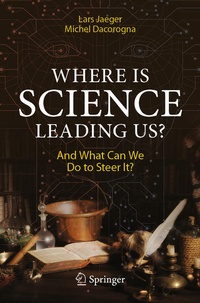
Where Is Science Leading Us?
Description

This book charts the evolution of the sciences and technologies that have shaped our modern age like nothing else in the last 60 years. As well as describing many exciting developments, it will also highlight the challenges and dangers of the technologies that have emerged from them. While science and technology have brought about enormous and often astonishing improvements in our quality of life, they have often also brought with them considerable risks, including the risk of human extinction. We place particular emphasis on the aspects that directly impact us as human beings: Artificial Intelligence (AI), enhancements of our brains/minds through innovative neuro-technologies, and the integration of nanotechnology into our bodies for early disease detection and elimination. What philosophical implications arise from these transformations? Authored by two theoretical physicists who are also experts in economics and capital markets - a rather rare combination - the book will explainthe developments of modern science and the resulting technologies. It also examines the current state of play and emerging developments in a manner accessible to non-scientists. Based on their own experience and the analysis, the authors also propose ways in which science can progress more harmoniously in future.
More details
Other editions
Additional editions
Persons
Michel Dacorogna is partner at Prime Re Solutions, a company advising financial institutions on actuarial and economic matters. He is the former scientific advisor to the chairman of SCOR, the fifth largest reinsurer. He conducts research in the field of insurancemathematics, capital management and risks. He presents models and capital management techniques to management and customers. Michel was deputy group CRO of SCOR in charge of Solvency II and risk modelling. He was at the origin of SCOR's internal model, which he developed with his team for more than 10 years. In 2009, he received from Risk Magazine the price of Insurance Risk Manager of the year.Author and co-author of more than 95 publications in refereed scientific journals; he is often invited to present his results in international conferences and specialized seminars. His work is referenced in many publications. One of the papers he co-authored was the most quoted paper over 5 years in the Journal of Banking and Finance. His book: "An Introduction to High Frequency Fi-nance" remains a reference in the field. He also lectures at the ETH and University of Zurich, and at Università Cattolica del Sacro Cuore in Milan, at ESSEC Business School (Paris) in their Master of Finance and insurance programs.
Content
Publicly backed science in competition with private companies. Science as part of capitalism.- Philosophy in science is over, and why we need to reinstall it.- Promising and scary developments in future technologies, an overview.- Physics from 1960 to Today, And what we do not know yet.- Computers, nanotechnology, internet and many other technologies. What benefits and challenges physics brought us and will bring us in the future?.- Biology from 1953 to 2023: Major breakthroughs and their ethical issues. How biology became the centre of science and today also lies at the centre of ethical concerns.- Brain research since the 1990s. Significant progress in understanding human (self-)consciousness or a scientific attack on something outside of science?.- Artificial Intelligence from its origins via today to the future. Significant progress in understanding, replicating, and changing us humans or solely technological advances contained to optimising certain processes?.- The path towardsmodern mathematics. More and more abstraction as well as more and more concrete applications.- Astronomical research. The oldest science in history with the newest results of all sciences.- The future of sciences/technologies? From utopian optimism to dystopian pessimism (and possibly back).- The myth of the optimally functional invisible hand. Why and how research projects and future technologies should be discussed, respectively governed by the public domain?.- Science, Technology and Spirituality. What science can do for society, how society has to shape technology - and how spirituality can set a frame for this shaping process?.
