

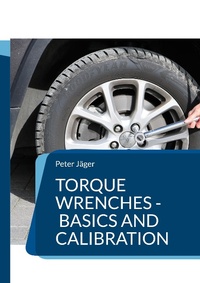
Torque wrenches - basics and calibration
1st Edition
Published on 17. January 2023
164 pages
978-3-7578-8836-7 (ISBN)
Description

This book is intended to provide concentrated information on the subject of torque wrenches.
Torque wrenches have undergone a rapid development from simple tools to precise measuring tools. This is due to advanced mechanization, ever-improving manufacturing methods and optimization processes. While it was still possible to repair a motor vehicle with a set of wrenches in the 1970s, such an "intervention" today would be a blatant safety risk and probably also the technical end of an engine, for example. Torque wrenches have also become indispensable in the medical field. Dental implants, for example, are precisely placed and fastened with the smallest torques.
Unfortunately, it can be observed that the landscape of standards and regulations - thought out and developed by experts - is often not, or only slightly, transported to the people who are supposed to implement the normative specifications. This book is intended as an introduction to the subject of torque wrenches, providing the user with basic knowledge and serving as a reference work and list of references and a usefull helper for torque wrench calibration issues.
Torque wrenches have undergone a rapid development from simple tools to precise measuring tools. This is due to advanced mechanization, ever-improving manufacturing methods and optimization processes. While it was still possible to repair a motor vehicle with a set of wrenches in the 1970s, such an "intervention" today would be a blatant safety risk and probably also the technical end of an engine, for example. Torque wrenches have also become indispensable in the medical field. Dental implants, for example, are precisely placed and fastened with the smallest torques.
Unfortunately, it can be observed that the landscape of standards and regulations - thought out and developed by experts - is often not, or only slightly, transported to the people who are supposed to implement the normative specifications. This book is intended as an introduction to the subject of torque wrenches, providing the user with basic knowledge and serving as a reference work and list of references and a usefull helper for torque wrench calibration issues.
More details
Other editions
Additional editions
Peter Jäger
Torque wrenches - basics and calibration
Book
01/2023
1st Edition
BoD - Books on Demand
€24.50
Shipment within 10-15 days
Person
Peter Jäger, born in 1959: After high school and an apprenticeship as a radio-television technician, he entered professional metrology with an approx. 4-year apprenticeship as a calibration technician. Most of this training took place at the US Air Force in Denver / Colorado.
After working in the calibration laboratory as a calibration technician, among other things for oscilloscopes, multimeters and measuring transmitters, he trained as a state-certified technician.
From 1991, he was head of a mobile calibration laboratory; later, for several years, he was head of a calibration laboratory for physical measurands, achieving accreditation for the measurand temperature, and was a member of the corresponding technical committee of the DKD. After a subsequent period of about two years as a project manager for calibration projects, which also included the preparation of calibration regulations and procedures, there was a change to the utilization management for measuring and testing equipment of a large authority.
From there, he successfully completed training to become a DGQ Quality Manager and then focused on developing, building and operating an effective and standards-compliant quality management system. During this time, he regularly gave technical presentations on the subject of calibration/metrology/measuring equipment management at technical conferences such as the Measurement Science Conference MSC or National Conference Of Standard Laboratories (international) NCSLi in the USA and published technical articles, e.g. in the globally published magazine "Metrologist". Later he worked on projects "Optimization of Calibration" and "Management of Measuring Equipment in SAP".
Currently he is working as service development- and calibration operations manager for a leading and accredited company for torque measurement and calibration.
After working in the calibration laboratory as a calibration technician, among other things for oscilloscopes, multimeters and measuring transmitters, he trained as a state-certified technician.
From 1991, he was head of a mobile calibration laboratory; later, for several years, he was head of a calibration laboratory for physical measurands, achieving accreditation for the measurand temperature, and was a member of the corresponding technical committee of the DKD. After a subsequent period of about two years as a project manager for calibration projects, which also included the preparation of calibration regulations and procedures, there was a change to the utilization management for measuring and testing equipment of a large authority.
From there, he successfully completed training to become a DGQ Quality Manager and then focused on developing, building and operating an effective and standards-compliant quality management system. During this time, he regularly gave technical presentations on the subject of calibration/metrology/measuring equipment management at technical conferences such as the Measurement Science Conference MSC or National Conference Of Standard Laboratories (international) NCSLi in the USA and published technical articles, e.g. in the globally published magazine "Metrologist". Later he worked on projects "Optimization of Calibration" and "Management of Measuring Equipment in SAP".
Currently he is working as service development- and calibration operations manager for a leading and accredited company for torque measurement and calibration.
