

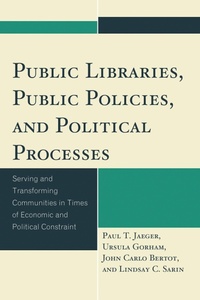
Public Libraries, Public Policies, and Political Processes
Serving and Transforming Communities in Times of Economic and Political Constraint
1st Edition
Published on 15. April 2014
1 pages
979-8-216-24320-5 (ISBN)
Description

Drawing on two decades of original research conducted by the authors, as well as existing research about the intersection of public policy, political discourse, and public libraries, this book seeks to understand the origins and implications of the current standing of public libraries in public policy and political discourse. It both explains the complex current circumstances and offers strategies for effectively creating a better future for public libraries.
The main message is that there is a pressing need for public librarians and other supporters of public libraries to be:
Aware of the political process and its implications for libraries;Attuned to the interrelationships between policy and politics; andEngaged in the policy process to articulate the need for policies that support public libraries. The style is both scholarly and accessible to general readers, with the goal of being useful to students, educators, researchers, practitioners, and friends of public libraries in library and information science. It will also be usefull for those engaged in areas of public policy, government, economics, and political science who are interested in the relationships between public libraries, public policy, and political processes.
Building upon the discussion of the key issues, the book offers proposals for professional, policy-making, and political strategies that can strengthen the public library and its ability to meet the needs of individuals and communities. The discussion and analysis in the book draw upon data and real world examples from the many studies that the authors have conducted on related topics, including libraries' outreach to increasingly diverse service populations and efforts to meet community needs through innovative partnerships.
As the intersection of politics, policy, and libraries has grown in importance and complexity in recent years, the need for a book on their interrelationships is long overdue.
The main message is that there is a pressing need for public librarians and other supporters of public libraries to be:
Aware of the political process and its implications for libraries;Attuned to the interrelationships between policy and politics; andEngaged in the policy process to articulate the need for policies that support public libraries. The style is both scholarly and accessible to general readers, with the goal of being useful to students, educators, researchers, practitioners, and friends of public libraries in library and information science. It will also be usefull for those engaged in areas of public policy, government, economics, and political science who are interested in the relationships between public libraries, public policy, and political processes.
Building upon the discussion of the key issues, the book offers proposals for professional, policy-making, and political strategies that can strengthen the public library and its ability to meet the needs of individuals and communities. The discussion and analysis in the book draw upon data and real world examples from the many studies that the authors have conducted on related topics, including libraries' outreach to increasingly diverse service populations and efforts to meet community needs through innovative partnerships.
As the intersection of politics, policy, and libraries has grown in importance and complexity in recent years, the need for a book on their interrelationships is long overdue.
More details
Edition
1. Auflage
Language
English
Place of publication
United States
Publishing group
Bloomsbury Publishing Plc
Illustrations
3 tables; 16 graphs
ISBN-13
979-8-216-24320-5 (9798216243205)
Copyright in bibliographic data and cover images is held by Nielsen Book Services Limited or by the publishers or by their respective licensors: all rights reserved.
Schweitzer Classification
Other editions
Additional editions
Paul T. Jaeger | Ursula Gorham | John Carlo Bertot
Public Libraries, Public Policies, and Political Processes
Serving and Transforming Communities in Times of Economic and Political Constraint
Book
04/2014
Rowman & Littlefield Publishers
€103.50
Shipment within 10-20 days
Persons
Paul T. Jaeger, PhD, JD, is associate professor and diversity officer of the College of Information Studies and co-director of the Information Policy and Access Center at the University of Maryland. He is the author of more than 130 journal articles and book chapters including Information Worlds: Social Context, Technology, & Information Behavior in the Age of the Internet (2010) with Gary Burnett; Public Libraries and the Internet: Roles, Perspectives, and Implications (2011) with John Carlo Bertot and Charles R. McClure; and Disability and the Internet: Confronting a Digital Divide (2012). Dr. Jaeger is also the co-editor of Library Quarterly and Information PolicyBook Series , and associate editor of Government Information Quarterly.
Ursula Gorham, JD, is a doctoral candidate in the College of Information Studies at the University of Maryland and a graduate research associate at the Information Policy & Access Center (iPAC).
John Carlo Bertot, PhD, is professor and co-director of the Information Policy & Access Center in the College of Information Studies at the University of Maryland. He is also president of the Digital Government Society of North America and serves as chair of the International Standards Organization's Library Performance Indicator (ISO 11620) working group and is past chair of the American Library Association's Library Research Round Table. John is Editor of Government Information Quarterly and Co-Editor of Library Quarterly.
Lindsay C. Sarin is MLS program coordinator and a research fellow at the Information Policy & Access Center in the College of Information Studies at the University of Maryland. Lindsay previously worked in a number of diverse academic library settings, where she provided information literacy instruction and outreach services.
Ursula Gorham, JD, is a doctoral candidate in the College of Information Studies at the University of Maryland and a graduate research associate at the Information Policy & Access Center (iPAC).
John Carlo Bertot, PhD, is professor and co-director of the Information Policy & Access Center in the College of Information Studies at the University of Maryland. He is also president of the Digital Government Society of North America and serves as chair of the International Standards Organization's Library Performance Indicator (ISO 11620) working group and is past chair of the American Library Association's Library Research Round Table. John is Editor of Government Information Quarterly and Co-Editor of Library Quarterly.
Lindsay C. Sarin is MLS program coordinator and a research fellow at the Information Policy & Access Center in the College of Information Studies at the University of Maryland. Lindsay previously worked in a number of diverse academic library settings, where she provided information literacy instruction and outreach services.
Content
Acknowledgments
List of Acronyms
List of Figures and Tables
Preface
Chapter 1: Politics, Policies, and Public Libraries
Chapter 2: The Development of Public Libraries as a Public Good in the United States
Chapter 3: The Evolution of Policies Affecting Public Libraries in the Unites States
Chapter 4: Prevailing Governance and Economic Ideologies
Chapter 5: Changes in Public Libraries and Changes in Communities
Chapter 6: Engagement and Valuation of the Public Good
Chapter 7: Demonstrating Library Value and Advocating for Support
Chapter 8: The Public Library in the Local Political Process
References
About the Authors
List of Acronyms
List of Figures and Tables
Preface
Chapter 1: Politics, Policies, and Public Libraries
Chapter 2: The Development of Public Libraries as a Public Good in the United States
Chapter 3: The Evolution of Policies Affecting Public Libraries in the Unites States
Chapter 4: Prevailing Governance and Economic Ideologies
Chapter 5: Changes in Public Libraries and Changes in Communities
Chapter 6: Engagement and Valuation of the Public Good
Chapter 7: Demonstrating Library Value and Advocating for Support
Chapter 8: The Public Library in the Local Political Process
References
About the Authors
