

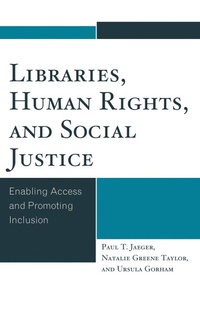
Libraries, Human Rights, and Social Justice
Enabling Access and Promoting Inclusion
1st Edition
Published on 10. June 2015
1 pages
979-8-216-24133-1 (ISBN)
Description

Libraries, Human Rights, and Social Justice: Enabling Access and Promoting Inclusion examines the interrelationships between digital literacy, digital inclusion, and public policy, emphasizing the impacts of these policy decisions on the ability of individuals and communities to successfully participate in the information society. It is the first large-scale consideration of digital literacy and digital inclusion as policy problems and provides policy recommendations to promote digital literacy and digital inclusion.
This book is intended to help librarians better understand and articulate their roles in promoting human rights and social justice, as well as to educate policymakers, government officials, professionals in other fields, and researchers in other disciplines about the contributions of libraries to human rights and social justice. It explores the intersections of information, human rights, and social justice from a range of perspectives and addresses the differing roles of library institutions (public, school, academic, and special libraries), library professionals, professional organizations, governments, and library patrons.
Discussion focuses on the practical side of human rights and avoids most of the philosophical discussions of the term. Similarly, this book emphasizes the practical nature of social justice and the social and societal structures that foster equality.
Related issues of digital literacy and digital inclusion are considered as essential to providing information in human rights and social justice contexts. Digital literacy, the ability to use the Internet to meet information, combines with access to the Internet in order to successfully apply the skills of digital literacy is discussed under the topic of digital inclusion.
These topics are discussed through legal, policy, social, cultural, and economic lenses. Issues are examined both in terms of efforts to support equity in communities as a whole and the efforts intended to promote equity in specific disadvantaged or marginalized populations, such as the homeless, immigrants, people with disabilities, and the socioeconomically disadvantaged. Many examples of the issues discussed are drawn from the original research that the authors have conducted.
The ideas and suggestions in this book should help members of the library community understand where their roles related to human rights and social justice originate, how they fit within the broader policy context, how to improve their related services and practices, and how to advocate for better support of these roles.
The authors of this book have been involved in this research for many years and this breadth allows the book to offer comprehensive policy recommendations, solutions, and best practices for an area that is currently extremely fragmented. The writing is at a level to make it useful to undergraduate and postgraduate students, researchers, and policy makers.
This book is intended to help librarians better understand and articulate their roles in promoting human rights and social justice, as well as to educate policymakers, government officials, professionals in other fields, and researchers in other disciplines about the contributions of libraries to human rights and social justice. It explores the intersections of information, human rights, and social justice from a range of perspectives and addresses the differing roles of library institutions (public, school, academic, and special libraries), library professionals, professional organizations, governments, and library patrons.
Discussion focuses on the practical side of human rights and avoids most of the philosophical discussions of the term. Similarly, this book emphasizes the practical nature of social justice and the social and societal structures that foster equality.
Related issues of digital literacy and digital inclusion are considered as essential to providing information in human rights and social justice contexts. Digital literacy, the ability to use the Internet to meet information, combines with access to the Internet in order to successfully apply the skills of digital literacy is discussed under the topic of digital inclusion.
These topics are discussed through legal, policy, social, cultural, and economic lenses. Issues are examined both in terms of efforts to support equity in communities as a whole and the efforts intended to promote equity in specific disadvantaged or marginalized populations, such as the homeless, immigrants, people with disabilities, and the socioeconomically disadvantaged. Many examples of the issues discussed are drawn from the original research that the authors have conducted.
The ideas and suggestions in this book should help members of the library community understand where their roles related to human rights and social justice originate, how they fit within the broader policy context, how to improve their related services and practices, and how to advocate for better support of these roles.
The authors of this book have been involved in this research for many years and this breadth allows the book to offer comprehensive policy recommendations, solutions, and best practices for an area that is currently extremely fragmented. The writing is at a level to make it useful to undergraduate and postgraduate students, researchers, and policy makers.
More details
Other editions
Additional editions
Paul T. Jaeger | Natalie Greene Taylor | Ursula Gorham
Libraries, Human Rights, and Social Justice
Enabling Access and Promoting Inclusion
Book
06/2015
Rowman & Littlefield Publishers
€116.90
Shipment within 10-20 days
Persons
Paul T. Jaeger is associate professor and diversity officer of the College of Information Studies and Co-Director of the Information Policy and Access Center at the University of Maryland. Dr. Jaeger's research focuses on the ways in which law and public policy shape information behavior, particularly for underserved populations. He is the author of more than one hundred and fifty journal articles and book chapters. This is his ninth book. His other recent books are Information Worlds: Social Context, Technology, & Information Behavior in the Age of the Internet (Routledge, 2010) with Gary Burnett; and Public Libraries and the Internet: Roles, Perspectives, and Implications (Libraries Unlimited, 2011) with John Carlo Bertot and Charles R. McClure; Disability and the Internet: Confronting a Digital Divide (Lynne Rienner, 2012); Public Libraries, Public Policies, and Political Processes: Serving and Transforming Communities in Times of Economic and Political Constraint (Rowman and Littlefield, 2014) with Ursula Gorham, John Carlo Bertot, and Lindsay C. Sarin; and Digital Literacy and Digital Inclusion: Information Policy and the Public Library (Rowman and Littlefield, 2014) with Kim M. Thompson, Natalie Greene Taylor, Mega Subramaniam, and John Carlo Bertot. His research has been funded by the Institute of Museum & Library Services, the National Science Foundation, the American Library Association, the Smithsonian Institution, and the Bill & Melinda Gates Foundation, among others. Dr. Jaeger is Editor of Library Quarterly, Co-Editor of the Advances in Librarianship Book Series, and Associate Editor of Government Information Quarterly.
Natalie Greene Taylor is a doctoral candidate at the College of Information Studies at the University of Maryland, where she also received her Masters of Library Science, specializing in e-government and school library media. She is a Graduate Research Associate at the Information Policy & Access Center (iPAC) where her research has focused on partnerships between libraries and government agencies and the role of school libraries in improving adolescent health and information literacy. Her research interests also include the role of policy in limiting or promoting youth information access, and her dissertation explores adolescents' experiences with digital government health information. Shehas published articles in Library & Information Science Research, Public Library Quarterly, Information Polity, and International Journal of Public Administration in the Digital Age, among others, and co-authored the book Digital Literacy and Digital Inclusion: Information Policy and the Public Library. She is also an Associate Editor of Library Quarterly.
Ursula Gorham is a doctoral candidate in the College of Information Studies and a Graduate Research Associate at the Information Policy and Access Center (iPAC). She holds a law degree, as well as graduate degrees in library science and public policy, from the University of Maryland. She is admitted to practice law in Maryland and, prior to beginning the doctoral program, served as a law clerk in Maryland appellate and federal bankruptcy courts. Ursula's work at iPAC has focused on e-government partnerships in public libraries and the role of libraries in public policy and political processes. Her research interests also include the accessibility of legal information and court documents, with an emphasis on self-represented litigants, and her dissertation will explore the use of technology to expand access to justice for low-income individuals in the United States. Her work has been published in Government Information Quarterly, Public Library Quarterly, Journal of Open Access to Law, Information Polity, and International Journal of Public Administration in the Digital Age. She is an Associate Editor of Library Quarterly.
Natalie Greene Taylor is a doctoral candidate at the College of Information Studies at the University of Maryland, where she also received her Masters of Library Science, specializing in e-government and school library media. She is a Graduate Research Associate at the Information Policy & Access Center (iPAC) where her research has focused on partnerships between libraries and government agencies and the role of school libraries in improving adolescent health and information literacy. Her research interests also include the role of policy in limiting or promoting youth information access, and her dissertation explores adolescents' experiences with digital government health information. Shehas published articles in Library & Information Science Research, Public Library Quarterly, Information Polity, and International Journal of Public Administration in the Digital Age, among others, and co-authored the book Digital Literacy and Digital Inclusion: Information Policy and the Public Library. She is also an Associate Editor of Library Quarterly.
Ursula Gorham is a doctoral candidate in the College of Information Studies and a Graduate Research Associate at the Information Policy and Access Center (iPAC). She holds a law degree, as well as graduate degrees in library science and public policy, from the University of Maryland. She is admitted to practice law in Maryland and, prior to beginning the doctoral program, served as a law clerk in Maryland appellate and federal bankruptcy courts. Ursula's work at iPAC has focused on e-government partnerships in public libraries and the role of libraries in public policy and political processes. Her research interests also include the accessibility of legal information and court documents, with an emphasis on self-represented litigants, and her dissertation will explore the use of technology to expand access to justice for low-income individuals in the United States. Her work has been published in Government Information Quarterly, Public Library Quarterly, Journal of Open Access to Law, Information Polity, and International Journal of Public Administration in the Digital Age. She is an Associate Editor of Library Quarterly.
Content
Preface
Chapter 1: Introduction
Chapter 2: The Historical Evolution of the Concepts of Human Rights and Social Justice
Chapter 3: The Current State of Digital Inclusion
Chapter 4: Libraries as Institutions Promoting Social Justice and Human Rights
Chapter 5: The Unspoken Roles of Libraries as Institutions of Social Justice and Human Rights
Chapter 6: Information Policies Related to Human Rights and Social Justice
Chapter 7: Arsenals of Human Rights and Social Justice
Chapter 8: From Fire, By Fire: Rights and Justice in Policy, Practice, and Advocacy
References
About the Authors
Chapter 1: Introduction
Chapter 2: The Historical Evolution of the Concepts of Human Rights and Social Justice
Chapter 3: The Current State of Digital Inclusion
Chapter 4: Libraries as Institutions Promoting Social Justice and Human Rights
Chapter 5: The Unspoken Roles of Libraries as Institutions of Social Justice and Human Rights
Chapter 6: Information Policies Related to Human Rights and Social Justice
Chapter 7: Arsenals of Human Rights and Social Justice
Chapter 8: From Fire, By Fire: Rights and Justice in Policy, Practice, and Advocacy
References
About the Authors
