

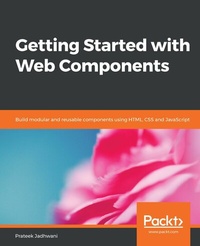
Getting Started with Web Components
Build modular and reusable components using HTML, CSS and JavaScript
Published on 23. September 2024
158 pages
978-1-83864-003-3 (ISBN)
Description

Explore modern Web Component design and integrate them with a variety of web frameworks to build encapsulated reusable UI components for your web apps
Key Features
Learn Web Components with more than 50 web component examples for both beginners and advanced users
Create responsive and highly customizable web pages using HTML, CSS, and JavaScript
Extend the potential of Web Components by integrating them with standard web frameworks
Book DescriptionWeb Components are a set of APIs that help you build reusable UI modules that can operate in any modern browser using just Vanilla JavaScript. The power of Web Components lies in their ability to build frontend web applications with or without web frameworks. With this practical guide, you will understand how Web Components can help you build reusable UI components for your modern web apps. The book starts by explaining the fundamentals of Web Components' design and strategies for using them in your existing frontend web projects. You will also learn how to use JavaScript libraries such as Polymer.js and Stencil.js for building practical components. As you progress, you will build a single-page application using only Web Components to fully realize their potential. This practical guide demonstrates how to work with Shadow DOM and custom elements to build the standard components of a web application. Toward the end of the book, you will learn how to integrate Web Components with standard web frameworks to help you manage large-scale web applications. By the end of this book, you will have learned about the capabilities of Web Components in building custom elements and have the necessary skills for building a reusable UI for your web applications.What you will learn
Understand Web Component design, specifications, and life cycle
Create single-page applications using Web Components
Enable reusability and customization for your UI components
Implement Web Components in your web apps using Polymer and Stencil libraries
Build powerful frontend components from scratch and deploy them on the web
Design patterns and best practices to integrate Web Components into your existing web application
Who this book is forThis book is for developers who have heard about web components, but don't really know where to start. This book is also for intermediate and advanced developers who know what web components are, but are still afraid to use them in production. This book is also for frontend engineers who are simply looking into web components in order to increase their knowledge and skills.
Key Features
Learn Web Components with more than 50 web component examples for both beginners and advanced users
Create responsive and highly customizable web pages using HTML, CSS, and JavaScript
Extend the potential of Web Components by integrating them with standard web frameworks
Book DescriptionWeb Components are a set of APIs that help you build reusable UI modules that can operate in any modern browser using just Vanilla JavaScript. The power of Web Components lies in their ability to build frontend web applications with or without web frameworks. With this practical guide, you will understand how Web Components can help you build reusable UI components for your modern web apps. The book starts by explaining the fundamentals of Web Components' design and strategies for using them in your existing frontend web projects. You will also learn how to use JavaScript libraries such as Polymer.js and Stencil.js for building practical components. As you progress, you will build a single-page application using only Web Components to fully realize their potential. This practical guide demonstrates how to work with Shadow DOM and custom elements to build the standard components of a web application. Toward the end of the book, you will learn how to integrate Web Components with standard web frameworks to help you manage large-scale web applications. By the end of this book, you will have learned about the capabilities of Web Components in building custom elements and have the necessary skills for building a reusable UI for your web applications.What you will learn
Understand Web Component design, specifications, and life cycle
Create single-page applications using Web Components
Enable reusability and customization for your UI components
Implement Web Components in your web apps using Polymer and Stencil libraries
Build powerful frontend components from scratch and deploy them on the web
Design patterns and best practices to integrate Web Components into your existing web application
Who this book is forThis book is for developers who have heard about web components, but don't really know where to start. This book is also for intermediate and advanced developers who know what web components are, but are still afraid to use them in production. This book is also for frontend engineers who are simply looking into web components in order to increase their knowledge and skills.
More details
Edition
Digital original
Language
English
Place of publication
Birmingham
United Kingdom
Target group
Professional and scholarly
US School Grade: College Graduate Student
Edition type
Digital original
File size
5,41 MB
ISBN-13
978-1-83864-003-3 (9781838640033)
Copyright in bibliographic data and cover images is held by Nielsen Book Services Limited or by the publishers or by their respective licensors: all rights reserved.
Schweitzer Classification
Other editions
Additional editions
Prateek Jadhwani
Getting Started with Web Components
Build modular and reusable components using HTML, CSS and JavaScript
Book
08/2019
Packt Publishing
€27.10
Shipment within 3-4 weeks
Person
Jadhwani Prateek :
Prateek Jadhwani is a developer specializing in frontend technologies, living and working in the US. His experience includes 10 years of working as a frontend developer for many high-profile clients and many early-adoption side projects. Prateek had his first exposure to Web Components in 2014, and instantly fell in love with component-driven methodologies. Since then, he has evangelized Web Components and its related libraries to people at work and outside of work. Prateek loves all things open source and enjoys writing good JavaScript. A love for programming in general and a thirst for knowledge provide the motivation he carries through his work.
Prateek Jadhwani is a developer specializing in frontend technologies, living and working in the US. His experience includes 10 years of working as a frontend developer for many high-profile clients and many early-adoption side projects. Prateek had his first exposure to Web Components in 2014, and instantly fell in love with component-driven methodologies. Since then, he has evangelized Web Components and its related libraries to people at work and outside of work. Prateek loves all things open source and enjoys writing good JavaScript. A love for programming in general and a thirst for knowledge provide the motivation he carries through his work.
Content
Table of Contents
Web Components Essential and Specifications
Web Components Life Cycle Callback Methods
Universal Web Components
Building Reusable Web Components
Managing States and Props
Building a Single Page App using Web Components
Implementing Web Components using Polymer and Stencil
Integrating Web Components with Web Framework
Web Components Essential and Specifications
Web Components Life Cycle Callback Methods
Universal Web Components
Building Reusable Web Components
Managing States and Props
Building a Single Page App using Web Components
Implementing Web Components using Polymer and Stencil
Integrating Web Components with Web Framework
