

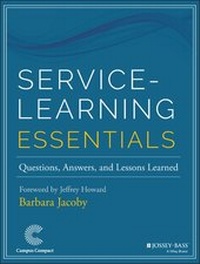
Service-Learning Essentials
Description

More details
Other editions
Additional editions
Persons
Content
Figures and Exhibits ix
Dedication x
Foreword xi
Preface xv
Acknowledgments xxii
About the Author xxiv
About Campus Compact xxvi
Chapter 1: Introduction to Service-Learning 1
1.1 What is service-learning? 1
1.2 What are the theoretical foundations of service-learning? 5
1.3 What else can we call service-learning if that term does not work for us? 10
1.4 What are the benefits of service-learning? 11
1.5 What is the history of service-learning? 14
1.6 How widespread is service-learning? 18
1.7 What should an institution offer in the way of service-learning? 21
1.8 How does service-learning vary by institutional type? 23
Conclusion 25
Chapter 2: Understanding and Facilitating Critical Reflection 26
2.1 What is critical reflection? 26
2.2 What are the forms of reflection? 29
2.3 What are the steps in designing and implementing critical reflection? 31
2.4 How can critical reflection empower students to move beyond direct service to other forms of civic and political engagement? 42
2.5 How can I make reflection work in my discipline? 45
2.6 How does reflection work in cocurricular service-learning, especially one-time or short-term experiences? 48
Conclusion 50
Chapter 3: Developing and Sustaining Campus-Community Partnerships for Service-Learning 51
3.1 What are the definition and basic principles of campus-community partnerships for service-learning? 52
3.2 What are the different types of service-learning partnerships? 56
3.3 What are the steps to developing a service-learning partnership? 58
3.4 What are the logistical issues involved in service-learning partnerships? 63
3.5 What are the best practices for developing and sustaining partnerships? 65
3.6 What infrastructure should an institution have in place for developing and sustaining campus-community partnerships? 69
3.7 Should campus-community partnerships include corporate partners? How? 71
3.8 What are the key issues for international partnerships for service-learning? 73
3.9 How can small-scale partnerships for service-learning lead to broader and deeper institutional engagement? 75
Conclusion 79
Chapter 4: Integrating Service-Learning into the Curriculum 80
4.1 When is service-learning the right pedagogy for a course? 80
4.2 How does service-learning work in my discipline? 82
4.3 Is service-learning academically rigorous? 86
4.4 What are the different models for integrating service-learning into the curriculum? 88
4.5 How do I start developing a service-learning course? 100
4.6 How should I assess and grade service-learning? 103
4.7 What are the unique elements of a service-learning syllabus? 106
4.8 What are the logistical issues involved in teaching a service-learning course? 109
4.9 How does service-learning work in an online or blended course? 111
4.10 Should service-learning courses be formally designated? 113
4.11 What does it take to motivate and support faculty to practice service-learning? 115
4.12 How can service-learning be valued in the faculty review, promotion, and tenure process? 117
4.13 How can service-learning lead to the broad and deep engagement of an entire academic department? 119
Conclusion 121
Chapter 5: Designing and Implementing Cocurricular Service-Learning 122
5.1 What is cocurricular service-learning? 122
5.2 What is the relationship between service-learning and student development? 125
5.3 What are the different forms of cocurricular service-learning? 129
5.4 How can service-learning be incorporated into the various areas of student life? 139
5.5 What is the relationship between service-learning and leadership education? 142
5.6 What are the steps in developing cocurricular service-learning experiences? 143
5.7 How can assessment of student learning be done in cocurricular service-learning? 148
5.8 How can service-learning educators support student-initiated and -led service-learning? 150
Conclusion 153
Chapter 6: Assessment of Service-Learning 154
6.1 What does service-learning assessment entail? 154
6.2 What are the possible methods for assessing service-learning? 158
6.3 What issues should we consider in choosing assessment methods? 162
6.4 What should assessment of service-learning student participants comprise? 164
6.5 How should service-learning be assessed from the community perspective? 166
6.6 How should service-learning partnerships be assessed? 170
6.7 What should faculty assessment consist of in regard to service-learning? 171
6.8 What assessment should be done at the institutional level? 174
6.9 What are the challenges of service-learning assessment? How can we address them? 179
Conclusion 182
Chapter 7: Administration of Service-Learning 183
7.1 How do we start with service-learning? 184
7.2 What are the components of a center for service-learning? 191
7.3 What staffing is required for a service-learning center? 192
7.4 Where should service-learning be organizationally located? 193
7.5 Besides a service-learning center, what other elements of institutional infrastructure are necessary to support service-learning? 196
7.6 How should the service-learning center be funded? 199
7.7 How can we demonstrate the value of service-learning? 205
7.8 What are the logistical considerations that service-learning requires? 207
7.9 What liability and risk-management issues do we need to address? 212
7.10 What administrative issues are involved in international service-learning? 216
7.11 How should we recognize outstanding work in service-learning? 220
Conclusion 223
Chapter 8: Facing the Complexities and Dilemmas of Service-Learning 225
8.1 How can service-learning be accessible and appropriate for all students? 225
8.2 Should service-learning be required for graduation? 229
8.3 How should we deal with resistant students? 230
8.4 How can participation in service-learning enhance students' understanding and appreciation of differences in race, ethnicity, and socioeconomic status? Of power and privilege? Of systemic oppression? 232
8.5 What is critical service-learning? Why does it matter? 235
8.6 What is the relationship of service-learning to politics? 239
8.7 Should service-learning be institutionalized? 242
8.8 Can campus-community partnerships really be reciprocal relationships among equals? 245
8.9 Should the focus of service-learning be local or global? 247
Conclusion 252
Chapter 9: Securing the Future of Service-Learning in Higher Education 253
9.1 What assessment and research are needed to validate service-learning as a pedagogy and practice? 253
9.2 How can institutionalizing service-learning secure its future? 260
9.3 What can we do to more fully recognize service-learning, community-based research, and engaged scholarship in the faculty reward system? 262
9.4 What can we learn from international models of service-learning? 265
9.5 What are the service-learning partnerships of the future? 267
9.6 How can we help students develop a global perspective through local service-learning? 272
9.7 What is the role of service-learning in responding to domestic and international humanitarian crises? 274
9.8 What is the future of service-learning in the online environment? 277
9.9 How can service-learning strengthen higher education's engagement in K-12 schools? 278
9.10 What is the relationship of the future of service-learning to social entrepreneurship? 281
Conclusion 284
References 288
Index 305
Preface
It was a beautiful morning on a rolling green campus of a regional Midwestern university. As faculty members arrived for the 9:00?a.m. workshop on service-learning course design, I asked them, as I always do, to jot down on Post-it Notes their reasons for coming to the workshop and their most important questions about service-learning. I looked over the questions while members of the university's technology services staff set up the podium and projector. I was not surprised to see familiar questions such as: "How is service-learning different from internships?" "Could it work in my discipline?" and "How do I get started?" Those who have some experience with service-learning wondered, "How can I develop sustained community partnerships?" "How can I increase academic rigor?" and "Can service-learning be taught online?"
At lunch, I met with institutional leaders who asked me questions about what it would take to "grow" service-learning across disciplines. They were concerned about student recruitment and retention and wondered whether there is evidence that service-learning can make a difference in these areas. If we go "full speed ahead" with service-learning as an institutional priority, they asked, how will we know "if we move the needle"?
Later that afternoon, I met with the staff of the small service-learning center, a few student affairs professionals, and student leaders who were involved in planning and organizing service days. I engaged the students in a reflection activity about the differences between volunteerism and social change. They were enthusiastic about service-learning, but they asked: "How can we get participants to take reflection seriously?" "Should we focus on responding to natural disasters far away or on needs in our local communities?"
When I returned to my own campus, I visited a graduate class in our higher education and student affairs program as a guest speaker about service-learning. The students wanted to "trouble" the concept and practice of service-learning, to grapple with questions such as: "How do we keep service-learning from perpetuating the status quo of need and dependency?" "Can universities and communities really develop authentic, democratic partnerships with communities, or is the power differential simply too great?" "What is the ultimate purpose of service-learning?"
The need for this book became increasingly clear to me as I recognized that I have been asked these and other questions over and over again as I engage with hundreds of faculty members, administrators, students, and community leaders through conference keynote addresses, workshops, consultations, and online formats. As I answered the questions that have good answers and puzzled through those that do not, I realized that I needed to record these questions along with the best possible responses. I felt the need to compile the questions-from the simplest to the most complex-for the faculty, staff, and students new to service-learning who encounter its difficult dilemmas, as well as for those of us with much experience who find it useful to revisit and examine its basic principles and practices as we develop new courses and cocurricular experiences. Further, except for my own books, I know of none that encompasses and validates both curricular and cocurricular service-learning. The others tend to focus on academic, course-based service-learning, leaving student affairs professionals, leadership educators, campus ministers, and others with few resources to guide their work.
I also strongly feel the need to share the many lessons I have learned over the years that I have labored in the vineyards of service-learning. I have made mistakes, embarrassed myself, and learned a great deal from my faculty and student affairs colleagues, community partners, and students. I have also learned much from those of you who have taken me into your confidence about your own missteps and dilemmas and how you handled them. I have shared the joys and frustrations you have experienced and been inspired by what you have discovered about service-learning and yourselves.
I have been intimately involved with service-learning since 1992, when I was charged with starting the service-learning program at the University of Maryland by my supervisor, the iconic vice president for student affairs, William L. "Bud" Thomas, Jr. I immediately informed him that I planned to develop service-learning simultaneously in both the curriculum and the cocurriculum. He promptly responded, "Barbara, if you try to involve the faculty, they will sink your ship before you get it out of the harbor." When I proposed to do the book that became Service-Learning in Higher Education: Concepts and Practices (1996), Gale Erlandson, my editor at Jossey-Bass, seriously questioned the wisdom of using the term service-learning instead of community service, wondering whether service-learning had enough traction in higher education to attract a sufficient audience.
We have come a long way. I wholeheartedly agree with my distinguished University of Maryland colleague, KerryAnn O'Meara, that "service-learning is now part of the permanent landscape of higher education" (2011, p. 181). We have amassed considerable evidence of the benefits of service-learning for students and communities. Further, I agree with other respected colleagues, Patti H. Clayton, Robert G. Bringle, and Julie A. Hatcher, that "change does not come easily to higher education, but service-learning has demonstrated its capacity to have an influence on dimensions of the academy that are among the most difficult to change: the curriculum, faculty work, organizational infrastructure, budget allocations, promotion and tenure, assessment of student learning, and community-campus partnerships" (2013, vol. 1, p. ix).
Some of you who are familiar with my extensive work in the area of civic engagement may wonder why this book focuses squarely on service-learning rather than more broadly on-call it what you will-civic learning and democratic engagement, active citizenship, or public service. It was very tempting. However, I decided to concentrate on service-learning partly because I agree strongly with our colleagues at Campus Compact that "service-learning is the most widespread, well-known practice . aimed at preparing students with the knowledge and the skills needed for democratic citizenship" (cited in Zlotkowski, 2011, pp. 223-224). Further, as firmly as I believe in the tremendous potential of service-learning to prepare students to be active participants in our democracy and to work on behalf of social change, I am also all too aware that, when not done well, service-learning can have unfortunate effects on students, such as reinforcing their stereotypes and perpetuating the view that service is the most effective means of addressing social issues. Therefore, the primary purpose of this book is to define and promote high-quality service-learning, both to enable it to fulfill its promise and to serve as the foundation for advancing civic agency and engagement.
I believe that service-learning will survive and thrive into the future because we continue to ask questions-fundamental and straightforward, demanding and challenging-about its purpose and value, how to do it and how to do it better, how we will know whether it makes any difference, and how the powerful combination of service and learning can catalyze broader and deeper engagement between higher education institutions and communities around the world and in our own backyards. In this spirit, I offer questions, answers, and lessons learned to stimulate the further growth of service-learning across the spectrum of higher education, to enhance our practice, and to inspire deeper reflection on how service-learning can realize its unbounded potential to enrich teaching and learning, to enhance communities, to improve higher education institutions, and to educate the next generation of socially responsible citizens, scholars, and leaders.
Audiences
The audiences for this book are faculty in all disciplines, leaders and staff members of service-learning centers, colleagues who engage faculty in professional development, student affairs professionals, campus ministers, leadership educators, service-learning advocates, and administrators seeking to support service-learning. I also believe the book will be both practical and provocative for graduate and undergraduate students who study service-learning and engage others in service-learning experiences inside and outside the formal curriculum. To my international colleagues: I have certainly learned much from you, and I highlight some of your outstanding service-learning work in this book. In return, I hope that you will benefit from lessons we have learned here in the United States.
As faculty members new to service-learning, you will learn how service-learning is different from other forms of experiential learning, how to engage students in reflection, the fundamentals of community...
