

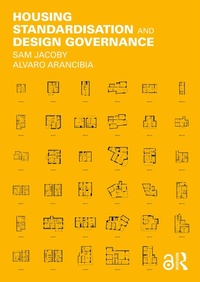
Housing Standardisation and Design Governance
Published on 28. May 2026
330 pages
978-1-040-63632-9 (ISBN)
Description

Equitable access to decent housing remains a major global challenge, particularly for lower-income populations reliant on subsidised, affordable homes. This is exacerbated by the continued commodification of housing, demographic change, and the increasing time many people now spend at home. Addressing these challenges requires, as this book argues, stronger state intervention, closer cooperation between housing regulators, providers, and occupants, and a more robust evidence base that links housing policy, supply, quality, and design, along with a shift towards more long-term social and environmental housing values.
This book examines how housing design governance and lived experience shape the quality of homes and the wellbeing of residents, analysing the political, economic, social, historical, and environmental drivers of design. Drawing on new and rich comparative data and evidence from England, Chile, China, the Netherlands, Spain, and Switzerland, it explores how contextual standards, cultural norms, and regulatory practices influence everyday life and perceptions of subsidised housing.
Combining historical, technical, and social perspectives through a comparative international lens, this interdisciplinary design research offers a multidimensional understanding of housing quality. It provides insights for policymakers, housing providers, and designers, demonstrating how design research and lived experience can inform standards and policies to create more inclusive, adaptable, and sustainable homes and neighbourhoods, with implications for contemporary housing practice.
This book examines how housing design governance and lived experience shape the quality of homes and the wellbeing of residents, analysing the political, economic, social, historical, and environmental drivers of design. Drawing on new and rich comparative data and evidence from England, Chile, China, the Netherlands, Spain, and Switzerland, it explores how contextual standards, cultural norms, and regulatory practices influence everyday life and perceptions of subsidised housing.
Combining historical, technical, and social perspectives through a comparative international lens, this interdisciplinary design research offers a multidimensional understanding of housing quality. It provides insights for policymakers, housing providers, and designers, demonstrating how design research and lived experience can inform standards and policies to create more inclusive, adaptable, and sustainable homes and neighbourhoods, with implications for contemporary housing practice.
More details
Language
English
Place of publication
London
United Kingdom
Publishing group
Taylor & Francis Ltd
Target group
College/higher education
Professional and scholarly
Product notice
Reflowable
Illustrations
28 Tables, black and white; 83 Line drawings, black and white; 79 Halftones, black and white; 162 Illustrations, black and white
File size
102,64 MB
ISBN-13
978-1-040-63632-9 (9781040636329)
Copyright in bibliographic data and cover images is held by Nielsen Book Services Limited or by the publishers or by their respective licensors: all rights reserved.
Schweitzer Classification
Other editions
Additional editions

Sam Jacoby | Alvaro Arancibia
Housing Standardisation and Design Governance
Book
05/2026
1st Edition
Routledge
€52.50
Shipment within 10-20 days
Sam Jacoby | Alvaro Arancibia
Housing Standardisation and Design Governance
Book
05/2026
1st Edition
Routledge
€191.50
Shipment within 10-20 days
Persons
Sam Jacoby is Professor of Architectural and Urban Design Research, Research Lead of the School of Architecture, and Director of both the Intergenerational Design Lab and the Laboratory for Design and Machine Learning at the Royal College of Art. His interdisciplinary work is focused on the social impact of design research, spatial strategies, and architecture.
Alvaro Arancibia is an architect trained at the Pontificia Universidad Catolica de Chile, with an MPhil in Urban Design and a PhD in Architectural Design from the Architectural Association in London. His work bridges practice and research, focusing on collective housing and urban design in Santiago, Chile. His doctoral thesis received the AA Graduate Prize for Research: Outstanding Work 2015-2016, and between 2022 and 2025 he was co-investigator of the project Housing Standardisation: The Architecture of Regulations and Design Standards. Through his practice, he has won several housing competitions organised by the Chilean Ministry of Housing, including the Mirador Laguna project, completed in 2024. His research and design work have been published internationally and presented at universities in Chile, the United Kingdom, the United States, and Mexico, contributing to debates on housing policy, standards, and typologies.
Alvaro Arancibia is an architect trained at the Pontificia Universidad Catolica de Chile, with an MPhil in Urban Design and a PhD in Architectural Design from the Architectural Association in London. His work bridges practice and research, focusing on collective housing and urban design in Santiago, Chile. His doctoral thesis received the AA Graduate Prize for Research: Outstanding Work 2015-2016, and between 2022 and 2025 he was co-investigator of the project Housing Standardisation: The Architecture of Regulations and Design Standards. Through his practice, he has won several housing competitions organised by the Chilean Ministry of Housing, including the Mirador Laguna project, completed in 2024. His research and design work have been published internationally and presented at universities in Chile, the United Kingdom, the United States, and Mexico, contributing to debates on housing policy, standards, and typologies.
Content
Introduction: Housing Standardisation and Design Governance Part 1: Study Contexts 1. The Design Governance of Subsidised Housing 2. Comparative Housing Design Research Part 2: Design Governance Histories 3. Housing Standards and Standardisation in England: A Historical Study of Design Governance 4. The Evolution of Housing Design Standards in Chile Part 3: Systems and Standards 5. Housing Systems: Subsidised Housing Design and Regulatory Instruments 6. Housing Standards: Socio-technical Design Controls Part 4: Homes 7. In-depth Case Study Cartographies 8. Home Use Studies: An Insight into Lived Experiences 9. Wellbeing and Housing Quality: Comparative Case Studies in Six Countries Part 5: Conclusion 10. Decent Homes: Emerging Bodies of Evidence
