

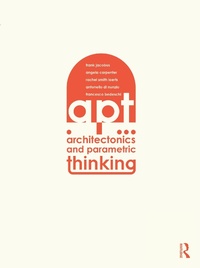
Architectonics and Parametric Thinking
Computational Modeling for Beginning Design
1st Edition
Published on 12. July 2023
298 pages
978-1-000-88157-8 (ISBN)
Description

This book is an approachable guide for students and professionals to learn parametric modeling through the lens of architectonics, allowing readers to pair fundamental ideas about architecture with parametric thinking.
Architectonics and Parametric Thinking begins by clearly positioning the potentials of parametric design through a series of chapters written by leaders in their respective industries. This helps to situate the vast potential of parametric softwares, allowing the reader to understand the full range of what is made possible by working computationally. Following this theoretical introduction, the book presents a manual that walks readers through the step-by-step construction of parametric modeling scripts built through an architectonic lens using clear, compelling diagrams. Each of these diagrams provide textual accompaniment that describes how each new portion of the script is transforming the algorithm as a whole, as well as diagrams that show the physical transformation that is taking place as a result of the script's evolution.
Parametric modeling is radically transforming the design disciplines and will become the primary way designer's generate new products moving forward. Written and expertly designed for architecture students and professionals, this book provides an interactive approach to teaching the basics of parametric thinking in relation to architecture and design.
Architectonics and Parametric Thinking begins by clearly positioning the potentials of parametric design through a series of chapters written by leaders in their respective industries. This helps to situate the vast potential of parametric softwares, allowing the reader to understand the full range of what is made possible by working computationally. Following this theoretical introduction, the book presents a manual that walks readers through the step-by-step construction of parametric modeling scripts built through an architectonic lens using clear, compelling diagrams. Each of these diagrams provide textual accompaniment that describes how each new portion of the script is transforming the algorithm as a whole, as well as diagrams that show the physical transformation that is taking place as a result of the script's evolution.
Parametric modeling is radically transforming the design disciplines and will become the primary way designer's generate new products moving forward. Written and expertly designed for architecture students and professionals, this book provides an interactive approach to teaching the basics of parametric thinking in relation to architecture and design.
More details
Edition
1. Auflage
Language
English
Place of publication
London
United Kingdom
Publishing group
Taylor & Francis Ltd
Target group
College/higher education
Professional and scholarly
Illustrations
450 Halftones, black and white; 450 Illustrations, black and white
ISBN-13
978-1-000-88157-8 (9781000881578)
Copyright in bibliographic data and cover images is held by Nielsen Book Services Limited or by the publishers or by their respective licensors: all rights reserved.
Schweitzer Classification
Other editions
Additional editions
Frank Jacobus | Angie Carpenter | Rachel Smith Loerts
Architectonics and Parametric Thinking
Computational Modeling for Beginning Design
Book
07/2023
1st Edition
Routledge
€215.77
Shipment within 10-20 days
Frank Jacobus | Angie Carpenter | Rachel Smith Loerts
Architectonics and Parametric Thinking
Computational Modeling for Beginning Design
Book
07/2023
1st Edition
Routledge
€64.63
Shipment within 10-20 days
Persons
Frank Jacobus is an award-winning artist, educator, and principal architect of SILO AR+D. He has completed residential and institutional projects across the United States. SILO's architecture is recognized nationally and internationally with design awards and was selected recently as an Emerging Voice by the Architectural League of New York, and as a Next Progressive by Architecture Magazine. Frank's other book projects include "Archi-Graphic: An Infographic Look at Architecture", "The Visual Biography of Color", and "The Making of Things: Modeling Processes and Effects in Architecture".
Angela Carpenter is the Fabrication Labs Manager at the Fay Jones School of Architecture and Design Build Lab. Angela oversees the facility and integration of building focused courses taught at all scales. She provides expertise and instructional support in digital fabrication techniques and procuring specialized equipment. Angela has taught as a Visiting Assistant Professor and Instructor in advanced Design-Build studios and Additive Manufacturing. Her experience has allowed for developing multi-scale investigations in material manipulation and construction advancements.
Rachel Smith Loerts is a Visiting Instructor at the Fay Jones School of Architecture and Design. After working four years as a project designer for multiple architecture firms, Rachel spent six years managing Digital Fabrication Laboratories. As manager she facilitated student and faculty digital fabrication processes for design studios, seminars, fabrication research, and community outreach programs. During this time, she was awarded the Tau Sigma Delta Silver Medal for her commitment to developing student fabrication knowledge.
Antonello Di Nunzio is a freelance architect and programmer who develops innovative tools for more environmentally conscious architectural design. He has more than six years of practical experience as consultant and open-source developer in the AEC industry. He worked at Accenture as senior programmer and collaborates with the University of Arkansas Rome Center and with different companies such as Sinergi Integrated Building Sciences as environmental simulation specialist for LEED. Currently Antonello works mainly with Ladybug Tools LLC as an application developer to innovate the AEC industry.
Francesco Bedeschi is an architect and an educator. Since 2003 Francesco is an Adjunct Professor of architecture at the University of Arkansas Rome Center and since 2019, he has taken the role of Director. In 2007-2008 Francesco became connected with the green building movement in the United States. He is now a member of the Green Building Council Italia where he currently serves on the executive board. Since 2010 he has collaborated with SINERGI Integrated Building Sciences.
Angela Carpenter is the Fabrication Labs Manager at the Fay Jones School of Architecture and Design Build Lab. Angela oversees the facility and integration of building focused courses taught at all scales. She provides expertise and instructional support in digital fabrication techniques and procuring specialized equipment. Angela has taught as a Visiting Assistant Professor and Instructor in advanced Design-Build studios and Additive Manufacturing. Her experience has allowed for developing multi-scale investigations in material manipulation and construction advancements.
Rachel Smith Loerts is a Visiting Instructor at the Fay Jones School of Architecture and Design. After working four years as a project designer for multiple architecture firms, Rachel spent six years managing Digital Fabrication Laboratories. As manager she facilitated student and faculty digital fabrication processes for design studios, seminars, fabrication research, and community outreach programs. During this time, she was awarded the Tau Sigma Delta Silver Medal for her commitment to developing student fabrication knowledge.
Antonello Di Nunzio is a freelance architect and programmer who develops innovative tools for more environmentally conscious architectural design. He has more than six years of practical experience as consultant and open-source developer in the AEC industry. He worked at Accenture as senior programmer and collaborates with the University of Arkansas Rome Center and with different companies such as Sinergi Integrated Building Sciences as environmental simulation specialist for LEED. Currently Antonello works mainly with Ladybug Tools LLC as an application developer to innovate the AEC industry.
Francesco Bedeschi is an architect and an educator. Since 2003 Francesco is an Adjunct Professor of architecture at the University of Arkansas Rome Center and since 2019, he has taken the role of Director. In 2007-2008 Francesco became connected with the green building movement in the United States. He is now a member of the Green Building Council Italia where he currently serves on the executive board. Since 2010 he has collaborated with SINERGI Integrated Building Sciences.
Content
1. Logics Introduction The Power of Parametric Thinking Invisible Parametrics Architectonics and Parametric Thinking Customization's Parametric Play Classical Architecture as Parametric Construct Parametric Thinking and Sustainable Design Fabricating Parametric Thinking Spatial Computing, Artificial Intelligence and the Future of Parametric Design 2. Elements 3 Constructions 3.1 Frame Objects 3.2 Plane Objects 3.3 Solid Objects 3.4 Hybrid Objects 4. Morphologies
