

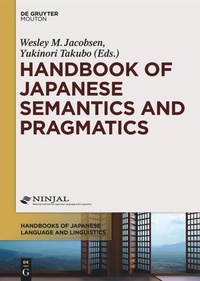
Handbook of Japanese Semantics and Pragmatics
Description

The volume on Semantics and Pragmatics presents a collection of studies on linguistic meaning in Japanese, either as conventionally encoded in linguistic form (the field of semantics) or as generated by the interaction of form with context (the field of pragmatics), representing a range of ideas and approaches that are currently most influentialin these fields. The studies are organized around a model that has long currency in traditional Japanese grammar, whereby the linguistic clause consists of a multiply nested structure centered in a propositional core of objective meaning around which forms are deployed that express progressively more subjective meaning as one moves away from the core toward the periphery of the clause.
The volume seeks to achieve a balance in highlighting both insights that semantic and pragmatic theory has to offer to the study of Japanese as a particular language and, conversely, contributions that Japanese has to make to semantic and pragmatic theory in areas of meaning that are either uniquely encoded, or encoded to a higher degree of specificity, in Japanese by comparison to other languages, such as conditional forms, forms expressing varying types of speaker modality, and social deixis.
More details
Other editions
Additional editions

Persons
Content
- Intro
- Preface
- Introduction to the Handbooks of Japanese Language and Linguistics
- Table of Contents
- Contributors
- Introduction
- I Word-level semantics
- 1 The semantics of Japanese verbs
- 2 The semantics of nouns
- II Proposition-level semantics
- 3 Toward an empirical foundation for argument structure in Japanese, a prodrop language
- 4 Formal logical approaches to meaning in Japanese
- 5 Sentence structure and quantifier scope in Japanese: A retrospective and reanalysis
- III The semantics of time
- 6 Temporal categories: Interactions among tense, aspect, and nontemporal meaning
- 7 Formal treatments of tense and aspect
- 8 Tense and aspect in discourse
- IV The semantics of reality
- 9 Conditionals in Japanese
- 10 Negation
- 11 Possibility and necessity in Japanese: Prioritizing, epistemic, and dynamic modality
- V The semantics of information: Speaker-oriented modality
- 12 Evidentials: Marking the source of information
- 13 Presupposition and assertion
- 14 Sentence-final particles in Japanese
- VI Meaning in context: Inter-speaker modality and pragmatics
- 15 Nominal deixis in Japanese
- 16 Social deixis in Japanese
- 17 Conversational implicature
- 18 Japanese fillers as discourse markers: Meanings of "meaningless" elements
- Subject Index
