

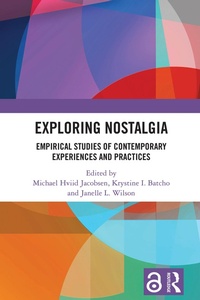
Exploring Nostalgia
Empirical Studies of Contemporary Experiences and Practices
1st Edition
Published on 21. October 2025
214 pages
978-1-040-75567-9 (ISBN)
Description

This volume provides an overview of a number of different areas of social and cultural life in which nostalgia is shown to be an important prism for understanding and analysing human thoughts, actions and feelings.
Featuring a rich collection of empirical studies and analyses of nostalgia, the contributors demonstrate creative ways to study nostalgia - from qualitative methods such as in-depth interviews/narrative analyses to experimental methods that involve inducing nostalgia in research participants. Altogether, these studies highlight the variability of the experience of nostalgia as well as the usefulness of nostalgia at both individual and collective levels, ultimately showing nostalgia to be a helpful, enriching emotion in everyday, pragmatic ways and also at deep, philosophical levels.
Exploring Nostalgia will appeal to scholars, academics, faculty and advanced students with interests in social theory, psychology, cultural studies and the sociology of emotions.
Chapter 3 of this book is freely available as a downloadable Open Access PDF at http://www.taylorfrancis.com under a Creative Commons Attribution-Non Commercial-No Derivatives (CC BY-NC-ND) 4.0 license.
Featuring a rich collection of empirical studies and analyses of nostalgia, the contributors demonstrate creative ways to study nostalgia - from qualitative methods such as in-depth interviews/narrative analyses to experimental methods that involve inducing nostalgia in research participants. Altogether, these studies highlight the variability of the experience of nostalgia as well as the usefulness of nostalgia at both individual and collective levels, ultimately showing nostalgia to be a helpful, enriching emotion in everyday, pragmatic ways and also at deep, philosophical levels.
Exploring Nostalgia will appeal to scholars, academics, faculty and advanced students with interests in social theory, psychology, cultural studies and the sociology of emotions.
Chapter 3 of this book is freely available as a downloadable Open Access PDF at http://www.taylorfrancis.com under a Creative Commons Attribution-Non Commercial-No Derivatives (CC BY-NC-ND) 4.0 license.
More details
Edition
1. Auflage
Language
English
Place of publication
London
United Kingdom
Publishing group
Taylor & Francis Ltd
Target group
College/higher education
Professional and scholarly
Illustrations
1 Tables, black and white; 1 Line drawings, black and white; 1 Illustrations, black and white
File size
2,74 MB
ISBN-13
978-1-040-75567-9 (9781040755679)
Copyright in bibliographic data and cover images is held by Nielsen Book Services Limited or by the publishers or by their respective licensors: all rights reserved.
Schweitzer Classification
Other editions
Additional editions
Michael Hviid Jacobsen | Krystine I. Batcho | Janelle L. Wilson
Exploring Nostalgia
Empirical Studies of Contemporary Experiences and Practices
Book
10/2025
1st Edition
Routledge
€201.80
Shipment within 15-20 days
Persons
Michael Hviid Jacobsen is Professor of Sociology at Aalborg University, Denmark. His research focuses on emotions, death and dying, palliative care, crime, literary sociology, social theory, qualitative research methodology and utopia/nostalgia.
Krystine I. Batcho is Professor of Psychology at Le Moyne College, USA. Her research focuses on nostalgia, memory, emotion, identity, coping, childhood happiness, family and news stories and psychological well-being.
Janelle L. Wilson is Professor of Sociology at the University of Minnesota Duluth, USA. She is a micro-level sociologist, whose research focuses on socialization processes, collective memory, nostalgia and the sociology of everyday life.
Krystine I. Batcho is Professor of Psychology at Le Moyne College, USA. Her research focuses on nostalgia, memory, emotion, identity, coping, childhood happiness, family and news stories and psychological well-being.
Janelle L. Wilson is Professor of Sociology at the University of Minnesota Duluth, USA. She is a micro-level sociologist, whose research focuses on socialization processes, collective memory, nostalgia and the sociology of everyday life.
Content
Introduction - Living in Times of Nostalgia: Empirical Studies of Contemporary Experiences and Practices 1. Why Be Nostalgic About Work? Exploring the Paradoxes of Workplace Attachment and Loss 2. Conscious Nostalgia: Reflections on Historical Craft Demonstrations 3. Neo-craft and Nostalgia 4. Restorative and Reflective Nostalgia and Belonging in Retirement Migration: British Women Living in Spain 5. Nostalgia in 'Sin City': Exploring Nostalgic Ambivalences Among Expats in Pattaya 6. Nostalgias and Belongings in the Neoliberal Context: A Chilean Case 7. Ostalgie: Nostalgia as Identity Politics 8. The Dark Side of Longing: How Nostalgia and Prostalgia May Be Used To Further Extremist Ideologies 9. Enchanted Places, Invoked Pasts: Nostalgia, Dementia and Poetry 10. Cherished Memories: Nostalgia as a Source of Well-Being 11. Even Nostalgia Scholars are Nostalgic: Reflections on and Experiences with Personal Nostalgia Afterword - Reflections on Nostalgia in Research and Life: Applications and Implications
