

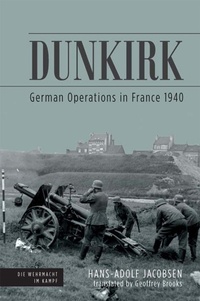
Dunkirk
German Operations in France, 1940
Published on 12. November 2020
264 pages
978-1-61200-660-4 (ISBN)
Description

A history of the battle from Germany's perspective:"An interesting account of a campaign that was decisive, but not as decisive as it could have been." -
Miniature Wargames
The German Army invaded France on May 10, 1940, and in just over ten days their rapid advance, led by three panzer corps, had left three French field armies, Belgian forces, and the British Expeditionary Force with their backs to the sea, trapped along the northern coast of France. General Gort realized that evacuation was the only option, and so began a chaotic withdrawal toward the port of Dunkirk.
While the Luftwaffe continued to attack pockets of Allied forces, the German ground forces were ordered to halt their advance on May 22. These orders were changed four days later-but these crucial four days of inaction allowed the Allies time to retreat into Dunkirk and prepare a defensive perimeter.
The fighting during the last days of May was desperate, with the remnants of the French First Army surrounded at Lille, holding off seven German divisions until finally forced to surrender, and the Belgian Army forced to capitulate to the east of Dunkirk. Though the cost was devastatingly high, Dunkirk was held long enough for over 300,000 Allied troops to be evacuated back to England, with the remainder of the rearguard of French troops surrendering on June 4.
The British narrative of the retreat and evacuation that prompted what was perhaps Winston Churchill's most famous wartime speech has long been well-known. Only now is Hans-Adolf Jacobsen's detailed account of the battle from the German perspective available in English.
The German Army invaded France on May 10, 1940, and in just over ten days their rapid advance, led by three panzer corps, had left three French field armies, Belgian forces, and the British Expeditionary Force with their backs to the sea, trapped along the northern coast of France. General Gort realized that evacuation was the only option, and so began a chaotic withdrawal toward the port of Dunkirk.
While the Luftwaffe continued to attack pockets of Allied forces, the German ground forces were ordered to halt their advance on May 22. These orders were changed four days later-but these crucial four days of inaction allowed the Allies time to retreat into Dunkirk and prepare a defensive perimeter.
The fighting during the last days of May was desperate, with the remnants of the French First Army surrounded at Lille, holding off seven German divisions until finally forced to surrender, and the Belgian Army forced to capitulate to the east of Dunkirk. Though the cost was devastatingly high, Dunkirk was held long enough for over 300,000 Allied troops to be evacuated back to England, with the remainder of the rearguard of French troops surrendering on June 4.
The British narrative of the retreat and evacuation that prompted what was perhaps Winston Churchill's most famous wartime speech has long been well-known. Only now is Hans-Adolf Jacobsen's detailed account of the battle from the German perspective available in English.
More details
Other editions
Additional editions
Book
03/2019
Casemate Publishers
€33.00
Shipment within 3-4 weeks
Persons
Hans-Adolf Jacobsen was a German political scientist and historian. In 1943, as a teenager, he joined the German Army, and soon after was taken prisoner by the Soviets. During five years' captivity he learned Russian and started a life-long interest in the Soviet Union. Upon release he returned to his education, becoming an renowned academic specializing in the Second World War and international relations.Geoffrey Brooks was an experienced author, researcher and historian. He translated and edited Hirschfeld - The Secret Diary of a U-Boat NCO and Fips - Legendary U-Boat Commander 1915-18. He was the author of Hitler's Nuclear Weapons.
Content
- Intro
- Title
- Copyright
- Contents
- Translator's Note
- Preface by Matthias Strohn
- Foreword
- Maps
- I Operational objectives and deployment
- II The German operations, 10-21 May 1940
- III The Allied resistance to the German attack, 10-21 May 1940
- IV The decision to halt the German panzers, 22-26 May 1940
- V The battle for Dunkirk, 27 May-4 June 1940
- VI Summary
- Endnotes
