

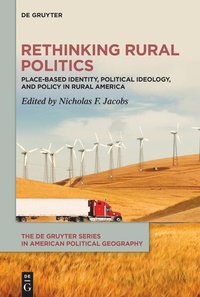
Rethinking Rural Politics
Description

Rural communities in the United States have become a distinctive political concern. In this interdisciplinary volume, Nicholas Jacobs brings together a collection of leading experts in rural studies to offer a comprehensive framework for understanding rural America and expand the scope of existing research.
With data-driven analysis, this volume challenges rural-urban binaries by highlighting difference and evolution among rural people, challenging stereotypical narratives about rural decline and political extremism. By illuminating specific aspects of rural life and place-based experience, cutting-edge contributions consider the intersecting influences of social identity, economics, policy change, and media representation on rural life.
More details
Other editions
Additional editions
Person
Nicholas F. Jacobs is The Goldfarb Family Distinguished Chair in American Government at Colby College and the Inaugural Director of Colby's Public Policy Lab. He writes widely about political geography, federalism, and rural politics.
Content
- Frontmatter
- Title Page
- Copyright
- Contents
- Nicholas F. Jacobs
- Introduction
- Am I Rural?
- Taking Stock of Rural Identity
- Ruralness and Resentment
- Ruralness and Political Nationalization
- Rethinking Rural
- References
- Kristin Lunz Trujillo and Jennifer Lin
- Ingroup Pride or Outgroup Resentment? Urban-Rural Emotions and Political Attitudes
- 1 Group-Based Emotions in Politics
- 2 Emotions across the Urban-Rural Divide
- 3 Measures and Methods
- 4 Results
- 4.1 Urban-Rural Differences in Group-Based Emotion
- 4.2 Emotion and Rural Identity
- 4.3 Emotion and Rural Resentment
- 4.4 Emotion and Political Outcomes
- 5 Discussion and Conclusion
- Appendix
- References
- Mara Casey Tieken and Michael J. Sargent
- The Racial Politics of Rural Resentment: An Examination of Black and White Rural Public Opinion
- 1 The Urban/Rural Divide and Race
- 2 Rural Resentment or Racial Resentment?
- 3 Our Study
- 3.1 Data
- 4 Race and Rural Resentment
- 5 Targets of Blame
- 6 Rural Resentment, Race, and Vote Choice
- 7 What Is the Association between Rural and Racial Resentment?
- 8 Discussion
- 8.1 Resentment: Rural, Racial, or Both?
- 9 Conclusion
- Appendix 1
- Appendix 2
- References
- B. Kal Munis and Nicole Huffman
- Why Does Place Matter More (Politically) to Rural People? Political Communication, Fomenting Place Resentment, and Urban Collective Narcissism
- 1 Introduction
- 2 Place-Based Asymmetry? Rural America's Place-Based Politics
- 3 Why Aren't Urban and Suburban Americans More (Politically) Motivated by Place?
- 4 Asymmetric Political Communication: Rural Abundance vs. Nonrural Sparsity
- 5 Can Place-Based Resentment Be Constructed by the Media among Urbanites and Suburbanites?
- 6 Public Opinion Is What Public Opinion Scholars Choose to Measure! Looking beyond Identity and Resentment and toward Place-Based Narcissism
- 7 Conclusion
- References
- Twan Huijsmans
- "American Exceptionalism" or "The Great Global Divider"? Urban-Rural Divides beyond the U.S. and Similar Countries
- 1 Urban-Rural Electoral Divides beyond the U.S., the U.K., and Canada
- 1.1 The Challenges of Comparing Urban-Rural Electoral Divides across Countries
- 1.2 Trends in Urban-Rural Electoral Divides in Fifteen Countries
- 1.3 Urban-Rural Electoral Divides in Multiparty Systems
- 2 Place-Based Grievances and Political Competition in Europe
- 2.1 How Political, Economic, and Cultural Inequalities Shape Place Resentment
- 2.2 "The Revenge of the Places That Don't Matter"?
- 2.3 The Changing Role of Place-Based Resentment
- 3 Conclusion
- References
- James R. G. Kirk
- Safe Haven? Place, Faith, and Perceptions of Religion in Rural America
- 1 Introduction
- 2 Religion in American Politics
- 3 Rural America and the Politics of Religion
- 4 Data and Methods
- 5 Results
- 6 Conclusion
- References
- Michael E. Shepherd
- Exploring the Rural-Urban Health Divide: Place-Based Health Experiences and Attitudes
- 1 Place-Based Health Disparities
- 2 Place-Based Resentment
- 3 Health Disparities and Place-Based Resentment
- 4 Place-Based Resentment and Health Policy Attitudes
- 5 Experimental Evidence from the Rural Voter Survey
- 6 Conclusion
- Appendix
- References
- Sarah Walton
- Carcerality in Context: The Relationship between Rurality, Punitiveness, and Perceptions of Local Criminal Justice Institutions
- 1 Introduction
- 2 Literature Review
- 2.1 Public Opinion, Punitiveness, and Criminal Justice Institutions - Spatial Considerations
- 2.2 Centering Rurality - Political and Community-Based Research
- 3 Data and Methods
- 4 Results
- 5 Discussion
- 6 Conclusion
- References
- Emily P. Diamond
- Is there a "rural environmental identity"? Characterizing differences between rural and urban perspectives on environmental protection
- 1 Introduction
- 1.1 Rural Environmental Attitudes
- 1.2 Rural Environmental Identity
- 1.2.1 Connectedness to Nature
- 1.3 Disconnectedness/Resentment
- 1.4 Rootedness
- 1.5 Self-reliance
- 2 Quantitatively Measuring Rural Environmental Identities
- 3 Findings
- 3.1 Can We Construct a Quantitative Measure of Rural Environmental Identity?
- 3.2 Do Rural Voters Hold a Stronger Rural Environmental Identity Than Non-rural Voters?
- 3.3 Does Prioritization of Environmental Protection Differ between Rural and Non-rural Voters? And Does Rural Environmental Identity Help Explain These Differences?
- 4 Discussion
- References
- Nicholas F. Jacobs
- Context Counts: Economic Inequality within and between Rural and Urban Communities
- 1 Is Rural Inequality Just in Their Heads?
- 2 Breaking Down the Rural-Urban Inequality Divide
- 3 Describing Rural-Urban Inequality
- 4 Where Divides Do and Don't Matter
- 5 Context Counts: Material Gaps Intensify Rural Resentment
- 6 Conclusion
- References
- Zoe Nemerever
- Rural Americans' Perceptions of Respect in American State Governments
- 1 Rural Evaluations of State Government
- 2 Measuring Respect from Government
- 3 Rural America Gives Mixed Reviews on State Governments
- 4 Rural Respect across Geographic and Partisan Contexts
- 5 Concluding Thoughts: Leveling Up Respect for Rural Communities
- Appendix
- References
- Charles R. Hunt
- Homegrown Rural Representation in Congress
- 1 Rural Representation in Congress
- 2 Descriptive Place Representation
- 3 Data and Measurement
- 4 Results
- 4.1 Collective Rural Representation
- 4.2 Dyadic Rural Representation
- 4.3 Descriptive Misrepresentation
- 4.4 Campaign Funding and Rural Influence
- 5 Discussion
- References
- Benjamin Toff
- How Rural Identity Affects Attitudes toward the News Media and Journalism
- 1 Trust in the News Media and Prior Research on Place-Based Differences
- 1.1 Expanding Rural News Deserts
- 1.2 An Increasingly White-Collar, Urban Profession
- 1.3 Structural Changes in the Ways People Are Accessing News
- 1.4 Political Polarization
- 2 Understanding Rural Voters' Relationships with News Media
- 2.1 Small Differences in News Consumption Behaviors
- 2.2 More Pronounced Geographic Differences in Trust in News
- 2.3 Examining Place-Based Differences across Countries
- 3 Discussion
- References
- Lisa R. Pruitt
- Leveraging Rural Identity to Revive Two-Party Politics in Rural America
- 1 It Takes Two to Tango
- 2 Disinvestment in the Rural Vote
- 3 From Mutual Resentment to Mutual Respect
- References
- Index
