

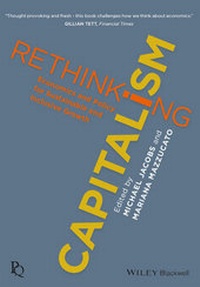
Rethinking Capitalism
Description

Reviews / Votes
Västvärldens kapitalism är i kris. Men det finns sätt att göra den mer innovativ, inkluderande och hållbar. Det anser författarna till Rethinking Capitalism. Economics and Policy for Sustainable and Inclusive Growth. I bokens kapitel diskuterar de problemen med moderna mainstreamteorier. De föreslår en rad lösningar på dagens ekonomiska problem, och menar att det krävs nytänkande såväl inom nationalekonomin som på policyområdet. För att förstå innovation behöver man studera verkliga exempel. Det duger inte att förlita sig på abstrakta teorier om företag som vinstoptimerande maskiner. Redaktörer är Michael Jacobs och Mariana Mazzucato. The capitalism of the western world is in crisis. But there are ways to make it more innovative, inclusive and sustainable. It considers the authors of Rethinking Capitalism. Economics and Policy for Sustainable and Inclusive Growth. In the chapter of the book they discuss the problems of modern mainstream theories. They propose a series of solutions to today's economic problems, and argue that it requires innovative thinking, both in the national economy and in the policy area. In order to understand innovation, one needs to study real examples. It is not good to rely on abstract theories about companies like profit optimizing machines. Editors are Michael Jacobs and Mariana Mazzucato. "A fine collection of chapters by leading progressives on what went wrong -- low growth, flagging investment and innovation, too few jobs and too much carbon -- and what might be done. May it close the door on the failed "mainstream" and open another, toward a fully-integrated, uncompromising, radical view of economics and economic policy." James K. Galbraith, Lloyd M. Bentsen, Jr. Professor in Government and Business Relations, University of Texas at Austin, author of Future of Growth and Inequality: What Everyone Needs to Know "The economies of developed countries face profound problems, including congested and polluted cities, deep inequalities, marginalisation of large segments of the population and sluggish growth. And the next twenty years will have to see severe cuts in greenhouse gas emissions if we are to have any serious chance of avoiding dangerous climate change. Economic policy must change radically and quickly if we are to tackle these deep and inter-related problems. That means, in turn, a deeper understanding of the workings of our capitalist system. This book is a very valuable and thoughtful contribution to these crucial tasks." Lord Nicholas Stern, IG Patel Professor of Economics and Government at the London School of Economics and author of the Stern Review on the Economics of Climate Change "This excellent book could not be more timely. With the rise of populist protest movements across the west, the hard realities of stagnating real wages and entrenched inequality, it is plain that modern capitalism is not working. Rethinking economics is invaluable contribution to the challenging tasks ahead." Will Hutton Principal Hertford College Oxford and author of The State We're In "We badly need fresh thinking in the world of economic policy making today - and this book offers a plethora of provocative ideas. It tackles numerous sacred cows in a lively and provocative manner and challenges our assumptions. It is thus a very valuable and welcome contribution to the current debate about why so many western economies have performed poorly since the great crisis." Gillian Tett, Financial TimesMore details
Other editions
Additional editions
Content
Notes on Contributors
Michael Jacobs is Visiting Professor in the School of Public Policy and Department of Political Science at University College London. An environmental economist and political theorist, his work has focused on the political economy of environmental change. His books include The Green Economy: Environment, Sustainable Development and the Politics of the Future (Pluto Press, 1991), Greening the Millennium? The New Politics of the Environment (ed., Blackwell, 1997), The Politics of the Real World (Earthscan, 1996) and Paying for Progress: A New Politics of Tax for Public Spending (Fabian Society, 2000). From 2004 to 2010 he was a Special Adviser to the UK Prime Minister, responsible for domestic and international policy on energy and climate change, and before that (2004-2007) a member of the Council of Economic Advisers at the Treasury. He has previously been General Secretary of the Fabian Society, Co-Editor of The Political Quarterly and a research fellow at Lancaster University and the London School of Economics.
Mariana Mazzucato is the RM Phillips Professor in the Economics of Innovation at SPRU at the University of Sussex. She has held academic positions at the University of Denver, London Business School, Open University and Bocconi University. Her book The Entrepreneurial State: Debunking Public vs. Private Sector Myths (Anthem, 2013) was on the Financial Times' 2013 Books of the Year list. She is winner of the 2014 New Statesman SPERI Prize in Political Economy and the 2015 Hans-Matthöfer-Preis, and in 2013 the New Republic called her one of the 'three most important thinkers about innovation'. She is an economic advisor to the Scottish government and the Labour Party, and is a member of the World Economic Forum's Global Agenda Council on the Economics of Innovation. Her current research is funded by the European Commission, the Institute for New Economic Thinking (INET), the Ford Foundation, NASA and the Brazilian Ministry for Science and Technology.
Stephanie Kelton is Professor of Economics at the University of Missouri-Kansas City. Her research expertise is in Federal Reserve operations, fiscal policy, social security, international finance and employment. She is best known for her contributions to the literature on Modern Monetary Theory. Her book, The State, The Market and the Euro (Edward Elgar, 2003) predicted the debt crisis in the eurozone. She served as Chief Economist on the US Senate Budget Committee and as an economic advisor to the Bernie Sanders 2016 presidential campaign. She was Founder and Editor-in-Chief of the top-ranked blog 'New Economic Perspectives' and a member of the TopWonks network of America's leading policy thinkers. She consults with policy-makers, investment banks and portfolio managers across the globe, and is a regular commentator on national radio and broadcast television.
L. Randall Wray is Professor of Economics at Bard College and Senior Scholar at the Levy Economics Institute. He is the author of Money and Credit in Capitalist Economies (Edward Elgar, 1990); Understanding Modern Money: The Key to Full Employment and Price Stability (Edward Elgar, 1998); and Modern Money Theory: A Primer on Macroeconomics for Sovereign Monetary Systems (Palgrave Macmillan, 2012, 2nd rev ed, 2015). He is also co-editor of, and a contributor to, Money, Financial Instability, and Stabilization Policy (Edward Elgar, 2006), and Keynes for the 21st Century: The Continuing Relevance of The General Theory (Palgrave Macmillan, 2008). His latest book is Why Minsky Matters: An Introduction to the Work of a Maverick Economist (Princeton University Press, 2016).
Yeva Nersisyan is Assistant Professor of Economics at Franklin and Marshall College. She received her BA in economics from Yerevan State University in Armenia in 2006, and her MA and PhD in economics and mathematics from the University of Missouri-Kansas City in 2013. She is a macroeconomist working in the post-Keynesian and institutionalist traditions. Her research interests include banking and financial instability, and fiscal and monetary theory and policy. She has published a number of papers on shadow banking, fiscal policy, government deficits and debt, financial fragility and instability, financial reform and retirement policy.
Andrew G. Haldane is the Chief Economist at the Bank of England and Executive Director, Monetary Analysis and Statistics. He is a member of the Bank's Monetary Policy Committee. He also has responsibility for research and statistics across the Bank. In 2014, TIME magazine named him one of the 100 most influential people in the world. Andrew has written extensively on domestic and international monetary and financial policy issues. He is co-founder of 'Pro Bono Economics', a charity which brokers economists into charitable projects.
William Lazonick is Professor of Economics at University of Massachusetts Lowell. He is co-founder and president of the Academic-Industry Research Network. Previously, he was Assistant and Associate Professor of Economics at Harvard University, Professor of Economics at Barnard College of Columbia University and Distinguished Research Professor at INSEAD. His book Sustainable Prosperity in the New Economy? Business Organization and High-Tech Employment in the United States (Upjohn Institute, 2009) won the 2010 Schumpeter Prize. His article, 'Innovative Business Models and Varieties of Capitalism' received the Henrietta Larson Award from Harvard Business School for best article in Business History Review in 2010. His article 'Profits Without Prosperity: Stock Buybacks Manipulate the Market and Leave Most Americans Worse Off' was awarded the HBR McKinsey Award for outstanding article in Harvard Business Review in 2014. He is currently completing a book, The Theory of Innovative Enterprise, to be published by Oxford University Press.
Stephany Griffith-Jones is Financial Markets Director, Initiative Policy Dialogue, Columbia University; Emeritus Professor, Institute of Development Studies, Sussex University, where she was Professorial Fellow; and Research Associate, Overseas Development Institute. An economist, she has led many major international research projects on international and domestic financial issues and has published widely, having written or edited over twenty books and numerous journal and newspaper articles. Her books include Time for a Visible Hand: Lessons from the 2008 World Financial Crisis, co-edited with Jose Antonio Ocampo and Joseph Stiglitz (Oxford University Press, 2010), and Achieving Financial Stability and Growth in Africa, co-edited with Ricardo Gottschalk (Routledge, 2016). She has advised many international organisations, including the European Commission, European Parliament, World Bank, Commonwealth Secretariat, IADB and various UN agencies and several governments and central banks, including those of the UK, Chile, Sweden, South Africa, Tanzania, Brazil and Czech Republic.
Giovanni Cozzi is Senior Lecturer in Economics at the University of Greenwich and a member of the Greenwich Political Economy Research Centre. He was formerly Senior Economist at the Foundation for European Progressive Studies (FEPS) in Brussels and Research Fellow at the Centre for Development Policy and Research at the School of Oriental and African Studies. His current research is on fiscal policies, the role of social and physical investment in promoting sustainable growth and employment and the role of development banks. Several of his research publications employ the Cambridge Alphametrics Model (CAM), a structuralist growth model, to project alternative macroeconomic scenarios and their policy implications.
Joseph E. Stiglitz is University Professor at Columbia University, the winner of the 2001 Nobel Prize in Economics and the John Bates Clark Medal. He was also one of the lead authors of the 1995 report of the Intergovernmental Panel on Climate Change, which shared the 2007 Nobel Peace Prize. He is Co-Chair of the High-Level Expert Group on the Measurement of Economic Performance and Social Progress at the OECD, Chief Economist of the Roosevelt Institute, and the Founder and Co-President of Columbia University's Initiative for Policy Dialogue. He was Chairman of the US Council of Economic Advisors under President Clinton and Chief Economist and Senior Vice President of the World Bank from 1997 to 2000. He held the Drummond Professorship at All Souls College Oxford and has taught at MIT, Yale, Stanford and Princeton. His books include Globalization and its Discontents (Penguin, 2002), The Price of Inequality (Penguin, 2012) and The Great Divide: Unequal Societies and What We Can Do About Them (Allen Lane, 2015).
Colin Crouch is a Professor Emeritus of the University of Warwick and external scientific member of the Max Planck Institute for the Study of Societies at Cologne. He is vice-president for social sciences of the British Academy. He is a former editor and former chair of the editorial board of The Political Quarterly. He has published within the fields of comparative European sociology and industrial relations, economic sociology and contemporary issues in British and European politics. His most recent books include Post-Democracy (Polity, 2004); Capitalist Diversity and Change: Recombinant Governance and Institutional Entrepreneurs (Oxford University Press, 2005); The Strange Non-death of Neoliberalism (Polity, 2011);...
