

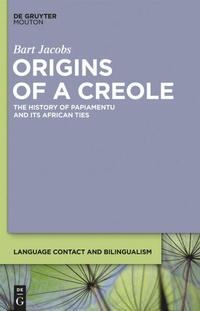
Origins of a Creole
Description

This study embarks on the intriguing quest for the origins of the Caribbean creole language Papiamentu. In the literature on the issue, widely diverging hypotheses have been advanced, but scholars have not come close to a consensus. The present study casts new and long-lasting light on the issue, putting forward compelling interdisciplinary evidence that Papiamentu is genetically related to the Portuguese-based creoles of the Cape Verde Islands, Guinea-Bissau, and Casamance (Senegal). Following the trans-Atlantic transfer of native speakers to Curaçao in the latter half of the 17th century, the Portuguese-based proto-variety underwent a far-reaching process of relexification towards Spanish, affecting the basic vocabulary while leaving intact the original phonology, morphology, and syntax. Papiamentu is thus shown to constitute a case of 'language contact reduplicated' in that a creole underwent a second significant restructuring process (relexification). These explicit claims and their rigorous underpinning will set standards for both the study of Papiamentu and creole studies at large and will be received with great interest in the wider field of contact linguistics.
More details
Other editions
Additional editions
Person
Content
2 - Abbreviations [Seite 13]
3 - Introduction [Seite 15]
3.1 - Presentation of the languages considered in the present study [Seite 17]
3.2 - Papiamentu (PA) [Seite 17]
3.3 - Cape Verdean Creole (CV) [Seite 20]
3.4 - The Creole of Guinea-Bissau and Casamance (GBC) [Seite 22]
3.5 - Hypothesis examined in the present study [Seite 23]
3.6 - Methodological remarks [Seite 24]
3.7 - Linguistic evidence [Seite 24]
3.8 - Negative evidence [Seite 25]
3.9 - Historical evidence [Seite 28]
3.10 - Structure of the present study [Seite 28]
4 - 1 Critical review of the literature on the origins of Papiamentu [Seite 31]
4.1 - Introduction [Seite 31]
4.2 - 1.1. From Schabel (1704) to Lenz (1928) [Seite 32]
4.3 - 1.2. Afro-Portuguese hypotheses: from Lenz (1928) to monogenesis [Seite 34]
4.4 - 1.3. Spanish hypotheses [Seite 38]
4.5 - 1.4. Critical discussion of the Spanish hypotheses [Seite 41]
4.5.1 - 1.4.1. Linguistic continuity between the pre- and post-1634 period? [Seite 42]
4.5.2 - 1.4.2. Linguistic evidence against Old Spanish in PA's superstate [Seite 43]
4.5.3 - 1.4.3. About the tendency to attribute the Portuguese to other Hispanic varieties [Seite 43]
4.6 - 1.5. PA birth among the Sephardim? [Seite 44]
4.6.1 - 1.5.1. On the linguistic profile of the early Curaçaoan Sephardim [Seite 45]
4.6.2 - 1.5.2. Demographic arguments against a PA birth among the Sephardim [Seite 50]
4.7 - 1.6. Where does the Portuguese come from? [Seite 53]
4.7.1 - 1.6.1. A shared origin for all Afro-Iberian creoles in the Caribbean? [Seite 53]
4.7.2 - 1.6.2. Goodman's Brazilian Creole Hypothesis [Seite 57]
4.7.3 - 1.6.3. Gulf of Guinea Portuguese-based Creole [Seite 58]
4.7.4 - 1.6.4. Upper Guinea Portuguese-based Creole [Seite 60]
4.8 - 1.7. Summary [Seite 62]
5 - 2 Phonology [Seite 65]
5.1 - Introduction [Seite 65]
5.2 - 2.1. Vowel features [Seite 66]
5.2.1 - 2.1.1. Vowel raising [Seite 66]
5.2.2 - 2.1.2. Rounding of unstressed vowels [Seite 69]
5.2.3 - 2.1.3. Vowel harmony [Seite 70]
5.2.4 - 2.1.4. Monophthongs [Seite 71]
5.3 - 2.2. Consonant features [Seite 76]
5.3.1 - 2.2.1. The voiceless palatal fricative /./ in PA and Upper Guinea PC [Seite 76]
5.3.2 - 2.2.2. Retention of Old Portuguese voiceless affricate /t./ in PA and Upper Guinea PC [Seite 82]
5.3.3 - 2.2.3. Rejection of voiced fricatives in PA and Upper Guinea PC [Seite 83]
5.3.4 - 2.2.4. The lack of lambdacism (/r/ > /l/) in PA and Upper Guinea PC [Seite 86]
5.3.5 - 2.2.5. Rhotacism (/d/ > /r/) [Seite 86]
5.4 - 2.3. Syllabic restructuring [Seite 87]
5.4.1 - 2.3.1. Apheresis of prefixes [Seite 88]
5.4.2 - 2.3.2. Vowel epenthesis [Seite 89]
5.4.3 - 2.3.3. Metathesis of the /r/ [Seite 90]
5.4.4 - 2.3.4. Negative evidence: syllabic restructuring in PLQ and Gulf of Guinea PC [Seite 91]
5.5 - 2.4. Paroxytonic verb stress in PA and SCV [Seite 92]
5.5.1 - 2.4.1. Verb stress in GBC [Seite 94]
5.5.2 - 2.4.2. On the diachrony of paroxytonic verb stress in PA and SCV [Seite 94]
5.6 - 2.5. Final remarks on phonology [Seite 95]
6 - 3 Selected parts of speech [Seite 97]
6.1 - Introduction [Seite 97]
6.2 - 3.1. Personal pronouns [Seite 97]
6.2.1 - 3.1.1. 1sg (a)mi [Seite 100]
6.2.2 - 3.1.2. Emphatic a- subject pronouns [Seite 100]
6.2.3 - 3.1.3. 2pl SCV nhos [Seite 102]
6.2.4 - 3.1.4. Digression: 2sg polite pronouns in PA [Seite 103]
6.2.5 - 3.1.5. PA nan [Seite 104]
6.2.6 - 3.1.6. Final remarks on pronouns [Seite 109]
6.3 - 3.2. Prepositions [Seite 109]
6.3.1 - 3.2.1. PA / Upper Guinea PC di [Seite 111]
6.3.2 - 3.2.2. PA / Upper Guinea PC na [Seite 112]
6.3.3 - 3.2.3. PA / Upper Guinea PC te [Seite 113]
6.3.4 - 3.2.4. PA / Upper Guinea PC riba (di) [Seite 114]
6.3.5 - 3.2.5. PA / Upper Guinea PC pa [Seite 115]
6.3.6 - 3.2.6. Zero preposition with motion verb + place [Seite 117]
6.3.7 - 3.2.7. Reanalysis of Iberian prepositions/adverbs 'in front of' and 'behind' as nouns [Seite 118]
6.3.8 - 3.2.8. Composed prepositions [Seite 120]
6.3.9 - 3.2.9. A reassessment of the time-depth of prepositions in PA [Seite 127]
6.3.10 - 3.2.10. Final remarks on prepositions [Seite 128]
6.4 - 3.3. Interrogatives [Seite 128]
6.4.1 - 3.3.1. Equally transparent interrogative paradigms [Seite 130]
6.4.2 - 3.3.2. PA: Portuguese rather than Spanish etyma [Seite 130]
6.4.3 - 3.3.3. Early PA *kantu, *kal [Seite 130]
6.4.4 - 3.3.4. PA unda, SCV unde and GBC nunde [Seite 131]
6.4.5 - 3.3.5. PA / Upper Guinea PC ken [Seite 131]
6.5 - 3.4. Conjunctions [Seite 132]
6.5.1 - 3.4.1. Coordinate conjunctions [Seite 132]
6.5.2 - 3.4.2. Subordinate conjunctions [Seite 134]
6.5.3 - 3.4.3. Final remarks on conjunctions [Seite 143]
6.6 - 3.5. Miscellaneous [Seite 143]
6.6.1 - 3.5.1. Reciprocity and reflexivity [Seite 143]
6.6.2 - 3.5.2. The deictic marker Early PA / Upper Guinea PC es [Seite 148]
6.6.3 - 3.5.3. Negation [Seite 153]
7 - 4 Morphology [Seite 157]
7.1 - Introduction [Seite 157]
7.2 - 4.1. Derivational morphology [Seite 158]
7.2.1 - 4.1.1. PA -mentu [Seite 158]
7.2.2 - 4.1.2. PA -dó [Seite 159]
7.2.3 - 4.1.3. Upper Guinea PC -mentu / -dor [Seite 159]
7.2.4 - 4.1.4. The suffix -dadi in Early PA texts [Seite 163]
7.3 - 4.2. Inflectional morphology [Seite 164]
7.3.1 - 4.2.1. The diachrony of PA's past participle morpheme -/Ø/ [Seite 165]
7.3.2 - 4.2.2. The regularization of past participle morphology in PA and Upper Guinea PC [Seite 168]
7.4 - 4.3. Passivization in (Early) PA and Upper Guinea PC [Seite 169]
7.4.1 - 4.3.1. Passivization in present-day PA [Seite 169]
7.4.2 - 4.3.2. Passivization in Upper Guinea PC [Seite 170]
7.4.3 - 4.3.3. Auxiliary-less passives in Early PA texts [Seite 171]
7.4.4 - 4.3.4. Digression: On the reliability of Early PA evangelical texts [Seite 176]
7.4.5 - 4.3.5. Auxiliary-less passives (/passive verbs) in present-day Papiamentu [Seite 177]
7.4.6 - 4.3.6. On the incorporation of wòrdu and ser [Seite 180]
7.4.7 - 4.3.7. Digression: The presumed non-nativeness of passives in PA [Seite 182]
7.4.8 - 4.3.8. Final remarks on passivization in PA and Upper Guinea PC [Seite 182]
7.5 - 4.4. Final remarks on morphology [Seite 183]
8 - 5 Verbal system [Seite 185]
8.1 - Introduction [Seite 185]
8.2 - 5.1. PA / Upper Guinea PC preverbal ta [Seite 186]
8.2.1 - 5.1.1. Analyzing CV ta as a progressive aspect marker [Seite 187]
8.2.2 - 5.1.2. Analyzing PA ta as [+imperfective], rather than [+present] [Seite 200]
8.2.3 - 5.1.3. Final remarks on PA / Upper Guinea PC preverbal ta [Seite 206]
8.3 - 5.2. The diachrony of the PA perfective past marker a [Seite 207]
8.4 - 5.3. Future tense marking in PA and Upper Guinea PC [Seite 211]
8.4.1 - 5.3.1. The PA future tense marker lo vs. its absence in Upper Guinea PC [Seite 212]
8.4.2 - 5.3.2. On the origin of PA lo [Seite 214]
8.4.3 - 5.3.3. The diachrony of future tense marking in PA and Upper Guinea PC [Seite 217]
8.4.4 - 5.3.4. Digression: SCV al and PA lo [Seite 221]
8.5 - 5.4. PA / BaCV taba - tabata [Seite 222]
8.5.1 - 5.4.1. Digression: On the diachrony of preverbal taba and postverbal -ba [Seite 225]
8.6 - 5.5. The issue of relative versus absolute tense marking in PA [Seite 228]
8.7 - 5.6. A comparison of stative verbs in PA and SCV [Seite 231]
8.7.1 - 5.6.1. The stative - nonstative distinction in creoles [Seite 231]
8.7.2 - 5.6.2. Strong vs. weak stative verbs [Seite 232]
8.7.3 - 5.6.3. The class of strong stative verbs [Seite 233]
8.7.4 - 5.6.4. The class of weak stative verbs [Seite 235]
8.7.5 - 5.6.5. Contrastive analysis [Seite 237]
8.7.6 - 5.6.6. Digression: The case of GBC [Seite 239]
8.8 - 5.7. Auxiliary verbs [Seite 240]
8.8.1 - 5.7.1. Modal auxiliaries [Seite 241]
8.8.2 - 5.7.2. Copular verbs [Seite 244]
8.8.3 - 5.7.3. Other auxiliaries [Seite 254]
8.8.4 - 5.7.4. Final remarks on auxiliary verbs [Seite 268]
8.9 - 5.8. Final remarks on the verbal system [Seite 269]
9 - 6 Summary and interim analysis of the linguistic results [Seite 271]
9.1 - Introduction [Seite 271]
9.2 - 6.1. Predominance of Portuguese-derived function words in PA [Seite 271]
9.3 - 6.2. Structural overlap between PA and Upper Guinea PC [Seite 273]
9.4 - 6.3. Negative evidence from PLQ and Gulf of Guinea PC [Seite 274]
9.4.1 - 6.3.1. Digression: What sets PA and Upper Guinea PC apart from Gulf of Guinea PC [Seite 275]
9.5 - 6.4. Old Portuguese features in PA and Upper Guinea PC [Seite 278]
9.6 - 6.5. The value of historical PA and Upper Guinea PC texts [Seite 279]
9.7 - 6.6. West-Atlantic and Mande features in PA and Upper Guinea PC [Seite 280]
10 - 7 The historical ties between Upper Guinea and Curaçao [Seite 283]
10.1 - Introduction [Seite 283]
10.2 - 7.1. On the presumed insignificance of Upper Guinea to the history of Curaçao [Seite 284]
10.3 - 7.2. The Dutch presence in Senegambia in the 17th century [Seite 287]
10.3.1 - 7.2.1. The Dutch in Gorée [Seite 291]
10.3.2 - 7.2.2. The Dutch on the Petite Côte (Rufisque, Portudal and Joal) [Seite 293]
10.3.3 - 7.2.3. The loss of Gorée and the Dutch retreat from Senegambia [Seite 295]
10.3.4 - 7.2.4. The Dutch ties with Cacheu and the Cape Verde Islands [Seite 299]
10.3.5 - 7.2.5. Final remarks on the Dutch presence in Senegambia in the 17th century [Seite 303]
10.4 - 7.3. Dutch slave trade from Upper Guinea to Curaçao [Seite 303]
10.4.1 - 7.3.1. Other factors relevant to the Dutch slave trade from Upper Guinea to Curaçao [Seite 305]
10.5 - 7.4. Sephardic Jewish networks linking Upper Guinea to Curaçao [Seite 308]
10.5.1 - 7.4.1. Ties between the Sephardim in Upper Guinea and Amsterdam [Seite 310]
10.5.2 - 7.4.2. Sephardim networks directly linking Upper Guinea to Curaçao [Seite 311]
10.5.3 - 7.4.3. Partnership between the Dutch WIC and the Sephardim [Seite 313]
10.6 - 7.5. Diffusion of Upper Guinea PC to the mainland, 16th and 17th centuries [Seite 314]
10.7 - 7.6. Summary, conclusions, and final remarks [Seite 318]
11 - 8 Discussion: The development from Upper Guinea PC to Papiamentu [Seite 321]
11.1 - Introduction [Seite 321]
11.2 - 8.1. Sociolinguistic considerations [Seite 322]
11.2.1 - 8.1.1. On the choice of slaves in the early period of Curaçao's settlement [Seite 322]
11.2.2 - 8.1.2. Sociolinguistic issues relevant to the consolidation of Upper Guinea PC on Curaçao and its diffusion among the (slave) population [Seite 326]
11.3 - 8.2. From Upper Guinea PC to PA: a case of rapid relexification towards Spanish [Seite 333]
11.3.1 - 8.2.1. PA, monogenesis, and the notion of relexification in creole studies [Seite 334]
11.3.2 - 8.2.2. From Upper Guinea PC to PA: 'relexification' rather than 'heavy borrowing' [Seite 336]
11.3.3 - 8.2.3. Analyzing Papiamentu as a mixed language [Seite 341]
11.3.4 - 8.2.4. The source(s) of the Spanish elements in PA's basic content vocabulary [Seite 345]
11.4 - 8.3. Summary of the discussion [Seite 349]
12 - 9 Conclusions [Seite 351]
13 - Appendices [Seite 353]
14 - References [Seite 359]
15 - Index [Seite 399]
