

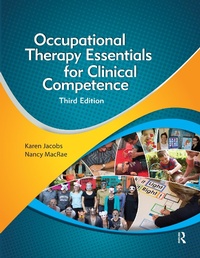
Occupational Therapy Essentials for Clinical Competence
3rd Edition
Published on 1. June 2024
964 pages
978-1-040-13628-7 (ISBN)
Description

Occupation, theory-driven, evidence-based, and client-centered practice continue to be the core of the profession and are the central focus of Occupational Therapy Essentials for Clinical Competence, Third Edition.
The Third Edition contains updated and enriched chapters that incorporate new perspectives and evidence-based information important to entry-level practitioners. The Third Edition continues to relate each chapter to the newest ACOTE Standards and is evidence-based, while also addressing the guidelines of practice and terms from the AOTA's Occupational Therapy Practice Framework, Third Edition.
Dr. Karen Jacobs and Nancy MacRae, along with their 61 contributors, introduce every topic necessary for competence as an entry-level practitioner. Varied perspectives are provided in each chapter with consistent references made to the relevance of certified occupational therapy assistant roles and responsibilities.
Additionally, chapters on the Dark Side of Occupation and Primary Care have been added to broaden the foundational scope of knowledge. Each chapter also contains a clinical case used to exemplify relevant content.
New in the Third Edition:
All chapters have been updated to reflect the AOTA's Occupational Therapy Practice Framework, Third Edition
Updated references and evidence-based practice chart for each chapter
Updated case studies to match the current standards of practice
References to the Occupational Therapy Code of Ethics (2015)
Faculty will benefit from the multiple-choice questions and PowerPoint presentations that coincide with each chapter
Included with the text are online supplemental materials for faculty use in the classroom.
Occupational Therapy Essentials for Clinical Competence, Third Edition is the perfect multi-use resource to be used as an introduction to the material, while also serving as a review prior to sitting for the certification exam for occupational therapists and occupational therapy assistants.
The Third Edition contains updated and enriched chapters that incorporate new perspectives and evidence-based information important to entry-level practitioners. The Third Edition continues to relate each chapter to the newest ACOTE Standards and is evidence-based, while also addressing the guidelines of practice and terms from the AOTA's Occupational Therapy Practice Framework, Third Edition.
Dr. Karen Jacobs and Nancy MacRae, along with their 61 contributors, introduce every topic necessary for competence as an entry-level practitioner. Varied perspectives are provided in each chapter with consistent references made to the relevance of certified occupational therapy assistant roles and responsibilities.
Additionally, chapters on the Dark Side of Occupation and Primary Care have been added to broaden the foundational scope of knowledge. Each chapter also contains a clinical case used to exemplify relevant content.
New in the Third Edition:
All chapters have been updated to reflect the AOTA's Occupational Therapy Practice Framework, Third Edition
Updated references and evidence-based practice chart for each chapter
Updated case studies to match the current standards of practice
References to the Occupational Therapy Code of Ethics (2015)
Faculty will benefit from the multiple-choice questions and PowerPoint presentations that coincide with each chapter
Included with the text are online supplemental materials for faculty use in the classroom.
Occupational Therapy Essentials for Clinical Competence, Third Edition is the perfect multi-use resource to be used as an introduction to the material, while also serving as a review prior to sitting for the certification exam for occupational therapists and occupational therapy assistants.
Reviews / Votes
"This text is easy to navigate due to the relative continuity in the formatting of the chapters. Students may also find the design and content of this text a beneficial resource to help gauge their knowledge and skill development in preparation for fieldwork, the registration exam, and practice as a generalist."- Regina Parnell, Canadian Journal of Occupational Therapy
More details
Edition
3rd edition
Language
English
Place of publication
London
United Kingdom
Publishing group
Taylor & Francis Ltd
Target group
College/higher education
Professional and scholarly
ISBN-13
978-1-040-13628-7 (9781040136287)
Copyright in bibliographic data and cover images is held by Nielsen Book Services Limited or by the publishers or by their respective licensors: all rights reserved.
Schweitzer Classification
Other editions
Additional editions
Karen Jacobs | Nancy MacRae
Occupational Therapy Essentials for Clinical Competence
Book
03/2017
3rd Edition
SLACK Incorporated
€218.70
Shipment within 3-4 weeks
Persons
Karen Jacobs, EdD, OTR/L, CPE, FAOTA, is a past president and vice president of the American Occupational Therapy Association (AOTA). She is a 2005 recipient of a Fulbright Scholarship to the University of Akureyri in Akureyri, Iceland; the 2009 recipient of the Award of Merit from the Canadian Association of Occupational Therapists (CAOT); the 2003 recipient of the Award of Merit from the AOTA; and recipient of the 2011 Eleanor Clarke Slagle Lectureship Award. The title of her Slagle lecture was PromOTing Occupational Therapy: Words, Images, and Action.
Dr. Jacobs is a clinical professor of occupational therapy and the Program Director of the online post-professional occupational therapy doctorate in occupational therapy program at Boston University. She has worked at Boston University for 34 years and has expertise in the development and instruction of online graduate courses.
Dr. Jacobs earned a doctoral degree at the University of Massachusetts, a Master of Science in Occupational Therapy at Boston University, and a Bachelor of Arts at Washington University in St. Louis, Missouri.
Dr. Jacobs' research examines the interface between the environment and human capabilities. In particular, she examines the individual factors and environmental demands associated with increased risk of functional limitations among populations of university- and middle school-aged students, particularly in notebook computing, use of tablets such as iPads (Apple), backpack use, and the use of games such as Wii Fit (Nintendo). Karen is presently part of an interprofessional demonstration project titled, Project Career: Development of an Interprofessional Demonstration to Support the Transition of Students With Traumatic Brain Injuries From Post-Secondary Education to Employment.
In addition to being an occupational therapist, Dr. Jacobs is also a certified professional ergonomist (CPE), the founding editor in chief of the international, interprofessional journal WORK: A Journal of Prevention, Assessment & Rehabilitation (IOS Press, The Netherlands), and a consultant in ergonomics, marketing, and entrepreneurship.
She is the proud mother of three children (Laela, Josh, and Ariel) and Amma (grandmother in Icelandic) to Sophie, Zachary, Liberty, and Zane. Her occupational balance is through travel, photography, kayaking, walking, co-writing children's books, and spending time with her family at Wakonda Pond.
Nancy MacRae, MS, OTR/L, FAOTA, is an associate professor at the University of New England (UNE), in Portland, Maine, where she has taught for 27 years. She has begun a 3-year process of phased-in retirement, where she teaches only one semester per school year. She is a past president of the Maine Occupational Therapy Association and a past director of the UNE occupational therapy program.
Nancy's work experience has been within the field of developmental disabilities, primarily mental retardation, across the lifespan. Her graduate degree is in adult education, with a minor in educational gerontology. Involvement in interprofessional activities at UNE allows her to mentor and learn with and from future health care practitioners and to model the collaboration our health care system needs. Scholarship has centered around aging and sexuality, documentation, professional writing, and interprofessional ventures. She has been a member of the editorial board of WORK: A Journal of Prevention, Assessment & Rehabilitation since its inception.
Nancy is the proud mother of two sons and a 17-year-old granddaughter. Occupational balance is maintained through participation in yoga, reading, walking, baking, and basket making, as well as volunteering within the community at a local school and working with caregivers of people with dementia. Travel plans have accelerated now that work is no longer full time.
Dr. Jacobs is a clinical professor of occupational therapy and the Program Director of the online post-professional occupational therapy doctorate in occupational therapy program at Boston University. She has worked at Boston University for 34 years and has expertise in the development and instruction of online graduate courses.
Dr. Jacobs earned a doctoral degree at the University of Massachusetts, a Master of Science in Occupational Therapy at Boston University, and a Bachelor of Arts at Washington University in St. Louis, Missouri.
Dr. Jacobs' research examines the interface between the environment and human capabilities. In particular, she examines the individual factors and environmental demands associated with increased risk of functional limitations among populations of university- and middle school-aged students, particularly in notebook computing, use of tablets such as iPads (Apple), backpack use, and the use of games such as Wii Fit (Nintendo). Karen is presently part of an interprofessional demonstration project titled, Project Career: Development of an Interprofessional Demonstration to Support the Transition of Students With Traumatic Brain Injuries From Post-Secondary Education to Employment.
In addition to being an occupational therapist, Dr. Jacobs is also a certified professional ergonomist (CPE), the founding editor in chief of the international, interprofessional journal WORK: A Journal of Prevention, Assessment & Rehabilitation (IOS Press, The Netherlands), and a consultant in ergonomics, marketing, and entrepreneurship.
She is the proud mother of three children (Laela, Josh, and Ariel) and Amma (grandmother in Icelandic) to Sophie, Zachary, Liberty, and Zane. Her occupational balance is through travel, photography, kayaking, walking, co-writing children's books, and spending time with her family at Wakonda Pond.
Nancy MacRae, MS, OTR/L, FAOTA, is an associate professor at the University of New England (UNE), in Portland, Maine, where she has taught for 27 years. She has begun a 3-year process of phased-in retirement, where she teaches only one semester per school year. She is a past president of the Maine Occupational Therapy Association and a past director of the UNE occupational therapy program.
Nancy's work experience has been within the field of developmental disabilities, primarily mental retardation, across the lifespan. Her graduate degree is in adult education, with a minor in educational gerontology. Involvement in interprofessional activities at UNE allows her to mentor and learn with and from future health care practitioners and to model the collaboration our health care system needs. Scholarship has centered around aging and sexuality, documentation, professional writing, and interprofessional ventures. She has been a member of the editorial board of WORK: A Journal of Prevention, Assessment & Rehabilitation since its inception.
Nancy is the proud mother of two sons and a 17-year-old granddaughter. Occupational balance is maintained through participation in yoga, reading, walking, baking, and basket making, as well as volunteering within the community at a local school and working with caregivers of people with dementia. Travel plans have accelerated now that work is no longer full time.
Content
Introduction Section I Setting the Stage Chapter 1 The Experience of Flow and Meaningful Occupation Chapter 2 Cultural Impact on Occupation Chapter 3 The Dark Side of Occupation Chapter 4 Interprofessional Education and Practice: A Current Necessity for Best Practice Section II Basic Tenets of Occupational Therapy Chapter 5 History and Philosophy Chapter 6 The Occupational Therapy Practice Framework: Domain and Process, Third Edition Chapter 7 Meaning and Dynamic of Occupation and Activity Chapter 8 Occupational Performance and Health Chapter 9 Effective Communication Chapter 10 Therapeutic Use of Self Chapter 11 Teaching, Learning, and Health Literacy Chapter 12 Safety and Support Chapter 13 Occupational Performance in Natural Environments: Dynamic Contexts for Participation Chapter 14 Clinical Reasoning Section III Occupational Therapy Theoretical Perspectives Chapter 15 Occupational Therapy Theory Development and Organization Chapter 16 Occupational Therapy Theory Use in the Process of Evaluation and Intervention Section IV Screening, Evaluation, and Referral Chapter 17 Screening, Evaluation, and Referral Chapter 18 Evaluation of Activities of Daily Living and Instrumental Activities of Daily Living Chapter 19 Evaluation of Education and Work Chapter 20 Evaluation of Play and Leisure L Chapter 21 Evaluation of Occupational Performance in Rest and Sleep Chapter 22 Evaluation of Occupational Performance in Social Participation Chapter 23 Documentation of Occupational Therapy Services Section V Intervention Plan: Formulation and Implementation Chapter 24 Intervention Planning and Program Development Chapter 25 Client Factors in Occupational Performance Functioning Chapter 26 Interventions to Enhance Occupational Performance in Activities of Daily Living and Instrumental Activities of Daily Living L Chapter 27 Interventions to Enhance Occupational Performance in Education and Work Chapter 28 Interventions of Play and Leisure Chapter 29 Interventions to Enhance Occupational Performance in Rest and Sleep Chapter 30 Interventions to Enhance Occupational Performance in Social Participation Chapter 31 Environmental Adaptation and Ergonomics Chapter 32 Assistive Technology Chapter 33 Occupation-Centered Functional and Community Mobility Chapter 34 Physical Agent Modalities Chapter 35 Interventions to Enhance Feeding, Eating, and Swallowing Chapter 36 Case Management and Coordination Chapter 37 Consultation, Referral, Monitoring, and Discharge Planning Section VI Context of Service Delivery Chapter 38 Emerging Areas of Practice Chapter 39 Telehealth Chapter 40 Occupational Therapy in Primary Care Section VII Management of Occupational Therapy Services Chapter 41 Legislation and Reimbursement of Occupational Therapy Services Chapter 42 Marketing and Management of Occupational Therapy Services Chapter 43 Quality Improvement Chapter 44 Supervision of Occupational Therapy Personnel Chapter 45 Fieldwork Education Chapter 46 Leadership Section VIII Scholarship Chapter 47 The Importance of Scholarship and Scholarly Practice for Occupational Therapy Chapter 48 Grants Chapter 49 Professional Presentations Section IX Professional Ethics, Values, and Responsibilities Chapter 50 Ethics and Its Application to Occupational Therapy Practice Chapter 51 Local to Global Resources for the Occupational Therapy Professional Chapter 52 Promoting Occupational Therapy to the General Public Chapter 53 Competence and Professional Development: Learning for Complexity Chapter 54 Roles of Occupational Therapy Practitioners Chapter 55 Resolution of Ethical Conflict Chapter 56 Advocacy in Occupational Therapy Appendix A 2011 Accreditation Council for Occupational Therapy Education Standards and Interpretive Guide Appendix B Assessment Tool Grid Appendix C Assessments in Play and Leisure Appendix D Intervention Plan Outline Appendix E Sample of an Individualized Education Program Appendix F American Occupational Therapy Association Occupational Therapy Code of Ethics (2015)Appendix G Procedures for the Enforcement of the National Board for Certification in Occupational Therapy Candidate/Certificant Code of Conduct Appendix H National Board for Certification in Occupational Therapy Complaint Form Appendix I World Federation of Occupational Therapists Code of Ethics Glossary Index
