

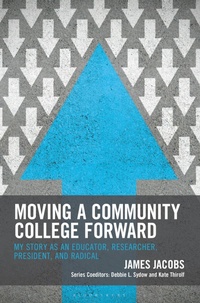
Moving a Community College Forward
My Story as an Educator, Researcher, President, and Radical
1st Edition
Published on 16. April 2026
256 pages
979-8-216-37795-5 (ISBN)
Description

What makes this book distinctive is the unique perspective of its author. James Jacobs spent fifty years at Macomb Community College, starting as a part-time instructor in 1967 and retiring in 2017 as president. After being temporarily fired by the college in 1970 for activist activities, Jacobs not only won his job back but began a transformation that led to a national role in developing community college workforce strategies used by many institutions today.
His evolution, from student radical to community college leader, happened in parallel with the evolution of community colleges, from local educational afterthoughts to national engines of personal and economic development. Since the context for the book is the Detroit region, issues such as racism, city-suburban relations, and changes in the auto industry are also examined.
Moving A Community College Forward has relevance for several audiences, including educators, policy experts, community college professionals, citizens of the Detroit region, and anyone who seeks guidance and inspiration from how things have evolved in the past as a way to prepare for and lead change into the future
His evolution, from student radical to community college leader, happened in parallel with the evolution of community colleges, from local educational afterthoughts to national engines of personal and economic development. Since the context for the book is the Detroit region, issues such as racism, city-suburban relations, and changes in the auto industry are also examined.
Moving A Community College Forward has relevance for several audiences, including educators, policy experts, community college professionals, citizens of the Detroit region, and anyone who seeks guidance and inspiration from how things have evolved in the past as a way to prepare for and lead change into the future
More details
Series
Edition
1. Auflage
Language
English
Place of publication
United States
Publishing group
Bloomsbury Publishing Plc
Target group
College/higher education
Professional and scholarly
Illustrations
5 B/W images, 6 textboxes
ISBN-13
979-8-216-37795-5 (9798216377955)
Copyright in bibliographic data and cover images is held by Nielsen Book Services Limited or by the publishers or by their respective licensors: all rights reserved.
Schweitzer Classification
Other editions
Additional editions
James Jacobs
Moving a Community College Forward
My Story as an Educator, Researcher, President, and Radical
Book
approx. 06/2026
Bloomsbury Academic
€30.00
Not yet published
Person
James Jacobs is a national expert on both the theory and practice of workforce development at community colleges. He specializes in occupational change and technology, regional economic development, occupational education, retraining displaced workers, and the skills needs of employers.
Jacobs combines his research with a long tenure as a community college educator and administrator. After serving nine years as its president, Jacobs is currently president emeritus of Macomb Community College in Michigan. Previously, he served the college in many capacities, including as the director of the Machinist Training Institution and as the associate vice president for public policy. As president of the college, Jacobs led efforts to merge credit and noncredit education and developed both National Science Foundation and Department of Labor grants to promote education and training in the auto industry. With support from JP Morgan Chase, he initiated the college's Innovation Fund, which awards startup businesses with funds to develop educational opportunities for Macomb students.
Jacobs was associate director of CCRC from 2000 to 2008 and a member of the Center's advisory board from 2008 to 2017. Jacobs has written extensively on issues regarding community colleges and workforce development. At CCRC he has coauthored publications on noncredit workforce education and IT certifications.
Jacobs served as president of the National Council for Workforce Education (NCWE), a national postsecondary organization of occupational education and workforce development specialists. He has also been an advisor to several national foundations and community colleges on workforce development issues. He was a member of the advisory board of the congressionally mandated National Assessment of Vocational Education (NAVE) and the Manufacturing Extension Partnership of the Department of Commerce. He also served on the community college advisory board for the Educational Testing Service and on the boards of the National Association for Community College Entrepreneurship and the Global Corporate College.
Currently, Jacobs is an advisor to the Wilson Foundation, which promotes development in the Detroit and Buffalo regions, and serves on the boards of the Center for Automotive Research, the Detroit Institute of Arts, and the United Way for Southeastern Michigan. Jacobs earned a BA from Harpur College, Binghamton University, part of the State University of New York system, and an MA and PhD in politics from Princeton University.
Jacobs combines his research with a long tenure as a community college educator and administrator. After serving nine years as its president, Jacobs is currently president emeritus of Macomb Community College in Michigan. Previously, he served the college in many capacities, including as the director of the Machinist Training Institution and as the associate vice president for public policy. As president of the college, Jacobs led efforts to merge credit and noncredit education and developed both National Science Foundation and Department of Labor grants to promote education and training in the auto industry. With support from JP Morgan Chase, he initiated the college's Innovation Fund, which awards startup businesses with funds to develop educational opportunities for Macomb students.
Jacobs was associate director of CCRC from 2000 to 2008 and a member of the Center's advisory board from 2008 to 2017. Jacobs has written extensively on issues regarding community colleges and workforce development. At CCRC he has coauthored publications on noncredit workforce education and IT certifications.
Jacobs served as president of the National Council for Workforce Education (NCWE), a national postsecondary organization of occupational education and workforce development specialists. He has also been an advisor to several national foundations and community colleges on workforce development issues. He was a member of the advisory board of the congressionally mandated National Assessment of Vocational Education (NAVE) and the Manufacturing Extension Partnership of the Department of Commerce. He also served on the community college advisory board for the Educational Testing Service and on the boards of the National Association for Community College Entrepreneurship and the Global Corporate College.
Currently, Jacobs is an advisor to the Wilson Foundation, which promotes development in the Detroit and Buffalo regions, and serves on the boards of the Center for Automotive Research, the Detroit Institute of Arts, and the United Way for Southeastern Michigan. Jacobs earned a BA from Harpur College, Binghamton University, part of the State University of New York system, and an MA and PhD in politics from Princeton University.
Content
List of Figures
List of Tables
Acknowledgments
Introduction: Why This Book?
Chapter 1: From Brooklyn to Macomb County
Chapter 2: Finding a Role
Chapter 3: America Discovers Community Colleges
Chapter 4: Becoming a Workforce Development Expert
Chapter 5: Community College Research Center and Considering the Presidency
Chapter 6: Becoming a President
Chapter 7: Getting Our Students Back to Work
Chapter 8: Running the College
Chapter 9: The College in the Community
Chapter 10: Wrapping It Up
Chapter 11; After the Presidency
Chapter 12: Epilogue
Bibliography
About the Author
List of Tables
Acknowledgments
Introduction: Why This Book?
Chapter 1: From Brooklyn to Macomb County
Chapter 2: Finding a Role
Chapter 3: America Discovers Community Colleges
Chapter 4: Becoming a Workforce Development Expert
Chapter 5: Community College Research Center and Considering the Presidency
Chapter 6: Becoming a President
Chapter 7: Getting Our Students Back to Work
Chapter 8: Running the College
Chapter 9: The College in the Community
Chapter 10: Wrapping It Up
Chapter 11; After the Presidency
Chapter 12: Epilogue
Bibliography
About the Author
