

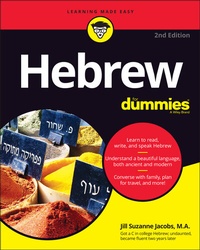
Hebrew For Dummies
Description

Shalom! Are you ready to dive into an ancient-yet-modern and rich language full of nuance? Then open up Hebrew For Dummies and get started learning your way around Hebrew by immersing yourself in its sounds and rhythms. You'll start with the basics--like simple grammar and the Hebrew alphabet--before you move onto commonly used phrases and small-talk.
This book gets you used to the more unfamiliar sounds of the Hebrew language--like gutturals--that English speakers aren't used to seeing. It will also help you:
* Recognize what Hebrew has in common with English (and what it doesn't)
* Learn to read from right to left, get a handle on the basics of Hebrew grammar, and pick up your first few phrases
* Discover commonly used expressions that help you get around, shop, eat, and have fun
Complete with online resources that help you pick up Hebrew by listening to real speakers have actual conversations, Hebrew For Dummies is the perfect companion to help you work your way towards Hebrew fluency!
More details
Other editions
Additional editions
Person
Content
Introduction
Hebrew is an incredible language. If you're picking up this book, I'm guessing that you have at least a passing interest in the subject, which thrills me because I think that Hebrew is an amazing, fascinating, and beautiful language. It's the only language in the history of the world to go from a deep freeze to a fully thawed, living, spoken language again. When you speak Hebrew, you're part of that amazing linguistic history. Whether you're interested in Hebrew because you want to communicate with your Israeli cousins, want to brush up on the subject so you can understand prayers and other sacred Jewish literature better, or want to impress your Jewish in-laws, Hebrew For Dummies can help.
About This Book
This book is a great place to start regardless of your motivation for picking up or dusting off your Hebrew skills. It won't make you fluent overnight (though wouldn't that be nice?) or turn you into a Biblical scholar, but Hebrew For Dummies can give you a solid foundation in both conversational Hebrew and the Hebrew of prayer, sacred texts, and holidays. As if that's not enough, I also share with you my love of things Jewish and the delightful, sometimes quirky culture of the modern State of Israel, where the largest group of Hebrew speakers resides today. But if you aren't planning on taking a trip to the Middle East, don't worry: Hebrew is alive and well all over the world. You can find plenty of opportunities to practice your language skills. (If you're not sure where to turn, I have you covered with some tips on where you can find Hebrew speakers and Hebrew sources right here in North America.) ????????????! (beh-hahtz-lah-?ah; Good luck! Much success to you!)
This book is only the beginning - but I hope it's a good one! You can pick up a language only through exposure and repetition, so go online and listen to the audio files for this book again and again. Be sure to practice, practice, and (you knew it was coming) practice. Go to places where you hear Hebrew and speak Hebrew in your home and workplace. Teach your favorite Hebrew words and expressions to everyone you know. Before you know it, Hebrew will creep into your mind, soul, and heart, and you'll speak it day and night!
Here are a couple of conventions that I use in this book for your reading pleasure:
- For this second edition, we're proud to include the Hebrew letters for each word (with vowels), along with the pronunciation (how to say the word) and translation (what the word means in English). In the pronunciations, the stressed syllables are italicized.
- Because Hebrew language is often gender-specific (with masculine and feminine nouns, verb forms, and so on; see Chapter 2 for an explanation of gender), I've included the following abbreviations wherever necessary:
- Masculine singular (MS)
- Feminine singular (FS)
- Nonbinary singular (NB)
- Masculine plural (MP)
- Feminine plural (FP)
To help you develop your language skills, For Dummies language books include
- Talkin' the Talk dialogues: Here's where you get to see Hebrew in action. These relatively short, real-life dialogues use the vocabulary and grammatical concepts that I introduce in the book.
- Words to Know blackboards: Here's where you can find the key words and phrases I introduce. It's all here: the word as it's written in Hebrew, the proh-nun-see-aye-shun, and the translation.
- Fun & Games activities: I'm a teacher; I just can't help myself. So, at the end of each chapter, I include some fun little exercises to help reinforce your newly acquired Hebrew.
Foolish Assumptions
My father taught me never to assume anything. He even had a little ditty about assumptions that I won't repeat here. But my editor said that I had to come up with some assumptions about you, the reader. So here they are:
- You know no Hebrew - or if you learned Hebrew in religious school, you don't remember a word of it.
- You're not looking for a book that will make you fluent in Hebrew; you just want to know some words, phrases, and sentence constructions so that you can communicate basic information in Hebrew.
- You don't want to have to memorize long lists of vocabulary words or a bunch of boring grammar rules.
- You're inexplicably drawn to all yellow-and-black books.
- You want to have fun and pick up some Hebrew at the same time.
Do any descriptions sound like you? Well, good. I bet you're in good company.
How This Book Is Organized
This book is organized into six parts plus an appendix. The six parts are broken down into chapters. I've organized the chapters around active topics - things you want to do (like go to a bank, go to a restaurant, or go to a synagogue). Each chapter gives you the lowdown on the Hebrew you need to know to get by while doing that activity. And, though I know that you don't want to be bogged down by grammar rules, I sneak a grammatical tidbit or two into each chapter. Don't worry: I make these brief excursions as quick and painless as possible.
Part 1: Getting Started
This part of the book starts with the basics. I introduce you to the Hebrew letters and vowels and give you some basic Hebrew vocabulary. I explain how I represent the Hebrew sounds in English letters (so you don't have to crack your teeth reading the Hebrew, although I encourage you to try). In Part 1, I also give you a basic grounding in Hebrew grammar.
Part 2: Hebrew in Action
Here's where I really get going. In these chapters, I give you basic Hebrew vocabulary to start using in your daily life - when you rise up, when you lie down, in your home, and when you walk (to quote from an important Hebrew prayer). Part 2 gives you the words to meet and greet, flirt and work, eat and drink, and shop 'til you drop. I also give you vocabulary to use when you go out for a night on the town and when you talk about it on the phone the next day. And I give you all the words you need when you're hanging out at home and cleaning up your place after you've made a mess.
Part 3: Hebrew on the Go
Here's where I start to get practical. I cover dealing with money, going to the bank, asking directions, getting around using various forms of transportation (funny thing - I don't mention camels; oh well), and hitting the road for a trip. So, if travel bug has paid you a visit, take a look at Part 3. I give you the words and phrases you need for planning the trip. And I also give you some vocabulary for handling - God forbid - an emergency.
Part 4: Israeli Life
When you travel to Israel or converse with Israelis about Israeli life, you'll need a specialized vocabulary. In these chapters, I've got you covered. You'll learn the names of some Israeli cities and towns, Israel's diverse religious, cultural and ethnic groups, and how to talk about Israel's history, conflicts and quest for peace. There's even a bit of Arabic in these chapters, too.
Part 5: Sacred Hebrew
Where would Hebrew be without Judaism? In this part, I present the sacred side of the Hebrew language. I tell you all about blessings, prayers, and Jewish holidays.
Part 6: The Part of Tens
What would a For Dummies book be without one of these? I'll put my top ten lists up against anyone's. In this section, I give you ten Israeli sayings so you can sound like a real ?????? (tzah-bahr; native Israeli), plus the top-ten Hebrew sayings heard in the Jewish Diaspora (that's everywhere outside of the Land of Israel). I also give you a list of some great reads about the wonderful, wild, and wacky world of Hebrew. It's all here.
Appendixes
Here's all the nuts and bolts. The cogs that make Hebrew run - verb tables and a Hebrew-English/English-Hebrew dictionary. And it doesn't stop there. I put the answers to the Fun & Games activities (which you find at the end of each chapter) here too. This is the place to go when you want some information, and you want it fast.
Icons Used in This Book
Sometimes, I want to point out something that's especially important or interesting: a grammatical concept, something to remember, a tip to help you with your Hebrew skills, or a bit of insider insight into the wonderful world of Jewish culture. In these cases, I use the following icons, which you can find in the margins.
This icon accompanies helpful tips for picking up the Hebrew language.
Think of this icon as that string around your finger that reminds you of all the little things you've gotta do but tend to forget. This icon flags important concepts that you have to keep in mind while you study Hebrew. You know what they say: God is in the details.
This little guy is by far my favorite icon. When you see this icon, you know that I've taken the opportunity to cram in all sorts of interesting information about the Jewish world...
