

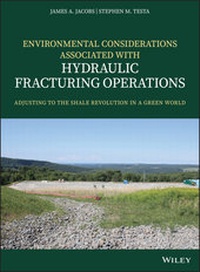
Environmental Considerations Associated with Hydraulic Fracturing Operations
Description

Environmental Considerations Associated with Hydraulic Fracturing Operations offers a much-needed resource that explores the complex challenges of fracking by providing an understanding of the environmental and communication issues that are inherent with hydraulic fracturing. The book balances the current scientific knowledge with the uncertainty and risks associated with hydraulic fracking. In addition, the authors offer targeted approaches for helping to keep communities safe.
The authors include an overview of the historical development of hydraulic fracturing and the technology currently employed. The book also explores the risk, prevention, and mitigation factors that are associated with fracturing. The authors also include legal cases, regulatory issues, and data on the cost of recovery. The volume presents audit checklists for gathering critical information and documentation to support the reliability of the current environmental conditions related to fracking operations and the impact fracking can have on a community. This vital resource:
* Contains the technical information and mitigation recommendations for safety and environmental issues related to hydraulic fracturing
* Offers an historical overview of conventional and unconventional oil and gas drilling
* Explains the geologic and technical issues associated with fracking of tight sand and shale formulations
* Presents numerous case studies from the United States EPA and other agencies
* Discusses issues of co-produced waste water and induced seismicity from the injection of wastewater
Written for environmental scientists, geologists, engineers, regulators, city planners, attorneys, foresters, wildlife biologists, and others, Environmental Considerations Associated with Hydraulic Fracturing Operations offers a comprehensive resource to the complex environmental and communication issues related to fracking.
More details
Other editions
Additional editions
Persons
JAMES A. JACOBS is Principal Resource Scientist and Hydrogeologist at Clearwater Group. He is a Fulbright Senior Scholar and co-author of four environmental books and has served as an expert in a variety of oil and gas valuation and environmental contamination cases.
STEPHEN M. TESTA is the former Executive Officer of the California State Mining and Geology Board and past president of the American Geosciences Institute, Environmental Geosciences and Energy Minerals Division of the American Association of Petroleum Geologists, American Institute of Professional Geologists, and Los Angeles Basin Geological Society.
Content
List of Figures xvii
List of Tables xxvii
Foreword xxxi
Acknowledgments xxxiii
1 Introduction 1
1.1 Energy and the Shale Revolution 1
1.2 Cultural Influences 3
1.3 Conventional Versus Unconventional Resources 4
1.4 Well Simulation 5
1.5 Hydraulic Fracturing in the United States 16
1.6 Environmental Considerations 17
1.7 Exercises 22
References 22
Suggested Reading 23
2 Historical Development from Fracturing to Hydraulic Fracturing 25
2.1 Introduction 25
2.2 Explosives and Guns (1820s-1930s) 26
2.3 The Birth of the Petroleum Engineer (1940s-1950s) 38
2.4 Going Nuclear During Peak Oil (1960s to Mid-1970s) 39
2.5 The Rise of the Unconventionals (Mid-1970s to Present) 45
2.6 Exercises 49
References 50
Suggested Reading 51
3 Geology of Unconventional Resources 53
3.1 Introduction 53
3.2 Oil Shale Nomenclature 54
3.3 Oil Shale Classification 54
3.4 Types of Shale Formations Based on Production 56
3.5 Geology of United States Shale Deposits 60
3.6 The Role of Natural Fractures 75
3.7 Exercises 76
References 77
Suggested Reading 79
4 Overview of Drilling and Hydraulic Fracture Stimulation Techniques for Tight Oil and Gas Shale Formations 81
4.1 Introduction 81
4.2 Phase 1: Prospect Generation for Unconventional Oil and Gas Targets 85
4.3 Phase 2: Planning Phase 92
4.4 Phase 3: Drilling 94
4.5 Brief Overview of Hydraulic Fracturing 109
4.6 Operators and Contractors 111
4.7 Phase 4: Completion 111
4.8 Overview of Hydraulic Fracturing Process 115
4.9 Single-Stage Treatment 119
4.10 Fluid Recovery and Waste Management 123
4.11 Oil and Gas Production 123
4.12 Naturally Occurring Radioactive Material (NORM) 126
4.13 Workshop #1: Gas Well Economic Limit 128
4.14 Workshop #2: Oil Well Economics 129
4.15 Well Destruction 129
4.16 Summary 131
4.17 Exercises 131
References 132
Suggested Reading 134
5 Overview of Impacts from Tight Oil and Shale Gas Resource Development 137
5.1 Introduction 137
5.2 Potential Impacts and Risks of Spills 137
5.3 Significance of Impacts 137
5.4 Overview of the Five Main Resource Categories 138
5.5 Primary Wastes Generated 146
5.6 Site-specific Impact Analysis 146
5.7 Summary of Resources and Issues 163
5.8 Summary 174
5.9 Exercises 176
References 177
Suggested Reading 179
6 Surface and Groundwater Risks, Resource Quality Management, and Impacts 183
6.1 Introduction 183
6.2 The Hydraulic Fracturing Water Cycle 183
6.3 Potential Impacts on Drinking Water Resources 188
6.4 Public Water System (PWS) Sources 189
6.5 Underground Injection Control 190
6.6 Case Histories 196
6.7 Exercises 198
References 198
Suggested Reading 199
7 Induced Seismicity 203
7.1 Introduction 203
7.2 Measuring Earthquake Severity 204
7.3 Anthropogenic-Induced Earthquakes 208
7.4 Mechanics of Anthropogenic-Induced Earthquakes 210
7.5 Induced Microseismicity and Microseismic Monitoring 212
7.6 Exercises 212
References 213
Suggested Reading 213
8 Air Quality Resources and Mitigation Measures 215
8.1 Introduction 215
8.2 Unconventional Resource Extraction and Air Quality 215
8.3 Sources of Air Emissions 215
8.4 Worker Safety 220
8.5 Gas Leaks and Vapor Sampling 230
8.6 Biogenic and Thermogenic Hydrocarbon Gases 232
8.7 Gas Leaks 233
8.8 Soil Vapor Intrusion Overview 234
8.9 General Approach to Evaluating Soil Vapor Intrusion 237
8.10 Summary 248
8.11 Exercises 249
References 249
Suggested Reading 253
9 Land Use Resources and Socioeconomics 255
9.1 Introduction 255
9.2 Community Concerns and Land Use Planning 255
9.3 Environmental Justice 259
9.4 Land Disturbance 259
9.5 Light Pollution 261
9.6 Noise 263
9.7 Odor 270
9.8 Socioeconomics 271
9.9 Transportation and Traffic 272
9.10 Visual Aesthetics 277
9.11 Worker Safety 278
9.12 Cumulative Impacts 278
9.13 Exercises 279
References 279
Suggested Reading 281
10 Ecological Resources 283
10.1 Introduction 283
10.2 Ecosystem Resources 283
10.3 Ecosystem Resources 283
10.4 Interim Reclamation 286
10.5 Summary 295
10.6 Exercises 295
References 296
Suggested Reading 297
11 Legislative Trends Associated with Well Stimulation and Hydraulic Fracturing 299
11.1 Introduction 299
11.2 Federal Laws and Regulations 300
11.3 State Legislation and Regulations 304
11.4 Bans and Moratoriums 311
11.5 Exercises 313
References 313
Suggested Reading 314
12 Sampling, Exposure Pathways, and Site Conceptual Models 315
12.1 Introduction 315
12.2 Hypothetical Scenario 317
12.3 Overview of Sampling Procedures 322
12.4 Soil and Water Sampling 327
12.5 Field Screening and Analysis 329
12.6 Other Considerations 332
12.7 Fate and Transport 339
12.8 Summary 342
12.9 Exercises 342
References 345
Suggested Reading 347
13 Financial Issues: Real Estate Values and Selected Contracting Costs of Repairs, Assessment, or Mitigation Activities for Unconventional Oil and Gas Production Areas 351
13.1 Introduction 351
13.2 Valuation of Real Estate 351
13.3 Water Supplies 357
13.4 Other Mitigating Costs 358
13.5 Mitigation of Subsurface Impacts 362
13.6 Remediation Strategies 365
13.7 Budgeting for Costs 369
13.8 Summary 372
13.9 Exercises 373
References 374
Suggested Reading 375
14 Legal Considerations and Case Law 377
14.1 Introduction 377
14.2 Environmental Tort Litigation 382
14.3 Environmental/Citizen Action and Industry Challenges Litigation 383
14.4 Infrastructure-Related Litigation 384
14.5 Traditional Oil and Gas Issues in Nontraditional Forums 384
14.6 Fracking Bans and Moratoriums 384
14.7 Summary 386
14.8 Exercises 387
Reference 387
Suggested Reading 387
15 Spills, Forensic Evaluation, and Case Studies 389
15.1 Introduction 389
15.2 Spill Studies 389
15.3 Spill Settlement Case Study 392
15.3.1 Rail Case Studies 393
15.3.2 Bakken Crude Oil Characteristics: Two Studies 394
15.3.3 Summary of Bakken Crude Oil Spill Incidents 394
15.3.4 Fate and Transport of Spilled Crude 394
15.3.5 Combustion 398
15.3.6 DOT-117 Tank Car Design 398
15.4 Violations 399
15.5 Forensic Analysis 399
15.5.1 Gas Chromatograms 400
15.5.2 Tentatively Identified Compounds (TICs) 401
15.5.3 Piper Diagrams 401
15.5.4 Biomarkers 403
15.5.5 Chemical and Biological Transformations 404
15.5.6 Chemical Ratios 406
15.5.7 Geochemical Tracers 406
15.5.8 Isotopes 407
15.5.9 Forensic Isotope Analysis 408
15.5.10 Boron and Strontium Isotope Ratios 409
15.5.11 Radioactive Isotopes 410
15.5.12 Case Studies 411
15.6 Prospective and Retrospective Case Studies 413
15.6.1 US EPA Retrospective Case Study 414
15.6.2 US EPA Retrospective Study Approach and Sampling Activities 415
15.6.3 Main Findings 420
15.6.4 Summary of US EPA Retrospective Studies 438
15.7 Exercises 439
References 440
Suggested Reading 446
16 Conclusions 453
Appendix A Selected University Studies, State, and Federal Reports 455
Appendix B Glossary 461
Appendix C List of Acronyms and Abbreviations 467
Appendix D Conversions 473
Appendix E Summary of Potential Job Hazards During Hydraulic Fracture Stimulation Process 477
Appendix F Chemical Additives Used in the High-Volume Hydraulic Fracturing Operations 481
Appendix G Exposure Planning, Emergency Response, and Toxicity Tables 485
Appendix H Selected Sampling Methods and Documentation 493
Appendix I Environmental Checklists 503
Appendix J Metric Conversion of Table 3.4 (Metric Units in Bold italics) 523
Appendix K US Crude Oil Prices 1859-2016 525
Index 527
List of Figures
Figure 1.1 From the start of 2007 through the end of 2012, total US private sector employment increased by more than one million jobs, about 1%. Over the same period, the oil and natural gas industry increased by more than 162?000 jobs, a 40% increase (USEIA 2013). Figure 1.2 Oil-gas basins and shale gas plays in the lower United States (API 2015). Figure 1.3 Fracking has reached the local coffee houses in downtown Sacramento, California, as reported by the Sacramento News and Review on 29 March 2012. Figure 1.4 Schematic diagram of the different types of onshore natural gas plays. Conventional resources are buoyancy-driven hydrocarbon accumulations, with secondary migration and structural and/or stratigraphic closures. Unconventional continuous gas accumulations in basin centers and transition zones are controlled by expulsion-driven secondary migration and capillary seal. Figure 1.5 US dry natural gas production in trillion cubic feet and billion cubic feet per day for shale resources that as of 2015 remain the dominant source of US natural gas production growth (USEIA 2015). Note that shale gas production becomes significant in 2010 and is projected to be dominant in 2040. Figure 1.6 An interesting statistic is that only about one-third of the worldwide oil and gas reserves are conventional in nature - the remainder are unconventional, which includes tight gas, coalbed methane (CBM), methane hydrates, shale gas, shale oil, heavy oil, and tar sands. Figure 1.7 Greater length of producing formation is exposed to the wellbore in a horizontal well (A) than in a vertical well (B) (USEIA 1993). Figure 1.8 Distribution of about 986?600 hydraulically fractured wells in the contiguous United States from 1947 to 2010, excluding wells situated offshore and in Alaska. Figure 1.9 Distribution of about 278?000 hydraulically fractured wells in the contiguous United States from 2000 to 2010, excluding wells situated offshore and in Alaska. Figure 1.10 The sustainability framework represents the world as three interrelated and interacting systems: economy, society, and environment. The arrows in the figure show the flows among the three systems. Figure 2.1 Historic photo of the Drake well circa 1859 (left) and Edwin Drake (right) who was neither a colonel nor a driller, but he was courageous and ambitious and did have a commitment to the new technology. Figure 2.2 Lt. Col. Edward A.L. Roberts in full Union army military regalia. Working with his brother, Walter B. Roberts, they formed the Roberts Torpedo Company in 1865 and patented their invention in 1866. Figure 2.3 The Roberts Torpedo barn factory was located far from populated areas due to a tendency of unintended explosions. Figure 2.4 Stock certification for the Roberts Petroleum Torpedo Company. Established in 1885, numerous patents provided Roberts a monopoly on torpedoes in the early years of the oil industry. Figure 2.5 Schematic of E.A.L. Roberts Torpedo, Patent No. 59936, 20 November 1866. The cylindrical torpedo would be filled with gunpowder and later nitroglycerin and lowered into the well and ignited by dropping a weight referred to as a "go-devil" along the suspension wire onto a percussion cap. Figure 2.6 A torpedo shell being filled with nitroglycerin, and was known as "shooting the well." Illegal shooting led to the term "moonlighting." Figure 2.7 Roberts Petroleum Torpedo Company's advertisement undated. Figure 2.8 View of Holmden Street from First Street in Pithole, one of the early oil boomtowns, now a Pennsylvania oil ghost town near Titusville, Pennsylvania. The site was cleared of overgrowth and was donated to the Pennsylvania Historical and Museum Commission in 1961. A visitor center, containing exhibits pertaining to the history of Pithole, was built in 1972. Pithole was listed on the National Register of Historic Places in 1973. None of the historic structures survived. Figure 2.9 A 1902 invention used a scissors-like expanding mechanism to drive and then retract "perforating levers" through the casing. Figure 2.10 The 1930s brought various downhole "guns" that shot steel-jacketed bullets through casing and about a foot into the producing formation. Figure 2.11 Although not a "machine gun" as noted in this August 1938 Popular Science Monthly article, vital production technologies provide explosive energy to cut through casing and strata and produce petroleum. Figure 2.12 Improved perforating technology evolves from the rocket grenade used in the Army's M1A1 "bazooka." Figure 2.13a US Patent Office No. 2,947,250, 1960. Figure 2.13b Henry Mohaupt's revolutionary idea was to use a conically hollowed-out explosive charge to direct and focus the detonation's energy. Figure 2.14 US chemist Herman Frasch (1851-1914) developed the sulfur mining process and a method for removing sulfur from crude oil, both referred to as the Frasch process. Figure 2.15 Herman Frasch 1896 US Patent No. 556,669 illustrating the increasing flow of oil in a well. Figure 2.16a Sequence of steps in the hydrafrac process. Figure 2.16b Well setup in the hydrafrac process. Figure 2.17 Total number of hydraulic fracturing treatment records associated with wells drilled from 1947 through 2010 and the top 95% of proppant, treatment fluid, and additive types. Shown are hydraulic fracturing records (1?763?815 records) (a): treatment fluid records (1?593?683 records) (b) and additive records (330?501 total) (c). Figure 2.18 Scientists lower a 13?ft (4?m) by 1.5?ft (0.5?m) diameter nuclear warhead into a well in New Mexico. The experimental 29-kiloton Project Gasbuggy device will be detonated at a depth of 4240?ft (1292?m). Figure 2.19 Gasbuggy: "Site of the first United States underground nuclear experiment for the stimulation of low-productivity gas reservoirs." Figure 2.20 The conceptual Project Wagon Wheel showing predicted explosive effects. Figure 2.21 Hubbert's curve and peak. Figure 2.22 US dry natural gas production in trillion cubic feet and billion cubic feet per day for shale resources, which as of 2015 remains the dominant source of US natural gas production growth (US EIA 2015). Note that shale gas production becomes significant by 2010 and is projected to be dominant by 2040. Figure 2.23 Greater length of producing formation is exposed to the wellbore in a horizontal well (A) than in a vertical well (B) (US EIA 1993). Figure 2.24 J.S. Campbell flexible driving shaft. Figure 3.1 Petrographic classification of oil shales (Hutton 1987). Figure 3.2 Global distribution of structural basins with shale gas and oil in 38 countries (EIA 2011). Dark shaded areas are assessed basins with assessed resource estimates. Light shaded areas are basins without assessed resource estimates. Figure 3.3 United States shale gas plays and associated production from year 2000 to 2015 (EIA 2015). Figure 3.4 Major tight gas plays within the United States (EIA 2010). Figure 3.5 US tight oil production per selected play (EIA 2015). Figure 3.6 Distribution of...
