

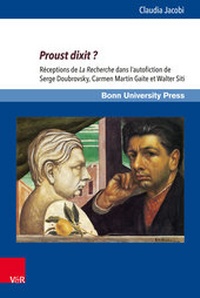
Proust dixit ?
Description

Die Zugehörigkeit der Proust'schen Recherche zur Autofiktion ist zweifelhaft - nicht aber ihre Verherrlichung als Gründungstext autofiktiven Schreibens. Zahlreiche Autoren erheben Marcel Proust zum Wegbereiter, zum literarischen Vorbild und sogar zum Schutzpatron dieses kontrovers diskutierten Genres. Die vorliegende Studie untersucht die Proust-Rezeption am Beispiel von drei eminenten Vertretern der Autofiktion in Frankreich, Spanien und Italien. Dabei reichen die Proust-Reminiszenzen von einer ambivalenten Aneignung der Erinnerungs- und Todesmetaphorik in Doubrovskys postmoderner Autofiktion über die fantastische Neuschreibung Combrays und des Temps retrouvé bei Carmen Martín Gaite bis hin zur ironischen Überarbeitung der Albertine-Figur und der Proust'schen Epiphanie in Walter Sitis hyperrealistischer Autofiktion.
Auszeichnungen:
»Prix de la République française«
»Prix présence de la langue française« der »Académie des Sciences, Arts et Belles-Lettres Toulouse«
Whether Proust's research can be classified as autofiction is subject to debate. What is not debatable is its glorification as the founding of autofictive writing. Many authors praise Marcel Proust as a revolutionary, exalting him as a quintessential literate, if not even a patron saint of this controversially discussed genre. The present study examines Proust's reception as exemplified by three preeminent writers of autofiction in France, Spain and Italy. The Proustian reminiscences span an ambivalent adoption of metaphors relating to memory and death in Doubrovsky's postmodern autofiction, extending through the fantastic rewriting of Combray and the Temps retrouvé by Carmen Martín Gaite up to the ironic revision of the Albertine figure and Proust's epiphany in Walter Sitis hyper-realistic autofiction.
More details
Other editions
Additional editions
Person
Content
- Intro
- Title Page
- Copyright
- Table of Contents
- Body
- Remerciements
- Tableau d'abréviations des ouvrages cités
- Introduction
- I. L'autobiographie dans l'histoire littéraire
- II. De l'autobiographie à l'autofiction
- III. La présence de Proust dans l'autofiction
- I. À la recherche du temps perdu de Marcel Proust
- I.1. À la recherche du moi perdu : la fonction de la mémoire involontaire pour la constitution du sujet
- I.2. Vers une déconstruction impressionniste du sujet et de la mémoire
- I.3. L'inscription de la mort dans la Recherche
- II. L'autofiction postmoderne de Serge Doubrovsky
- II.1a. Souvenir et conscience : une appropriation ambivalente de la mémoire proustienne
- II.1b. Souvenir et conscience : la consonance comme expression de l'inconscient
- II.2. À la recherche d'une identité : la déconstruction du sujet doubrovskyen
- II.3. L'inscription de la mort dans l'autofiction postmoderne de Serge Doubrovsky
- II.4. D'Un amour de Swann à Un amour de soi : une esthétique de l'insaisissable
- III. L'autofiction fantastique de Carmen Martín Gaite
- III.1. De la mémoire involontaire à une mémoire involontaire fantastique : réécritures de Combray
- III.2. À la recherche d'une identité : l'autofiction fantastique et la constitution du sujet féminin
- III.3. L'inscription de la mort dans l'autofiction fantastique de Carmen Martín Gaite
- IV. L'autofiction hyperréaliste de Walter Siti
- IV.1. De l'impressionnisme proustien à l'hyperréalité sitienne
- IV.2. De l'impression à l'image : Marcello - une Albertine hyperréaliste ?
- IV.3. La rencontre sexuelle avec Marcello comme épiphanie sécularisée
- IV.4. L'inscription de la mort dans l'autofiction hyperréaliste de Walter Siti
- V. Conclusion et perspectives
- Annexes : Les auteurs d'autofiction sur Marcel Proust (Messages privés des auteurs en ordre alphabéthique)
- Bibliographie
