

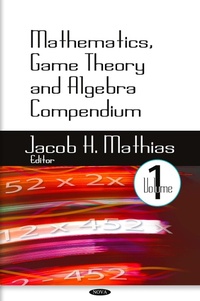
Mathematics, Game Theory and Algebra Compendium. Volume 1
Published on 11. February 2021
824 pages
978-1-61470-222-1 (ISBN)
Description

This book is devoted to new advances in all branches of mathematics, game theory and applications, and pure and applied algebra and geometry including Field Theory and Polynomials; Commutative Rings and Algebras; Algebraic Geometry; Linear and Multilinear Algebras; Matrix Theory; Associative Rings and Algebras; Nonassociative Rings and Algebras; K-Theory; Group Theory and Generaliza-tions; Topological Groups, Lie Groups; Geometry; Differential Geometry.
More details
Other editions
Additional editions
Book
05/2009
Nova Science Publishers Inc
€494.02
Shipment within 15-20 days
Content
- Intro
- MATHEMATICS, GAME THEORYAND ALGEBRA COMPENDIUM.VOLUME 1
- MATHEMATICS, GAME THEORYAND ALGEBRA COMPENDIUM.VOLUME 1
- CONTENTS
- PREFACE
- Chapter 1ON PROPERTY (E.A) IN GAUGE SPACES
- Abstract
- 1. Introduction and Preliminaries
- 2. Main Results
- References
- Chapter 2STRUCTURE OF CERTAINPERIODIC NEAR RINGS
- Abstract
- 1. Preliminaries
- 2. Introduction
- 3. Main Results
- References
- Chapter 3EXTENDED METHOD OF QUASILINEARIZATIONFOR A THREE-POINT BOUNDARY VALUE PROBLEMWITH GENERAL NONLINEAR NONCONVEXBOUNDARY CONDITIONS
- Abstract
- 1. Introduction
- 2. Preliminary Results
- 3. Main Result
- References
- Chapter 4THE JONES POLYNOMIALOF TWIST KNOTS
- Abstract
- 1. Introduction
- 2. The Jones Polynomial of Tn
- 3. The Conway Polynomial of Tn
- References
- Chapter 5ABSTRACT IDEAL THEORY: MULTIPLICATIVELATTICES AND x-SYSTEMS*
- Abstract
- Examples of Multiplicative Lattices
- Definition of an (Integral) x-System
- References
- Chapter 6COMMUTATIVITY OF RINGSWITH CONSTRAINTS ON NILPOTENTSAND THE JACOBSON RADICAL
- Abstract
- 1. Introduction
- 2. Main Results
- References
- Chapter 7DECOMPOSABILITY OF ITERATEDEXTENSIONS*
- Abstract
- Introduction
- 1. Invariance of Symbolic Powers of Certain Ideals
- 2. Decomposability of the Iterated Extension Rings
- References
- Chapter 8SOME ASPECTS OF A PURE THEORYOF BARGAINING: PLAYERS, INFORMATION,EQUILIBRIUM AND VOTING POWER
- Abstract
- 1. Introduction
- 2. The Model
- 3. The Complete Information Setting
- Result 1
- Proof
- 4. The Incomplete Information Setting
- 4.1. The Incomplete Information Setting without Intermediary
- Result 2
- Proof
- 4.2. Incomplete Information Setting and Intermediary Given Veto Power
- Result 3
- Proof
- We remark
- Step 1
- Step 2
- Step 3
- Step 4
- Step 5
- Result 4
- Proof
- Result 5
- Proof
- 5. Conclusion
- Summary
- References
- Chapter 9LIMITS AT INFINITY OF GENERALIZEDRIESZ POTENTIALS
- Abstract
- References
- Chapter 10PHASE OPERATOR ON ADEFORMED HILBERT SPACE
- Abstract
- 1. Introduction
- 2. Preliminaries and Notations
- 3. Phase Operator
- 4. Phase Distribution
- 4.1. Phase Vector
- 4.2. Completeness of Phase Vectors
- 4.3. Distribution
- 4.4. Examples
- 4.4.1. Incoherent Vectors
- 4.4.2. Coherent Vectors
- 4.4.3. Coherent Phase Vectors
- 5. Phase Measurement Statistics
- 5.1. Probability Operator Measure
- 5.2. Phase Estimation
- 6. Conclusion
- References
- Chapter 11GALOIS THEORYOF GRADED FIELDS*
- Abstract
- Introduction
- 1. Preliminaries
- 2. Galois Extensions
- 3. Concluding Remarks
- References
- Chapter 12SELF SIMILAR ISOTHERMAL EXPANSIONOF MAGNETO-HYDRODYNAMIC GASBEHIND A SPHERICAL SHOCK WAVEWITH SELF GRAVITATION
- Abstract
- Introduction
- Basic Equations and Boundary Conditions
- Similarity Solutions
- Results and Discussions
- Case I
- Case II
- References
- Chapter 13CLASSIFICATION OF THE 5-DIMENSIONALPOWER-ASSOCIATIVE 2nd-ORDERBERNSTEIN ALGEBRAS
- Abstract
- 1. Preliminary Results
- 2. Jordan and Power-Associative 2nd-order Bernstein Algebras
- 3. Classification in Dimension 5
- 3.1. Power-associative 2nd-order Bernstein Algebras of Type (1,4)
- 3.2. Power-associative 2nd-order Bernstein Algebras of Type (2,3)
- 3.3. Power-associative 2nd-order Bernstein Algebras of Type (3,2)
- References
- Chapter 14A DUAL APPROACHTO ALPHA-REGULARITY
- Abstract
- 1. Introduction
- 2. Subgroups of the Schur Multiplier
- 3. Applications
- Acknowledgments
- References
- Chapter 15LIMIT CYCLE IN FRACTIONALDIFFERENTIAL SYSTEMS
- Abstract
- 1. Introduction
- 2. Preliminaries
- 3. Melnikove Function Reduce to Abelian Function orRiemann-Liouville Function
- 4. Limit Cycles in Fractional Differential Systems
- References
- Chapter 16THE HALF-FACTORIAL PROPERTY IN THE RINGA+XI[X] WHERE A IS A UFR
- Abstract
- 1. Introduction
- 2. Half-Factorial Property
- 3. The Rings A+XI[X]
- References
- Chapter 17SOME DIOPHANTINE EQUATIONSASSOCIATED TO SEMINORMALCOHEN-KAPLANSKY DOMAINS
- Abstract
- 1. Introduction
- 2. Basic Results on CK Domains
- 3. Characterization of Seminormal CK Domains
- 4. On the Number of Solutions of a System of Two SpecialDiophantine Equations
- 5. On the Asymptotic Behaviour of the Number of DistinctFactorizations into Atoms in a Seminormal CK Domain
- References
- Chapter 18ON INTEGRALLY CLOSEDGOING-DOWN RINGS
- Abstract
- 1. Introduction
- 2. Results
- References
- Chapter 19COMPUTATIONALOF THE INTEGRAL CLOSURE
- Abstract
- Introduction
- 1. Preliminaries
- 2. Main Results
- 3. Applications
- References
- Chapter 20NEGACYCLIC CODESOF LENGTH 2e OVER Z4
- Abstract
- 1. Introduction
- 2. Negacyclic Codes
- 3. Dual Codes
- 4. Conclusion
- References
- Chapter 21COOPERATIVE STOCHASTIC GAMESIN STATIONARY STRATEGIES
- References
- Chapter 22TWO LEVEL GAMES
- 1. Introduction
- 2. One Leader, n Non-cooperative Followers
- 3. One Leader, n Cooperative Followers
- 4. Two Leaders Play a Non-cooperative Game
- References
- Chapter 23CONJUGATE-SET GAME FOR A NONLINEARPROGRAMMING PROBLEM*
- 1. Introduction
- 2. Strict Conjugate Sets
- 3. Conjugate-set Game
- References
- Chapter 24DYNKIN'S STOPPING GAMES WITH ZERO PAYOFFSFOR SEPARATE STOPPING
- 1. Introduction
- 2. Superharmonic and Subharmonic Functions.Martin Boundaries
- 3. Properties of Randomized Stopping Strategies
- 4. Optimality Equations and Games with Zero Values
- 5. Games with Transitive Strategies ?1/a
- 6. Games with Nontransitive and Nonstopping Strategies ?1/a
- 7. Illustrative Examples
- References
- Chapter 25AN INVESTMENT ALLOCATION GAMEWITH A COST
- 1. Introduction
- 2. One Firm Game
- 3. Two Firm Game
- 4. Solution of the Two Firms Game
- 5. A Numerical Example
- 6. Stackelberg Equilibrium
- 7. Conclusions
- References
- Chapter 26AN OPTIMAL INSURANCE POLICYIN THE INDIVIDUALRISK MODEL SEEN AS A BARGAINING GAME
- 1. Introduction
- 2. The Individual Risk Model as a Bargaining Game
- 3. Pareto-optimal Policies
- 4. Constructing a Nash's Solution
- 5. Constructing a Kalai-Smorodinsky's Solution
- References
- Chapter 27A FISHERY GAME MODELWITH MIGRATION:RESERVED TERRITORY APPROACH
- 1. Introduction
- 2. Game Model
- 2.1. Nash Optimal Solution
- 2.2. Stackelberg Optimal Solution
- 3. Model Over an Infinite Horizon
- 4. Nash Optimal Solution
- 4.1. Stackelberg Optimal Solution
- References
- Chapter 28NON-HIERARCHICAL SIGNALLING:TWO-STAGE FINANCING GAME
- 1. Introduction
- 2. Model
- 2.1. Perfect Market
- 2.2. Asymmetric Information
- 3. Two-Type Economy
- 4. Multiple Type Economy
- 5. Conclusion
- Acknowledgments
- Appendix 1
- Appendix 2
- References
- Chapter 29THREE-PLAYER GAMEOF 'KEEP-OR-EXCHANGE'
- 1. Three-Player Games of ' Score Showdown'
- 2. Keep-or-Exchange -Two-Player Game
- 3. Keep-or-Exchange -Three-Player Game
- 4. Simultaneous-Move Game
- References
- Chapter 30DYNAMIC NONCOOPERATIVE R&DIN DUOPOLY WITH SPILLOVERSAND TECHNOLOGY GAP*
- 1. Introduction
- 2. D'Aspremont and Jacquemin (AJ) Revisited -The Static Case
- 3. The Dynamic Case
- 4. A General Model of Dynamic R&Dwith Endogenous Spillovers
- 4.1. The Model
- 4.2. Solving the Model
- 5. Summary and Concluding Remarks
- 6. Appendix
- 6.1. Derivations of (13) and (14)
- 6.2. Proof for Proposition 2.1
- 6.3. Proof for Proposition 2.2
- 6.4. Proof for Proposition 3.1
- References
- Chapter 31MATHEMATICS OF THE JIPTOAND THEORY OF THE PURSUIT
- 1. Introduction
- 2. The Particularity of the JIPTO
- 3. Classification of the Versions
- 4. Mod`eles Mathematical
- 5. Modeling of the Strategies
- 6. Sources of the Irresolute Problems
- 7. Mathematics of the JIPTO and Differential Games
- References
- Chapter 32INVESTMENT DECISIONS UNDER UNCERTAINTYAND EVALUATION OF AMERICAN OPTIONS
- 1. Introduction
- 2. Formulation of the Problem
- 3. The Option Value for Projects with Zero Volatilities
- 4. Properties of the Exercise Region Boundary
- 5. Upper Bound for the Option Value
- 6. Discussion
- Appendix
- References
- Chapter 33ON A CONTINUOUS DYNAMICSTRATEGIC MARKET GAME
- 1. Introduction
- 2. Model and the Main Result
- 3. Proof of Theorem 1
- References
- Chapter 34DISTORTION OF LENGTHS UNDER FUNCTIONSSTARLIKE WITH RESPECT TO A BOUNDARY POINT
- Abstract
- 1. Introduction
- 2. Preliminaries
- References
- Chapter 35SERVICE FACILITY INVENTORYSYSTEM WITHIMPATIENT CUSTOMERS*
- Abstract
- 1. Introduction
- 2. Model Description
- Notations
- 3. Analyses
- 3.1. Transient Analysis
- 3.2. Steady State Analysis
- 4. System Performance Measures
- 4.1. Mean Inventory Level
- 4.2. Mean Reorder Rate
- 4.3. Mean Balking Rate
- 4.4. Mean Reneging Rate
- 4.5. Mean Failure Rate
- 4.6. MeanWaiting Time
- 5. Cost Analysis
- 6. Numerical Illustrations
- References
- Chapter 36CERTAIN WEAKER FORMS OF FUZZYPAIRWISE CONTINUOUS FUNCTIONSAND BIEXTENSION OF FUZZYBITOPOLOGICAL SPACES
- Abstract
- 1. Preliminaries
- 2. Main Results
- 3. Biextension of Fuzzy Bitopological Spaces
- References
- Chapter 37ON POLYNILPOTENT COVERING GROUPS OF APOLYNILPOTENT GROUP
- Abstract
- 1. Introduction and Motivation
- 2. The Main Result
- References
- Chapter 38THE BAER INVARIANT OF SEMIDIRECTAND VERBAL WREATH PRODUCTSOF GROUPS*
- Abstract
- 1. Introduction and Motivation
- 2. Notation and Preliminaries
- 3. Some Results on the Baer Invariant of a Semidirect Product
- 4. The Baer Invariant of a Verbal Wreath Product
- 5. The Baer Invariant of a Free Wreath Product
- References
- Chapter 39A CHARACTERIZATION OFCOMMUTATIVE CLEAN RINGS*
- Abstract
- 1. On 2-Clean Rings
- 2. All Rings Are Commutative and with Identity
- 3. Commutative Clean Group Rings
- 4. When G = Z2
- References
- Chapter 40ON ABSOLUTE MATRIX SUMMABILITY OF FOURIERSERIES AND ITS ALLIED SERIES
- Acknowledgement
- References
- Chapter 41SEMIREGULAR ASSOCIATIVE PAIRS
- Abstract
- Introduction
- 1. Definition and Basic Concepts
- 2. Semiregularity of the Standard Embedding
- 3. Preliminary Facts on Modules
- 4. Characterization of Semiregular Associative Pairs
- Acknowledgments
- References
- Chapter 42MAGNETOHYDRODYNAMIC FLOW AND RADIATIONOF A RAREFIED GAS
- Abstract
- 1. Introduction
- 2. Mathematical Analysis
- 3. Discussion
- References
- Chapter 43FIRST STRONGLY GRADED MODULES#
- Abstract
- 0. Introduction
- 1. Preliminaries
- 2. First Strongly Graded Modules
- References
- Chapter 44SOLVING SOME HIGHER-ORDERDISCRETE DYNAMIC SYSTEMSAND APPLICATIONS
- Abstract
- 1. Introduction
- 2. Some Expressions of Solutions of the System (1.2)
- 3. The Second-Order Discrete Systems: Simple Case
- 3.1. Solutions of the Homogeneous Part
- 3.2. Solutions of the System (3.14)
- 4. Study of the Discrete System (1.3): Simple Case
- 5. Combinatorial Solutions of (1.3)
- 6. Some Concluding Remarks
- References
- Chapter 45A PROPERTY OF THE CYCLOTOMICPOLYNOMIAL
- Abstract
- References
- Chapter 46ON STRONGER FORMS OF (1,2)* QUOTIENTMAPPINGS IN BITOPOLOGICAL SPACES
- Abstract
- 1. Introduction
- 2. Preliminaries
- 3. (1,2)* a-Quotient Mappings
- 4. Strongly (1,2)* a-Quotient Mappings
- 5. (1,2)* a* - Quotient Mappings
- 6. Comparisons
- References
- Chapter 47A FURTHER INSTABILITY RESULTFOR A CERTAIN VECTOR DIFFERENTIALEQUATION OF FOURTH ORDER
- Abstract
- 1. Introduction and Statement of the Result
- 2. Proof of the Theorem
- References
- Chapter 48ON THE REGULARITY OF MAGNETIC FLUXFUNCTION IN NUCLEAR FUSION
- Abstract
- 1. Introduction
- 2. Mathematical Model of an Axi-symmetric Equilibrium Statefor the Plasma in a Tokamak
- Plasma Region
- Vacuum Region
- Equation of State for Ideal Gas
- Internal Energy Density
- 2.1. Equilibrium of Plasma in Magnetic Field
- 2.2. Slow Evolution of a Quasi-Equilibrium Plasma-Vacuum System
- Plasma Region
- Vacuum Region
- Fixed Boundary Condition
- Free Boundary Conditions
- Plasma Region
- External Current
- Poloidal Flux Function
- Toroidal Flux Function
- Pressure Function
- Constraints of Motion
- 3. Smooth Variational Structures and Modified Lagrange MultiplierRule with a Functional Constraint
- Notations
- 4. A State of Equilibrium of Plasma Flow in Nuclear Fusion
- Outline of the proof
- References
- Chapter 49COLLISION ORBITS FOR N-BODY PROBLEMSWITH FIXED ENERGY
- Abstract
- 1. Introduction and Main Results
- 2. The Proof of Theorem 1.1 and Theorem 1.2
- References
- Chapter 50GRAPH SEARCHING PROBLEMSWITH THE COUNTERACTION
- 1. Introduction
- 2. Statement of the Problem
- 3. Theorems on -search Numbers
- 4. Related Problems
- 5. Cycles
- 6. A Chess Problem
- Acknowledgment
- References
- Chapter 51COMPETITION FOR STAFFBETWEEN TWO DEPARTMENTS
- 1. Introduction
- 2. Preliminary Notions
- 3. The Dominant Firm Problem
- 4. The One and Two Applicant Games with No CandidatePreference
- 5. The General Game with No Candidate Preference
- 6. Discussion of the Results
- References
- Chapter 52A COMPETITIVE PREDICTIONNUMBER GAME
- 1. Introduction
- 2. Zero-Sum Game
- 3. Non-Zero-Sum Game
- 4. Non-Zero-Sum Game
- References
- Chapter 53EFFICIENCY OF BERTRANDAND COURNOT UNDER PRECOMMITMENT
- 1. Introduction
- 2. The Model
- 3. Cournot Equilibrium
- 4. Bertrand Equilibrium
- 5. Comparison of Equilibria
- 6. Concluding Remarks
- References
- Chapter 54ONE APPROACH TO SOLUTIONOF COMPLEX GAME PROBLEMS
- 1. Introduction
- 2. Using Effect of Information Delay for Solution of the LinearEvolutionary Game with Perfect Information
- References
- Chapter 55A DIFFERENTIAL GAMEWITH INVESTMENT IN TRANSPORTAND COMMUNICATION R&D
- 1. Introduction
- 2. The Model
- 3. Bertrand Competition
- 3.1. Degenerate Markov Perfect Nash Equilibrium
- 4. Cournot Competition
- 4.1. Open-Loop Nash Equilibrium
- 4.2. Closed-Loop Nash Equilibrium
- 5. Social Optimum andWelfare Appraisal
- 6. Concluding Remarks
- Appendices
- Appendix 1: Proof of Proposition 1
- Appendix 2: Expression
- Appendix 3: Proof of Proposition 2
- References
- Chapter 56TIME-CONSISTENCY AND THE PROBLEMOF MINIMAL REDUCTION
- 1. Introduction
- 2. Preliminaries
- 3. Formulation of Minimal Reduction Problem
- 4. Conditionally Minimal Coalition
- 5. Acceptable Coalitions
- 6. Dynamic Example
- 7. Conclusion
- References
- Chapter 57A CONCEPT OF SOLUTIONFOR A STRATEGIC COOPERATIVE GAMEINVOLVING UNKNOWN PARAMETERS
- 1. Introduction
- 2. The Statement of the Problem
- 3. The Concept of the w-Equilibrium
- 4. The Existence of the w-Equilibrium
- 5. The Determination of w-Equilibrium
- 5.1. Class 1
- 5.2. Class 2
- 6. Conclusion
- References
- Chapter 58ON A DISCRETE ARBITRATIONPROCEDURE IN THREE POINTS
- 1. Introduction
- 2. Problem Statement
- 3. Optimal Strategies
- References
- Chapter 59REPEATED GAMEWITH CONSTRAINT ON THE TIMEOF OBSERVATION*
- 1. Introduction
- 2. Preservation of Equilibrium under Absence ofContinuous Observation
- 3. Dependence of Set of Situations of Equilibrium on Limitationon Time of Observation
- References
- Chapter 60VALUE FOR THE GAME WITHCHANGING COALITIONAL STRUCTURE
- 1. Introduction
- 2. Dynamic Game with Changing Coalitional Partition
- 3. The Algorithm for Aonstructing the Solution
- 4. Characteristic Functions for an Associated CooperativeGame
- 5. Example
- References
- Chapter 61THE REDISTRIBUTION PARADOX
- 1. Introduction
- 2. Power Indices and Their Paradoxes
- 2.1. Voting Games and Power Indices
- 2.2. Voting Power Paradoxes
- 3. Power Indices for the German Parliament
- 4. The Paradox of Redistribution in the German Parliament
- 5. Paradox of New Members in German Politics
- 6. Agreements between Power Indices
- 7. Conclusions
- Appendix
- References
- Chapter 62PLAYERS' INFORMATION IN TWO-PLAYER GAMESOF "SCORE SHOWDOWN"
- 1. Two-Player Game of "Score Showdown"
- 2. Game of "Keep-or-Exchange" under I10-01
- 3. Game of "Keep-or-Exchange" under I11-11
- 4. Game of "Keep-or-Exchange" under I10-11
- 5. Game of "Risky Exchange" under I10-01
- 6. Game of "Risky Exchange" under I11-11
- 7. Game of "Risky Exchange" under I10-11
- 8. Comparison between Theorem 1?6.
- 9. More about Games under Information I10-11.
- 10. Final Remark
- References
- Chapter 63INFINITELY REPEATEDSYMMETRIC 2 × 2-BIMATRIX GAMES
- 1. Introduction
- 2. Symmetric 2 × 2 Bimatrix Games
- 3. Infinitely Repeated Bimatrix Games With Finite Players'Memory
- 3.1. States of the Game
- 3.2. Dynamics of the Game
- 3.3. Graph of the Game
- 3.4. Payoff Functions of the Players
- 4. Nash Equilibria in the Infinitely Repeated Bimatrix Gamewith m-step Memory
- 4.1. Nash Algorithm of Finding the Nash Equilibria
- 5. Hierarchical Setting of the Game
- 5.1. Algorithm of Constructing the Optimal Partition
- 5.1.1. Constructing the Initial Partition
- 5.1.2. Choice of the Admissible Set of Multiplicities
- 5.1.3. Improvement of the Leader's Strategy in the Domain Pi
- 5.1.4. Survey of the Cycles
- Appendix A. Nash Equilibria in the Game With 1-step Memory
- Appendix B. Stackelberg Solution of Repeated SymmetricBimatrix Games With 1-step Memory
- Acknowledgements
- References
- Chapter 64NONSYMMETRIC CONSISTENTSURPLUS SHARING METHODS
- 1. Introduction
- 2. Surplus Sharing Methods and Their Properties
- 3. Parametric Methods
- 4. Path Independent Methods
- References
- INDEX
- Blank Page
- Blank Page
