

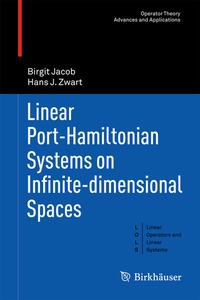
Linear Port-Hamiltonian Systems on Infinite-dimensional Spaces
Description

This book provides a self-contained introduction to the theory of infinite-dimensional systems theory and its applications to port-Hamiltonian systems. The textbook starts with elementary known results, then progresses smoothly to advanced topics in current research.
Many physical systems can be formulated using a Hamiltonian framework, leading to models described by ordinary or partial differential equations. For the purpose of control and for the interconnection of two or more Hamiltonian systems it is essential to take into account this interaction with the environment. This book is the first textbook on infinite-dimensional port-Hamiltonian systems. An abstract functional analytical approach is combined with the physical approach to Hamiltonian systems. This combined approach leads to easily verifiable conditions for well-posedness and stability.
The book is accessible to graduate engineers and mathematicians with a minimal background in functional analysis. Moreover, the theory is illustrated by many worked-out examples.
Reviews / Votes
From the reviews:
"This is an extremely well written monograph, which takes care to make the topic accessible to a vast audience of master's students and also beginning Ph.D. students, as well as researchers who want an introduction to the topic of the mathematical theory of the control of systems of evolution equations. . provide an insight into some fundamental definitions and results through a concise tutorial which focuses on linear systems of evolution equations, their systems properties and their relation with the dynamical models of physical systems." (Bernhard M. Maschke, Mathematical Reviews, August, 2013)More details
Other editions
Additional editions
Persons
Birgit Jacob received the M.Sc. degree in mathematics from the University of Dortmund in 1992 and the Ph.D. degree in mathematics from the University of Bremen in 1995. She held postdoctoral and professor positions at the universities of Twente, Leeds, Paderborn, at Berlin University of Technology and at Delft University of Technology. Since 2010, she has been with the University of Wuppertal, Germany, where she is a full professor in analysis. Her current research interests include the area of infinite-dimensional systems and operator theory, particularly well-posed linear systems and port-Hamiltonian systems.
Hans Zwart received his Master degree in 1984 and his Ph.D. degree in 1988, both in mathematics at the University of Groningen. Since 1988 he has been working at the Applied Mathematics Department, University of Twente, Enschede, The Netherlands. His research interests include analysis, controller design, and approximations of infinite-dimensional systems, in particular of port-Hamiltoninan systems.
