

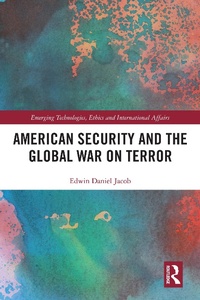
American Security and the Global War on Terror
1st Edition
Published on 8. April 2020
152 pages
978-1-000-06266-3 (ISBN)
Description

This book delivers an interpretive framework for making sense of today's geopolitical landscape and casts new light on the impact ideology and technology have had on American foreign policy and contemporary security practices.
Edwin Daniel Jacob argues that America's security practices in the Global War on Terror have been guided by an anachronistic Cold War logic that has subordinated strategy to tactics. Jacob shows that deep-rooted prejudices and presuppositions regarding American exceptionalism have had a disastrous impact on the policies of the United States, not only in dealing with terrorism, but also in seeking to impose American hegemony in the Middle East. Ineffectual security practices of dubious moral character, from rendition and torture to preemptive strikes and nation building to drones and assassinations, privilege exigency over ethics. Yet the result of this "post-strategic" approach to security, where interchangeable tactics, like these, masquerade as strategy, only increases insecurity. Jacob offers a fresh perspective on American foreign policy that links national security with human security in regional terms. This approach highlights the need for order, predictability, and stability-the cornerstone of political realism.
Making use of insights derived from Machiavelli, Hobbes, Marx, Weber, Schmitt, and Morgenthau, this interdisciplinary work provides an overview of American foreign policy in the twenty-first century and speaks to crucial themes in the fields of history, political science, and sociology.
Edwin Daniel Jacob argues that America's security practices in the Global War on Terror have been guided by an anachronistic Cold War logic that has subordinated strategy to tactics. Jacob shows that deep-rooted prejudices and presuppositions regarding American exceptionalism have had a disastrous impact on the policies of the United States, not only in dealing with terrorism, but also in seeking to impose American hegemony in the Middle East. Ineffectual security practices of dubious moral character, from rendition and torture to preemptive strikes and nation building to drones and assassinations, privilege exigency over ethics. Yet the result of this "post-strategic" approach to security, where interchangeable tactics, like these, masquerade as strategy, only increases insecurity. Jacob offers a fresh perspective on American foreign policy that links national security with human security in regional terms. This approach highlights the need for order, predictability, and stability-the cornerstone of political realism.
Making use of insights derived from Machiavelli, Hobbes, Marx, Weber, Schmitt, and Morgenthau, this interdisciplinary work provides an overview of American foreign policy in the twenty-first century and speaks to crucial themes in the fields of history, political science, and sociology.
Reviews / Votes
"American Security and the Global War on Terror offers a sharp critique of the approaches that have shaped United States security policy in the aftermath of September 11. Jacob explains how the cold war legacy of realism and subsequent dysfunctional perspectives-neoconservatism, neoliberalism, and Trump's misnamed "principled realism"- fed deepening Middle East conflict while leaving intact the roots of the terrorist threat. His compelling human security approach transcends ahistorical, "value neutral," and reactive policies, adapting to the diverse challenges of different regions. This incisive book will stimulate much needed intellectual reflection on the future of security studies in academic and policy circles." - Micheline Ishay, Professor, University of Denver, USA; and author of The Levant Express: The Arab Uprisings, Human Rights and the Future of the Middle East."This book expertly analyzes how Washington has remained constrained in a Cold War straightjacket over the past three decades, a prisoner of outmoded state-centric thinking. However, the book also proffers suggestions on how Washington could cut these mental chains, for the betterment of their own interests as well as those of the world." - Peter Hough, Associate Professor in International Politics, Middlesex University, UK; and Author of Understanding Global Security.
"In American Security and the Global War on Terror, Edwin Daniel Jacob provides a tightly focused, well documented critique of America's incoherent, self-defeating post-9/11 foreign policies and the misconceived theories of international relations that gave them birth. Jacob shows convincingly that the "global war on terror" reflects a collapse of strategic thought as well as a mistaken reliance on outmoded Cold War and nation-state concepts. Equally unsparing of neo-conservative and liberal interventionist nostrums, this imaginative study calls for a new appreciation of post-imperial social realities and ethical imperatives in the making of US foreign policy." - Richard Rubenstein, Professor, School for Conflict Analysis and Resolution at George Mason University, USA; and Author of Reasons to Kill: Why Americans Go To War (2010).
More details
Edition
1. Auflage
Language
English
Place of publication
London
United Kingdom
Publishing group
Taylor & Francis Ltd
Target group
College/higher education
ISBN-13
978-1-000-06266-3 (9781000062663)
Copyright in bibliographic data and cover images is held by Nielsen Book Services Limited or by the publishers or by their respective licensors: all rights reserved.
Schweitzer Classification
Other editions
Additional editions
Edwin Jacob
American Security and the Global War on Terror
Book
12/2021
1st Edition
Routledge
€64.70
Shipment within 10-20 days
Edwin Jacob
American Security and the Global War on Terror
Book
04/2020
1st Edition
Routledge
€179.51
Shipment within 15-20 days
Person
Dr. Edwin Daniel Jacob is a Post-Doctoral Research Fellow with the School for Conflict Analysis and Resolution at George Mason University. Dr. Jacob has published various works on security in popular and scholastic forms. His unique collection, Rethinking Security in the Twenty-First Century was published in 2017.
Content
Chapter 1 - Meditations on the Abyss: America's Imperial Illusions Chapter 2 - Past Prologue: Understanding Security in an Age of Terror hapter 3 - A Tragedy of Errors: Neo-conservatism, 9/11, and Iraq Chapter 4 - Not Fade Away: Revolving Actors and Evolving Tactics Under Obama Chapter 5 - Confronting the Abyss: Towards a Twenty-First-Century American Security
