

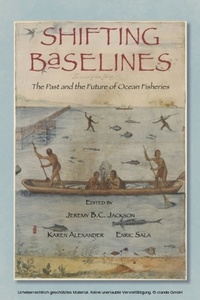
Shifting Baselines
Description

Shifting Baselines explores the real-world implications of a groundbreaking idea: we must understand the oceans of the past to protect the oceans of the future. In 1995, acclaimed marine biologist Daniel Pauly coined the term "shifting baselines" to describe a phenomenon of lowered expectations, in which each generation regards a progressively poorer natural world as normal. This seminal volume expands on Pauly's work, showing how skewed visions of the past have led to disastrous marine policies and why historical perspective is critical to revitalize fisheries and ecosystems. Edited by marine ecologists Jeremy Jackson and Enric Sala, and historian Karen Alexander, the book brings together knowledge from disparate disciplines to paint a more realistic picture of past fisheries. The authors use case studies on the cod fishery and the connection between sardine and anchovy populations, among others, to explain various methods for studying historic trends and the intricate relationships between species. Subsequent chapters offer recommendations about both specific research methods and effective management. This practical information is framed by inspiring essays by Carl Safina and Randy Olson on a personal experience of shifting baselines and the importance of human stories in describing this phenomenon to a broad public. While each contributor brings a different expertise to bear, all agree on the importance of historical perspective for effective fisheries management. Readers, from students to professionals, will benefit enormously from this informed hindsight.
All prices
More details
Other editions
Additional editions
Persons
Content
Introduction: The Importance of Shifting Baselines
Jeremy B. C. Jackson and Karen E. Alexander
PART I. THE PROBLEM DEFINED
Chapter 1. A Shoreline Remembrance
Carl Safina
Chapter 2. The "March of Folly" in Global Fisheries
U. Rashid Sumaila and Daniel Pauly
Chapter 3. If a Frond Falls in the Kelp Forest (does it make any sound?)
Randy Olson
PART II. ANCHOVIES AND SARDINES
Chapter 4. The Sardine-Anchovy Puzzle
Alec D. Maccall
Chapter 5. Variations in Fisheries and Complex Ocean Environments
David B. Field, Francisco Chavez, Carina B. Lange, and Paul E. Smith
PART III. COD
Chapter 6. The Historical Abundance of Cod on the Nova Scotian Shelf
W. Jeffrey Bolster, Karen E. Alexander, and William B. Leavenworth
Chapter 7. History and Context: Reflections from Newfoundland
Daniel Vickers, with Loren McClenachan
PART IV. METHODS IN HISTORICAL MARINE ECOLOGY
Chapter 8. Uncovering the Ocean's Past
Heike K. Lotze, Jon M. Erlandson, Marah J. Hardt, Richard D. Norris, Kaustuv Roy, Tim D. Smith, and Christine R. Whitcraft
Chapter 9. Whales, Logbooks, and DNA
Stephen R. Palumbi
PART V. FROM FISHERIES MANAGEMENT TO ECOSYSTEMS
Chapter 10. Management in the Gulf of Maine
Andrew A. Rosenberg, Karen E. Alexander, and Jamie M. Cournane
Chapter 11. Lessons from Coral Reefs
Enric Sala and Jeremy B. C. Jackson
Epilogue: Shifting Baselines for the Future
Jeremy B. C. Jackson and Karen E. Alexander
Notes
Contributors
Index

