

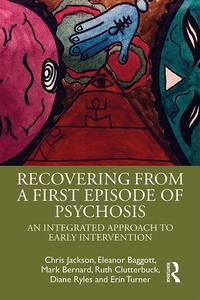
Recovering from a First Episode of Psychosis
An Integrated Approach to Early Intervention
Published on 7. May 2019
396 pages
978-1-315-46071-0 (ISBN)
Description

Despite years of research, debate and changes in mental health policy, there is still a lack of consensus as to what recovery from psychosis actually means, how it should be measured and how it may ultimately be achieved. In Recovering from a First Episode of Psychosis: An Integrated Approach to Early Intervention, it is argued that recovery from a first episode of psychosis (FEP) is comprised of three core elements: symptomatic, social and personal. Moreover, all three types of recovery need to be the target of early intervention for psychosis programmes (EIP) which provide evidence-based, integrated, bio-psychosocial interventions delivered in the context of a value base offering hope, empowerment and a youth-focused approach.
Over the 12 chapters in the book, the authors, all experienced clinicians and researchers from multi-professional backgrounds, demonstrate that long-term recovery needs to replace short term remission as the key target of early psychosis services and that, to achieve this, we need a change in the way we deliver EIP: one that takes account of the different stages of psychosis and the 'bespoke' targeting of integrated medical, psychological and social treatments during the 'critical period'.
Illustrated with a wealth of clinical examples, this book will be of great interest to clinical psychologists, psychiatrists, psychiatric nurses and other associated mental health professionals.
Over the 12 chapters in the book, the authors, all experienced clinicians and researchers from multi-professional backgrounds, demonstrate that long-term recovery needs to replace short term remission as the key target of early psychosis services and that, to achieve this, we need a change in the way we deliver EIP: one that takes account of the different stages of psychosis and the 'bespoke' targeting of integrated medical, psychological and social treatments during the 'critical period'.
Illustrated with a wealth of clinical examples, this book will be of great interest to clinical psychologists, psychiatrists, psychiatric nurses and other associated mental health professionals.
Reviews / Votes
"This extraordinary state-of-the-art book distils the accumulated clinical and practical experience from the UK's pioneers of Early Intervention in Psychosis in Birmingham.It is replete with varied and incisive case material covering all aspects of recovery; and does so combining science and evidence with compassion and amazing skill. This is a must-read for all practitioners working with psychosis."
Max Birchwood, Professor of Youth Mental Health, University of Warwick
"This book reminds readers of the central purpose of early intervention services... to secure meaning to the lives of people experiencing psychosis for the first time.
Concepts of recovery are explored in a well-constructed manual that successfully blends evidence-based practice with practice-based evidence, informed by the experience of this book's authors in delivering these services over the last two decades."
Dr. David Shiers, OBE, Retired GP and former joint national lead for EIP
"This excellent new book provides up-to-date evidence of how Early Intervention services have revolutionised the treatment of psychosis by providing a framework for the delivery of evidence-based interventions, embedded within a philosophy of hope and recovery. Moreover, this book challenges us to adjust our focus from early intervention to full, sustained, long-term recovery. It provides a compelling vision of an integrated system which engages effectively and enables rapid access to individualised treatment, without the need for compulsion. A vision worth pursuing."
Stephen 'Moggie' McGowan, Chair of IRIS (Initiative to Reduce the Impact of Schizophrenia) and Clinical Lead for Yorkshire and Humberside EIP and NHS England 'This extraordinary state-of-the-art book distils the accumulated clinical and practical experience from the UK's pioneers of Early Intervention in Psychosis in Birmingham. It is replete with varied and incisive case material covering all aspects of recovery; and does so combining science and evidence with compassion and amazing skill. This is a must-read for all practitioners working with psychosis.'
Max Birchwood, Professor of Youth Mental Health, University of Warwick
'This book reminds readers of the central purpose of early intervention services... to secure meaning to the lives of people experiencing psychosis for the first time. Concepts of recovery are explored in a well-constructed manual that successfully blends evidence-based practice with practice-based evidence, informed by the experience of this book's authors in delivering these services over the last two decades.'
Dr. David Shiers, OBE, retired GP and former joint national lead for EIP
'This excellent new book provides up-to-date evidence of how Early Intervention services have revolutionised the treatment of psychosis by providing a framework for the delivery of evidence-based interventions, embedded within a philosophy of hope and recovery. Moreover, this book challenges us to adjust our focus from early intervention to full, sustained, long-term recovery. It provides a compelling vision of an integrated system which engages effectively and enables rapid access to individualised treatment, without the need for compulsion. A vision worth pursuing.'
Stephen 'Moggie' McGowan, Chair of IRIS (Initiative to Reduce the Impact of Schizophrenia) and Clinical Lead for Yorkshire and Humberside EIP and NHS England
More details
Language
English
Place of publication
London
United Kingdom
Publishing group
Taylor & Francis Ltd
Target group
College/higher education
Professional and scholarly
Product notice
Reflowable
Illustrations
37 Tables, black and white; 9 Halftones, black and white
File size
6,24 MB
ISBN-13
978-1-315-46071-0 (9781315460710)
Copyright in bibliographic data and cover images is held by Nielsen Book Services Limited or by the publishers or by their respective licensors: all rights reserved.
Schweitzer Classification
Other editions
Additional editions
Chris Jackson | Eleanor Baggott | Mark Bernard
Recovering from a First Episode of Psychosis
An Integrated Approach to Early Intervention
Book
05/2019
1st Edition
Routledge
€54.20
Shipment within 10-20 days

Chris Jackson | Eleanor Baggott | Mark Bernard
Recovering from a First Episode of Psychosis
An Integrated Approach to Early Intervention
Book
05/2019
1st Edition
Routledge
€234.20
Shipment within 10-20 days
Persons
Chris Jackson is a consultant clinical psychologist and clinical lead for the Birmingham EIP service, Forward Thinking Birmingham. He has been involved in the development of psychological therapies for FEP for the last 25 years and has co-authored books on schizophrenia and early intervention approaches to first episode psychosis. His current interests include recovery, suicide prevention and emotional dysfunction following FEP, as well as refining the delivery of EIP services.
Eleanor Baggott is a UK-trained clinical psychologist. She worked at Birmingham and Solihull EIP for five years before emigrating to New Zealand. She is currently the senior clinical psychologist at Totara House, the EIP service in Christchurch, and sits on the executive committee of the NZ EIP Society. She has a special interest in working with families and using mindfulness and acceptance-based approaches.
Mark Bernard is a principal clinical psychologist in the North Birmingham Early Intervention Psychosis Team within Forward Thinking Birmingham, UK. His current interests include the application of psychological approaches following first episode psychosis, the use of Routine Outcome Measures within Early Intervention Psychosis services, and the development of clinical pathways for At Risk Mental States.
Ruth Clutterbuck is a senior clinical psychologist in the East Birmingham Early Intervention for Psychosis Team, Forward Thinking Birmingham, UK. She has a special interest in social recovery following a first episode psychosis and leads on social recovery strategy for Birmingham EIP services.
Diane Ryles qualified as a mental health nurse in North Staffordshire 28 years ago. She was an original member of the West Midlands IRIS group and worked in Birmingham EIP for 14 years as a care co-ordinator, lead nurse and manager. She is now the matron for recovery services, and a trainer in family work and suicide prevention. She is also a carer for a relative with psychosis.
Erin Turner is a consultant psychiatrist in the Early Intervention for Psychosis Service, Solihull, UK, Co-chair of West Midlands EIP Expert Advisory Group and trustee of mental health charity 'Beyond Shame, Beyond Stigma'. She led the development of the 'Silver Linings' app for young people recovering from psychosis and is a board member of HEARTH, Theatre Company. Her interests include promoting collaborative compassionate care and using the arts to reduce stigma and demystify psychosis.
Eleanor Baggott is a UK-trained clinical psychologist. She worked at Birmingham and Solihull EIP for five years before emigrating to New Zealand. She is currently the senior clinical psychologist at Totara House, the EIP service in Christchurch, and sits on the executive committee of the NZ EIP Society. She has a special interest in working with families and using mindfulness and acceptance-based approaches.
Mark Bernard is a principal clinical psychologist in the North Birmingham Early Intervention Psychosis Team within Forward Thinking Birmingham, UK. His current interests include the application of psychological approaches following first episode psychosis, the use of Routine Outcome Measures within Early Intervention Psychosis services, and the development of clinical pathways for At Risk Mental States.
Ruth Clutterbuck is a senior clinical psychologist in the East Birmingham Early Intervention for Psychosis Team, Forward Thinking Birmingham, UK. She has a special interest in social recovery following a first episode psychosis and leads on social recovery strategy for Birmingham EIP services.
Diane Ryles qualified as a mental health nurse in North Staffordshire 28 years ago. She was an original member of the West Midlands IRIS group and worked in Birmingham EIP for 14 years as a care co-ordinator, lead nurse and manager. She is now the matron for recovery services, and a trainer in family work and suicide prevention. She is also a carer for a relative with psychosis.
Erin Turner is a consultant psychiatrist in the Early Intervention for Psychosis Service, Solihull, UK, Co-chair of West Midlands EIP Expert Advisory Group and trustee of mental health charity 'Beyond Shame, Beyond Stigma'. She led the development of the 'Silver Linings' app for young people recovering from psychosis and is a board member of HEARTH, Theatre Company. Her interests include promoting collaborative compassionate care and using the arts to reduce stigma and demystify psychosis.
Content
Foreword: From psychosis to politics Foreword: A carer's experience 1. The first episode of psychosis and how EIP services have evolved to optimise adaptation and recovery 2. Adapting, adjusting and recovering from a first episode of psychosis: the need for integration 3. Biological and medical approaches to symptomatic recovery and adaptation 4. Psychosocial approaches to symptomatic recovery and adaptation 5. Social recovery in first episode psychosis 6. Treatment approaches to social recovery in first episode psychosis 7. Optimising personal recovery and promoting psychological adaptation following first episode psychosis 8. When psychological adaptation and recovery go wrong 9. Identifying and managing suicidality following a first episode of psychosis 10. Working with comorbidity and diagnostic uncertainty 11. Family adaptation and recovery following FEP 12. Integrating and operationalising symptomatic, social and personal recovery: managing EIP and pathways of care Conclusion Appendix 1 Appendix 2
