

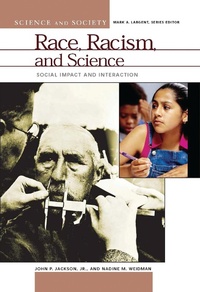
Race, Racism, and Science
Social Impact and Interaction
Published on 13. October 2004
424 pages
978-1-85109-453-0 (ISBN)
Description

A provocative overview of the history of the race concept in European and American science, based on current research that shows how race and science grew together in Western thought.
What, historically, has the term 'race' meant? What is the relationship between the scientific study of race and racism? Race, Racism, and Science: Social Impact and Interaction explores these questions as it recaps the history of race-centered research from its origins in the late 1700s to Darwin's influential work on natural selection to the present. It is a compelling introduction to the way race science initially gained acceptance and how race studies both reflect and shape their times.
Readers will see how scientific and pseudoscientific explanations of racial differences (social Darwinism, eugenics, craniometry, scientific racism) provided intellectual cover for inhuman acts, and how Ashley Montagu, Richard Lewontin, and other 20th-century antiracists fought to refute the scientific support of bigotry.
What, historically, has the term 'race' meant? What is the relationship between the scientific study of race and racism? Race, Racism, and Science: Social Impact and Interaction explores these questions as it recaps the history of race-centered research from its origins in the late 1700s to Darwin's influential work on natural selection to the present. It is a compelling introduction to the way race science initially gained acceptance and how race studies both reflect and shape their times.
Readers will see how scientific and pseudoscientific explanations of racial differences (social Darwinism, eugenics, craniometry, scientific racism) provided intellectual cover for inhuman acts, and how Ashley Montagu, Richard Lewontin, and other 20th-century antiracists fought to refute the scientific support of bigotry.
More details
Series
Language
English
Place of publication
Oxford
United Kingdom
Target group
Adult education
Interest Age: From 7 to 17 years
Illustrations
45 bw illus
File size
4,53 MB
ISBN-13
978-1-85109-453-0 (9781851094530)
Copyright in bibliographic data and cover images is held by Nielsen Book Services Limited or by the publishers or by their respective licensors: all rights reserved.
Schweitzer Classification
Other editions
Additional editions
John P. Jackson | Nadine M. Weidman | Mark A. Largent
Race, Racism, and Science
Social Impact and Interaction
Book
10/2004
ABC-CLIO
€106.66
Article exhausted; check different version
Persons
John P. Jackson, Jr., PhD, teaches in the Department of Communication at the University of Colorado Boulder, Boulder, CO.
Nadine M. Weidman, PhD, teaches history of science at the Harvard University Extension School in Cambridge, MA.
Nadine M. Weidman, PhD, teaches history of science at the Harvard University Extension School in Cambridge, MA.
Content
- Cover
- Contents
- Series Editor's Preface
- Prologue
- Asking Questions and Defining Terms
- 1 The Origins of Racial Science, Antiquity-1800
- Was There Race in Antiquity?
- The Curse of Ham and Medieval Racial Thought
- The Age of Exploration
- Natural Philosophy and the Colonial Experience: The Sixteenth and Seventeenth Centuries
- The Science of Anthropology
- The Atlantic Slave System
- Enlightenment Values and Racial Thought
- Conclusion
- Bibliographic Essay
- 2 The Establishment of Racial Typology, 1800-1859
- The Reign of Monogenism: Prichard and Lawrence
- Steps toward Polygenesis
- American Polygenism: Morton, Nott, and Gliddon
- Polygenism in the Land of Prichard
- Conclusion
- Bibliographic Essay
- 3 Race and Evolution, 1859-1900
- Darwin's Argument in On the Origin of Species
- Darwin and Wallace on Natural Selection and Human Origins
- Darwin on Human Evolution
- Physical Anthropology and the Persistence of Polygenism
- Spencer and Evolution
- Spencer on the Savage Mind
- Social Darwinism and Its Variants
- Social Darwinism in Germany
- Sociocultural Evolutionism in Britain
- Bibliographic Essay
- 4 The Hardening of Scientific Racism, 1900-1945
- The Problem of Heredity
- Francis Galton
- Hard Heredity
- The Rise of Nordicism
- Nordicism and Civilization
- The Supremacy of Nordics
- The Rise of Eugenics
- Eugenics and Race in the United States
- German Rassenhygiene
- Bibliographic Essay
- 5 The Retreat of Scientific Racism, 1890-1940
- Boas and the Culture Concept
- Boasian Anthropology and Black Folklore
- Psychologists and the Critique of IQ Testing
- From Race Psychology to Studies in Prejudice
- Genetics and the Critique of Eugenics
- Bibliographic Essay
- 6 The Liberal Orthodoxy, 1940-1960
- The Geneticists' Manifesto
- Wartime Antiracism: Benedict, Montagu, and Dunn and Dobzhansky
- Experts in Prejudice
- An American Dilemma
- The Post-Myrdal Liberal Orthodoxy
- The Damage Argument
- The Breakdown of the Liberal Orthodoxy
- The UNESCO Statements on Race
- Bibliographic Essay
- 7 A Multicultural Science of Race, 1965 to the Present
- Movement Scholarship
- The Rejection of the Pathology of Black Culture
- Institutional Racism and Colonialism
- Genetics, New Physical Anthropology, and the Abandonment of Race
- Forward to the Past: The Psychometrician Case for Race Differences
- Psychometrics, Intelligence, and Heritability
- Geneticists versus the Psychometricians
- The Psychometricians versus Scholars of Institutional Racism
- Psychometric Case for Policy
- Bibliographic Essay
- Chronology
- Glossary
- Documents
- On the Natural Varieties of Mankind
- Notes on the State of Virginia, Chapter 6
- The Races of Man
- The Descent of Man, and Selection in Relation to Sex
- The Races of Europe: A Sociological Study
- Old and New Aspects of the Aryan Question
- Dominant Race among the Primitive Aryan Peoples
- The Passing of the Great Race, or the Racial Basis of European History
- The Competition of Races
- New Evidence in Regard to the Instability of Human Types
- A Study of American Intelligence
- Section VIII The Race Hypothesis
- Section IX Re-Examination of Previous Conclusions in the Light of the Race Hypothesis
- The Racial Elements of European History
- The Nordic Ideal-a Result of the Anthropological View of History
- The Effects of Segregation and the Consequences of Desegregation: A Social Science Statement
- I
- Definitions
- II
- III
- IV
- The Study of Race
- Black Science and Nation-Building
- Examples of Inapplicable White Experience Models and Theories: An Assimilation Theory
- The Consumer Sovereignty Theory
- The Deferred Gratification Theory
- The Multidisciplinary Approach to the Black Experience
- From the Sociological Perspective
- From the Psychological Perspective
- From the Political Perspective
- From the Economic Perspective
- Conclusion
- American Anthropological Association Statement on "Race"
- AAA Position Paper on "Race": Comments?
- Bibliography
- Primary Sources
- Secondary Sources
- Index
- About the Authors
