

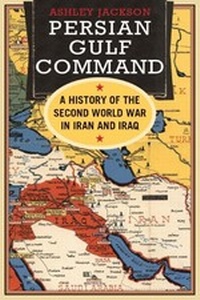
Persian Gulf Command
A History of the Second World War in Iran and Iraq
1st Edition
Published on 26. June 2018
352 pages
978-0-300-23536-4 (ISBN)
Description

"
Offers us a fascinating new perspective on the Second World War-its impact on local societies in the Middle East." (Richard J. Aldrich, author of
The Black Door)
This dynamic history is the first to construct a total picture of the experience and impact of World War II in Iran and Iraq. Contending that these two countries were more important to the Allied forces' war operations than has ever been acknowledged, historian Ashley Jackson investigates the grand strategy of the Allies and their operations in the region and the continuing legacy of Western intervention in the Middle East.
Iran and Iraq served as the first WWII theater in which the U.S., the U.K., and the U.S.S.R. fought alongside each other. Jackson charts the intense Allied military activity in Iran and Iraq and reveals how deeply the war impacted common people's lives. He also provides revelations about the true nature of Anglo-American relations in the region, the beginnings of the Cold War, and the continuing corrosive legacy of Western influence in these lands.
"Skillfully brings together the complex range of developments that took place in Iraq and Iran during the Second World War." -Evan Mawdsley, author of December 1941
"A brilliant book that confirms Ashley Jackson's place among the preeminent scholars of the British empire." -Joe Maiolo, author of Cry Havoc
"Consistently fascinating and thought-provoking." -Simon Ball, author of The Bitter Sea
"In this lucid work, filled with telling details and well-crafted arguments, Jackson has finally revealed the undoubted significance of Iran and Iraq to the wider war." -NiallBarr, author of Eisenhower's Armies
This dynamic history is the first to construct a total picture of the experience and impact of World War II in Iran and Iraq. Contending that these two countries were more important to the Allied forces' war operations than has ever been acknowledged, historian Ashley Jackson investigates the grand strategy of the Allies and their operations in the region and the continuing legacy of Western intervention in the Middle East.
Iran and Iraq served as the first WWII theater in which the U.S., the U.K., and the U.S.S.R. fought alongside each other. Jackson charts the intense Allied military activity in Iran and Iraq and reveals how deeply the war impacted common people's lives. He also provides revelations about the true nature of Anglo-American relations in the region, the beginnings of the Cold War, and the continuing corrosive legacy of Western influence in these lands.
"Skillfully brings together the complex range of developments that took place in Iraq and Iran during the Second World War." -Evan Mawdsley, author of December 1941
"A brilliant book that confirms Ashley Jackson's place among the preeminent scholars of the British empire." -Joe Maiolo, author of Cry Havoc
"Consistently fascinating and thought-provoking." -Simon Ball, author of The Bitter Sea
"In this lucid work, filled with telling details and well-crafted arguments, Jackson has finally revealed the undoubted significance of Iran and Iraq to the wider war." -NiallBarr, author of Eisenhower's Armies
More details
Other editions
Additional editions
Book
05/2018
Yale University Press
€28.50
Article not available at the moment
Person
Ashley Jackson is professor of imperial and military history, King's College, London, and visiting fellow at Kellogg College, Oxford. He has published extensively on the British Empire in times of war. He lives in Oxfordshire, UK.
Content
- Cover page
- Halftitle page
- Title page
- Copyright
- Dedication
- CONTENTS
- ILLUSTRATIONS
- PREFACE AND ACKNOWLEDGEMENTS
- Map
- INTRODUCTION
- CHAPTER 1 Iran, Iraq and the great powers
- German influence in Iran and Iraq
- Iran, Reza Shah's regime and the great powers
- Iran and the coming of war
- Britain, Arab nationalism and the Iraqi state
- America in Iran
- Britain and the challenges of imperial overstretch
- CHAPTER 2 Defending Iran and Iraq
- CHAPTER 3 Towards the Iraqi coup
- Rashid Ali's coup
- CHAPTER 4 Iraq goes to war
- Wavell wavers
- The siege is lifted
- CHAPTER 5 Fallujah and the advance on Baghdad
- The embassy siege
- Breakout from Habbaniya and the capture of Fallujah
- To Baghdad
- Accounting for Iraq's defeat
- The Farhud
- CHAPTER 6 Mopping up and de-Nazification
- Casualties and compensation
- Showing the flag, mopping up and invading Syria
- De-Nazifying Iraq
- CHAPTER 7 Barbarossa and Iran
- CHAPTER 8 Anglo-Soviet invasion
- The troops go in in the south
- The British attack in the north
- CHAPTER 9 Abdication and occupation
- The shah's procrastination
- Abdication and the occupation of Tehran
- Britain and the new shah
- Troubles in Kurdistan
- Quinan's tasks
- Differences with the Soviets
- American involvement
- CHAPTER 10 The consequences of occupation
- Theft, petty sabotage and ambushes
- Crimes committed by allied forces
- Murders and unexplained deaths
- Cash and employment
- The East Persian Auxiliary Transport Service
- CHAPTER 11 War and the home front
- Inflation and the cost of living
- Food and hoarding
- Trucks and tyres
- The December 1942 riots
- The Polish refugees
- CHAPTER 12 Churchill's new command
- The oil review, July 1942
- Reinforcements: Iran and Iraq trump Egypt
- Churchill's desert sojourn
- The choice of commander
- CHAPTER 13 'Jumbo' and the Germans
- PAIC's composition and plans to fight the Germans
- Scorched earth and special forces
- German plans
- The Qashqai and German agents
- The threat passes
- CHAPTER 14 The Persian corridor
- The challenge of aiding the Soviet Union
- The work of Persian Gulf Command troops
- Soldiers' complaints
- CHAPTER 15 An allied battleground
- America in Iran
- American suspicions and British reactions
- Parliamentary elections and the shah
- Problems with the Soviets
- US civil-military relations and the Hurley-Roosevelt exchange
- The intensification of allied competition
- CHAPTER 16 War's end
- Winding down the Persian corridor
- Looking to the post- war future
- The consequences for Iran and Iraq
- ENDNOTES
- SOURCES AND BIBLIOGRAPHY
- INDEX
