

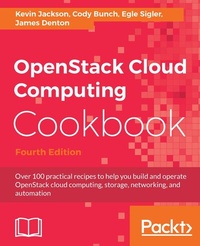
OpenStack Cloud Computing Cookbook
Over 100 practical recipes to help you build and operate OpenStack cloud computing, storage, networking, and automation
4th Edition
Published on 3. June 2024
398 pages
978-1-78839-933-3 (ISBN)
Description

The Fourth Edition of the industry-acclaimed OpenStack Cloud Computing Cookbook, from four recognized experts, updated to the latest OpenStack build including Cinder, Nova, and Neutron.Key Features - Over 100 recipes created by a team of OpenStack experts
- Updated to work with the latest OpenStack builds, with recipes covering the installation and use of OpenStack with Ansible
- It covers topics such as Keystone, Glance, Neutron, Nova, Cinder, and more, plus recipes for OpenStack storage, networking, and orchestrating workloads
- Test drive OpenStack using the accompanying Vagrant environment
Book DescriptionThis is the fourth edition of the industry-acclaimed OpenStack Cloud Computing Cookbook, created by four recognized OpenStack experts. It has now been updated to work with the latest OpenStack builds, using tools and processes based on their collective and vast OpenStack experience. OpenStack Open Source Cloud software is one of the most used cloud infrastructures to support a wide variety of use cases, from software development to big data analysis. It is developed by a thriving community of individual developers from around the globe and backed by most of the leading players in the cloud space today. We make it simple to implement, massively scalable, and able to store a large pool of data and networking resources. OpenStack has a strong ecosystem that helps you provision your cloud storage needs. Add OpenStack's enterprise features to reduce the cost of your business. This book will begin by showing you the steps to build up an OpenStack private cloud environment using Ansible. You'll then discover the uses of cloud services such as the identity service, image service, and compute service. You'll dive into Neutron, the OpenStack Networking service, and get your hands dirty with configuring networks, routers, load balancers, and more. You'll then gather more expert knowledge on OpenStack cloud computing by managing your cloud's security and migration. After that, we delve into OpenStack Object storage and you'll see how to manage servers and work with objects, cluster, and storage functionalities. Finally, you will learn about OpenStack dashboard, Ansible, Keystone, and other interesting topics.What you will learn - Understand, install, configure, and manage a complete OpenStack Cloud platform using OpenStack-Ansible
- Configure networks, routers, load balancers, and more with Neutron
- Use Keystone to setup domains, roles, groups and user access
- Learn how to use Swift and setup container access control lists
- Gain hands-on experience and familiarity with Horizon, the OpenStack Dashboard user interface
- Automate complete solutions with our recipes on Heat, the OpenStack Orchestration service as well as using Ansible to orchestrate application workloads
- Follow practical advice and examples to run OpenStack in production
Who this book is forThis book is written for cloud system engineers, system administrators, and technical architects who are moving from a virtualized environment to cloud environments. This book assumes that you are familiar with cloud computing platforms, and have knowledge of virtualization, networking, and managing Linux environments.
- Updated to work with the latest OpenStack builds, with recipes covering the installation and use of OpenStack with Ansible
- It covers topics such as Keystone, Glance, Neutron, Nova, Cinder, and more, plus recipes for OpenStack storage, networking, and orchestrating workloads
- Test drive OpenStack using the accompanying Vagrant environment
Book DescriptionThis is the fourth edition of the industry-acclaimed OpenStack Cloud Computing Cookbook, created by four recognized OpenStack experts. It has now been updated to work with the latest OpenStack builds, using tools and processes based on their collective and vast OpenStack experience. OpenStack Open Source Cloud software is one of the most used cloud infrastructures to support a wide variety of use cases, from software development to big data analysis. It is developed by a thriving community of individual developers from around the globe and backed by most of the leading players in the cloud space today. We make it simple to implement, massively scalable, and able to store a large pool of data and networking resources. OpenStack has a strong ecosystem that helps you provision your cloud storage needs. Add OpenStack's enterprise features to reduce the cost of your business. This book will begin by showing you the steps to build up an OpenStack private cloud environment using Ansible. You'll then discover the uses of cloud services such as the identity service, image service, and compute service. You'll dive into Neutron, the OpenStack Networking service, and get your hands dirty with configuring networks, routers, load balancers, and more. You'll then gather more expert knowledge on OpenStack cloud computing by managing your cloud's security and migration. After that, we delve into OpenStack Object storage and you'll see how to manage servers and work with objects, cluster, and storage functionalities. Finally, you will learn about OpenStack dashboard, Ansible, Keystone, and other interesting topics.What you will learn - Understand, install, configure, and manage a complete OpenStack Cloud platform using OpenStack-Ansible
- Configure networks, routers, load balancers, and more with Neutron
- Use Keystone to setup domains, roles, groups and user access
- Learn how to use Swift and setup container access control lists
- Gain hands-on experience and familiarity with Horizon, the OpenStack Dashboard user interface
- Automate complete solutions with our recipes on Heat, the OpenStack Orchestration service as well as using Ansible to orchestrate application workloads
- Follow practical advice and examples to run OpenStack in production
Who this book is forThis book is written for cloud system engineers, system administrators, and technical architects who are moving from a virtualized environment to cloud environments. This book assumes that you are familiar with cloud computing platforms, and have knowledge of virtualization, networking, and managing Linux environments.
More details
Other editions
Additional editions
Kevin Jackson | Cody Bunch | Egle Sigler
OpenStack Cloud Computing Cookbook - Fourth Edition
Over 100 practical recipes to help you build and operate OpenStack cloud computing, storage, networking, and automation
Book
01/2018
Packt Publishing
€63.70
Shipment within 3-4 weeks
Persons
Jackson Kevin :
Kevin Jackson is married and has three children. He is an IT professional with over 20 years of experience, working with businesses and enterprises of all sizes at Rackspace, as an OpenStack and private cloud specialist. Kevin has been working with OpenStack since the fist release, and he has extensive experience of various flavors of Linux, Unix, and hosting environments. Kevin authored the fist edition of this book, and coauthored the second and third editions. Kevin also coauthored OpenStack Architecture Design Guide, OpenStack Foundation, during a 5-day book sprint in California. He also regularly speaks at OpenStack community events.Bunch Cody :
Cody Bunch is a principal architect in the Rackspace Private Cloud group, based out ofSigler Egle :
Egle Sigler is an OpenStack Foundation board member and a principal architect in the Rackspace Private Cloud group, based out of San Antonio, Texas. Egle holds an MS degree in computer science. She started her career as a software developer and still has a soft spot for all the people who write, test, and deploy code, since she has had the chance to do all of these tasks throughout her career. Egle dreams about a day when writing, testing, and deploying code will be a seamless and easy process-bug and frustration free for all. Egle believes that knowledge should be shared and has tried to do this by writing this book, giving talks and workshops at conferences, and blogging.Denton James :
James Denton is a Principal Architect at Rackspace with over 15 years of experience in systems administration and networking. He has a bachelor's degree in Business Management with a focus on Computer Information Systems from Texas State University in San Marcos, Texas. He is currently focused on OpenStack operations and support within the Rackspace Private Cloud team. James is the author of the Learning OpenStack Networking (Neutron), first and second editions, as well as OpenStack Networking Essentials, both by Packt Publishing.
Kevin Jackson is married and has three children. He is an IT professional with over 20 years of experience, working with businesses and enterprises of all sizes at Rackspace, as an OpenStack and private cloud specialist. Kevin has been working with OpenStack since the fist release, and he has extensive experience of various flavors of Linux, Unix, and hosting environments. Kevin authored the fist edition of this book, and coauthored the second and third editions. Kevin also coauthored OpenStack Architecture Design Guide, OpenStack Foundation, during a 5-day book sprint in California. He also regularly speaks at OpenStack community events.Bunch Cody :
Cody Bunch is a principal architect in the Rackspace Private Cloud group, based out ofSigler Egle :
Egle Sigler is an OpenStack Foundation board member and a principal architect in the Rackspace Private Cloud group, based out of San Antonio, Texas. Egle holds an MS degree in computer science. She started her career as a software developer and still has a soft spot for all the people who write, test, and deploy code, since she has had the chance to do all of these tasks throughout her career. Egle dreams about a day when writing, testing, and deploying code will be a seamless and easy process-bug and frustration free for all. Egle believes that knowledge should be shared and has tried to do this by writing this book, giving talks and workshops at conferences, and blogging.Denton James :
James Denton is a Principal Architect at Rackspace with over 15 years of experience in systems administration and networking. He has a bachelor's degree in Business Management with a focus on Computer Information Systems from Texas State University in San Marcos, Texas. He is currently focused on OpenStack operations and support within the Rackspace Private Cloud team. James is the author of the Learning OpenStack Networking (Neutron), first and second editions, as well as OpenStack Networking Essentials, both by Packt Publishing.
Content
Table of Contents - Installing OpenStack with Ansible
- The OpenStack Client
- Keystone - OpenStack Identity Service
- Neutron - OpenStack Networking
- Nova - OpenStack Compute
- Glance - OpenStack Image Service
- Cinder - OpenStack Block Storage
- Swift - OpenStack Object Storage
- OpenStack Orchestration Using Heat and Ansible
- Using OpenStack Dashboard
- The OpenStack Client
- Keystone - OpenStack Identity Service
- Neutron - OpenStack Networking
- Nova - OpenStack Compute
- Glance - OpenStack Image Service
- Cinder - OpenStack Block Storage
- Swift - OpenStack Object Storage
- OpenStack Orchestration Using Heat and Ansible
- Using OpenStack Dashboard
