

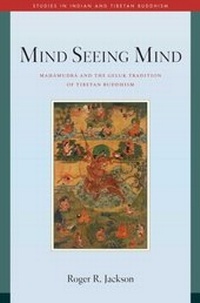
Mind Seeing Mind
Mahamudra and the Geluk Tradition of Tibetan Buddhism
1st Edition
Published on 29. October 2019
752 pages
978-1-61429-601-0 (ISBN)
Description

A definitive study of one of the most important practices in Tibetan Buddhism, with translations of a number of its key texts.
Mahamudra, the "great seal," refers to the ultimate nature of mind and reality, to a meditative practice for realizing that ultimate reality, and to the final fruition of buddhahood. It is especially prominent in the Kagyü tradition of Tibetan Buddhism, so it sometimes comes as a surprise that mahamudra has played an important role in the Geluk school, where it is part of a special transmission received in a vision by the tradition's founder, Tsongkhapa. Mahamudra is a significant component of Geluk ritual and meditative life, widely studied and taught by contemporary masters such as the Dalai Lama.
Roger Jackson's Mind Seeing Mind offers us both a definitive scholarly study of the history, texts, and doctrines of Geluk mahamudra and masterful translations of its seminal texts. It provides a skillful survey of the Indian sources of the teaching, illuminates the place of mahamudra among Tibetan Buddhist schools, and details the history and major textual sources of Geluk mahamudra. Jackson also addresses critical questions, such as the relation between Geluk and Kagyü mahamudra, and places mahamudra in the context of contemporary religious studies. The translation portion of Mind Seeing Mind includes ten texts on mahamudra history, ritual, and practice. Among these are the First Panchen Lama's root verses and autocommentary on mahamudra meditation, his ritual masterpiece Offering to the Guru, and a selection of his songs of spiritual experience.
Mind Seeing Mind adds considerably to our understanding of Tibetan Buddhist spirituality and shows how mahamudra came to be woven throughout the fabric of the Geluk tradition.
Mahamudra, the "great seal," refers to the ultimate nature of mind and reality, to a meditative practice for realizing that ultimate reality, and to the final fruition of buddhahood. It is especially prominent in the Kagyü tradition of Tibetan Buddhism, so it sometimes comes as a surprise that mahamudra has played an important role in the Geluk school, where it is part of a special transmission received in a vision by the tradition's founder, Tsongkhapa. Mahamudra is a significant component of Geluk ritual and meditative life, widely studied and taught by contemporary masters such as the Dalai Lama.
Roger Jackson's Mind Seeing Mind offers us both a definitive scholarly study of the history, texts, and doctrines of Geluk mahamudra and masterful translations of its seminal texts. It provides a skillful survey of the Indian sources of the teaching, illuminates the place of mahamudra among Tibetan Buddhist schools, and details the history and major textual sources of Geluk mahamudra. Jackson also addresses critical questions, such as the relation between Geluk and Kagyü mahamudra, and places mahamudra in the context of contemporary religious studies. The translation portion of Mind Seeing Mind includes ten texts on mahamudra history, ritual, and practice. Among these are the First Panchen Lama's root verses and autocommentary on mahamudra meditation, his ritual masterpiece Offering to the Guru, and a selection of his songs of spiritual experience.
Mind Seeing Mind adds considerably to our understanding of Tibetan Buddhist spirituality and shows how mahamudra came to be woven throughout the fabric of the Geluk tradition.
More details
Other editions
Additional editions
Book
11/2019
Wisdom Publications,U.S.
€56.00
Article not available at the moment
Person
Roger R. Jackson is John W. Nason Professor of Asian Studies and Religion, emeritus, at Carleton College, where for nearly three decades he taught the religions of South Asia and Tibet. He has also taught at the University of Michigan, Fairfield University, McGill University, and Maitripa College. He has a BA from Wesleyan University and an MA and PhD from the University of Wisconsin, where he studied under Geshe Lhundub Sopa. He maintains a scholarly interest in Indian and Tibetan Buddhist systems of philosophy, meditation, and ritual; Buddhist and other types of religious poetry; the study of mysticism; and the contours of modern Buddhist thought. His books include The Wheel of Time: Kalachakra in Context (with Geshe Sopa and John Newman, 1985), Is Enlightenment Possible? (1993), Tibetan Literature (with José Cabezón, 1996), Buddhist Theology (with John Makransky, 1999), Tantric Treasures (2004), The Crystal Mirror of Philosophical Systems (with Geshe Sopa et al., 2009), and Mahamudra and the Bka' brgyud Tradition (with Matthew Kapstein, 2011). He has written dozens of articles, book chapters, and reviews and has presented regularly at national and international scholarly conferences. He was editor-in-chief of the Journal of the International Association of Buddhist Studies from 1985 to 1993 and served as coeditor of the Indian International Journal of Buddhist Studies from 2006 to 2018.
Content
- Intro
- Title Page
- Dedication
- Publisher's Acknowledgment
- Contents
- Preface
- Permissions
- Technical Note
- Introduction
- A Summary of the Book
- Part 1. The Background to Geluk Mahamudra
- 1. Mahamudra in India: Hindus and Buddhists, Sutras and Tantras
- Seals and Great Seals in Hindu Traditions
- Seals and Great Seals in Sutra-Based Buddhism
- Tantric Buddhism
- Mahamudra in the "Lower" Buddhist Tantras
- Mahamudra in the Mahayoga and Yogini Tantras
- 2. Mahamudra in India: The Mahasiddhas
- The Seven Attainment Texts
- Saraha: The Essential Trilogy and Beyond
- Savaripa and Virupa
- Tilopa and Naropa
- Maitripa and the Practice of Nonmentation
- A Perfection Vehicle Mahamudra?
- 3. Mahamudra in Some Tibetan Renaissance Schools
- Transmitting Mahamudra to Tibet
- Atisa and the Kadam
- Shiché and Chö
- Shangpa Kagyü
- Sakya
- Nyingma
- 4. Mahamudra in Early Marpa Kagyü
- Marpa and Milarepa
- Rechungpa and Gampopa
- Gampopa's Successors
- Shang Rinpoché and the Tsalpa Kagyü
- Phakmo Drupa Kagyü and Drigung Kagyü
- Drukpa Kagyü
- Early Karma Kagyü
- 5. Mahamudra in Later Marpa Kagyü
- Sakya Pa??ita's Critique of Kagyü Mahamudra
- The Third Karmapa, Rangjung Dorjé
- Great Madhyamaka, Shentong, and the Jonang Tradition
- The Fourteenth and Fifteenth Centuries
- Sixteenth-Century Scholasticism
- Karma Trinlepa and Pawo Tsuklak Trengwa
- The Eighth Karmapa and Dakpo Tashi Namgyal
- Pema Karpo
- The Ninth Karmapa
- The State of Kagyü Discourse in 1600
- The Kagyü-Geluk Conflict
- Part 2. Early Geluk Mahamudra
- 6. Tsongkhapa, the Geluk, and Mahamudra
- Tsongkhapa's Life and Works
- Tsongkhapa's Secret Teachings
- From Tsongkhapa to Pa?chen Chögyen, and Back Again
- Tsongkhapa and Mahamudra: A Closer Look
- Mahamudra in Tsongkhapa's Tantric Writings
- Tsongkhapa's Views of His Contemporaries' Meditation Practices
- Did Tsongkhapa Teach His Own Mahamudra System?
- 7. From Tsongkhapa to Pa?chen Chögyen: Khedrup Jé and the Main Line of the Hearing Transmission
- Khedrup Jé
- Tokden Jampal Gyatso
- Baso Chökyi Gyaltsen
- Chökyi Dorjé
- The Great Ensapa
- Khedrup Sangyé Yeshé
- 8. From Tsongkhapa to Pa?chen Chögyen: Masters Outside the Main Line of the Hearing Transmission
- Gendun Drup, the First Dalai Lama
- Khedrup Norsang Gyatso
- Gendun Gyatso, the Second Dalai Lama
- Pa?chen Sönam Drakpa
- Sönam Gyatso, the Third Dalai Lama
- Khöntön Paljor Lhundrup
- 9. Pa?chen Chögyen in Focus
- Pa?chen Chögyen's Life and Works
- Highway of the Conquerors
- Lamp So Bright
- Mahamudra Lineage Prayer
- Like a Treasure Inventory
- Offering to the Guru
- Pa?chen Chögyen's Spiritual Songs
- Why Mahamudra?
- Part 3. Later Geluk Mahamudra
- 10. Pa?chen Chögyen's Successors
- The Fifth Dalai Lama
- Shar Kalden Gyatso
- Jamyang Shepa
- Kalsang Gyatso, The Seventh Dalai Lama
- 11. Yeshé Gyaltsen
- Works Focused Mainly on Mahamudra
- Works Focused Mainly on the Madhyamaka View
- Works Focused Mainly on Guru Yoga
- Final Remarks
- 12. Four Later Commentators
- Gugé Losang Tenzin
- Gungthang Könchok Tenpei Drönmé
- Ngulchu Dharmabhadra
- Keutsang Losang Jamyang Mönlam
- 13. Later Lamas from Amdo and Kham
- Changkya Rölpai Dorjé
- Thuken Losang Chökyi Nyima
- Shabkar Tsokdruk Rangdröl
- Gyalrong Geshé Tsultrim Nyima
- Akhu Sherab Gyatso
- Choné Lama Lodrö Gyatso
- Losang Dongak Chökyi Gyatso
- 14. The Twentieth Century and Beyond
- Phabongkha Rinpoché
- Geshé Rabten
- Geshé Acharya Thubten Loden
- Gelek Rinpoché
- Geshé Kelsang Gyatso
- The Fourteenth Dalai Lama
- A Note on Recent Tibetan Editions
- Part 4. Perspectives on Geluk Mahamudra
- 15. Three Issues in Geluk Mahamudra
- The Name of the Tradition
- Geluk and Kagyü Mahamudra Compared
- The Place of Mahamudra in Geluk Life
- 16. Archer Among the Yellow Hats: Geluk Uses of Saraha
- Tsongkhapa and Saraha
- Khedrup Norsang Gyatso and Saraha
- Pa?chen Chögyen and Saraha
- Khöntön Paljor Lhundrup and Saraha
- Jamyang Shepa and Saraha
- Final Remarks
- 17. The Big Picture: Sixteen Questions
- 1. Is There Scriptural Warrant for Mahamudra?
- 2. To Which Dharma Wheel Does Mahamudra Belong?
- 3. Is There Mahamudra outside the Tantras?
- 4. Is Sudden Realization Possible?
- 5. Can a Single Realization Suffice?
- 6. Are We All Already Buddhas?
- 7. What Sort of Negation Is Emptiness?
- 8. Of What Is Buddha Mind Empty?
- 9. What Is Serenity and What Is Insight?
- 10. Is There a Place for Reason in Mahamudra?
- 11. Is There a Place for Devotion in Mahamudra?
- 12. Does Mahamudra Transcend Ritual?
- 13. Is There Room for Ethics in Mahamudra?
- 14. Is Mahamudra Expressible?
- 15. Is All Mahamudra Realization the Same?
- 16. What Is Mind?
- Part 5. Translations
- 1. Synopsis of the Spiritual Practice Taught by the Exalted Mañjugho?a
- 2. Bright Lamp of the Excellent Path: An Excerpt
- 3. Mahamudra Lineage Prayer
- 4. Highway of the Conquerors
- 5. Lamp So Bright
- 6. The Hundred Deities of Tu?ita
- 7. The Bright Lamp of Mahamudra
- 8. Offering to the Guru
- 9. The Crystal Mirror of Tenet Systems: Excerpts
- 10. Poetic Expressions
- Appendix A: The Geluk Mahamudra Uncommon Proximate Lineage
- Appendix B: The Geluk Mahamudra Uncommon Distant Lineage
- Appendix C: Keutsang Jamyang Mönlam's Outline of Highway of the Conquerors
- Bibliography
- Index
- About the Author
- Copyright
