

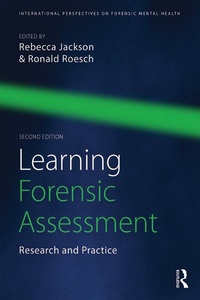
Learning Forensic Assessment
Research and Practice
2nd Edition
Published on 5. October 2015
546 pages
978-1-317-68123-6 (ISBN)
Description

Major developments in the field since the publication of Learning Forensic Assessment are integrated in this revised edition, including revised editions of the DSM-5, HCR-20 scale, and child custody guidelines.
This textbook is designed for graduate students learning forensic assessment and psychologists coming to forensic practice later in their careers. It is organized around five broad areas: Professional and Practice Issues, Adult Forensic Assessment, Juvenile Forensic Assessment, Civil Forensic Assessment, and Communicating Your Findings.
Each chapter begins with a strong teaching and learning foundation. The latter part of each chapter is assessment specific, covering available assessment measures and approaches to assessment. The authors go well beyond simple descriptions of assessment measures and provide a conceptual discussion of the evaluation process that helps the reader understand how assessment measures fit into the overall evaluation process. The evaluation component is geared toward assessing the important aspects of the construct as laid out in the early part of each chapter. Each chapter then concludes with a case example to illustrate the measures and techniques described.
This textbook is designed for graduate students learning forensic assessment and psychologists coming to forensic practice later in their careers. It is organized around five broad areas: Professional and Practice Issues, Adult Forensic Assessment, Juvenile Forensic Assessment, Civil Forensic Assessment, and Communicating Your Findings.
Each chapter begins with a strong teaching and learning foundation. The latter part of each chapter is assessment specific, covering available assessment measures and approaches to assessment. The authors go well beyond simple descriptions of assessment measures and provide a conceptual discussion of the evaluation process that helps the reader understand how assessment measures fit into the overall evaluation process. The evaluation component is geared toward assessing the important aspects of the construct as laid out in the early part of each chapter. Each chapter then concludes with a case example to illustrate the measures and techniques described.
Reviews / Votes
I have often recommended the first edition of Becky Jackson's Learning Forensic Assessment to students and trainees ranging from undergraduates to postdoctoral fellows and practicing psychologists. Therefore, I was delighted to see this second edition, co-edited with Ron Roesch, featuring many of the same topics and expert authors. Like the first edition, the tone of the text remains clear and accessible for those new to our discipline, but the content is substantive and detailed, providing meaningful and specific guidance. Learning Forensic Assessment remains a superb resource for clinicians at any stage who are transitioning into the challenging field of forensic mental health assessment.-Daniel Murrie, PhD, is the Director of Psychology at the Institute of Law, Psychiatry, and Public Policy as well as Professor of Psychiatry and Neurobehavioral Sciences at the University of Virginia School of Medicine.Jackson and Roesch's revision of Learning Forensic Assessment represents a tremendous advance for the field. Building on what was already an outstanding volume (and one that I use for my graduate course in Forensic Assessment), the second edition provides greater breadth and depth, while still retaining the "hands on" feel of the first edition. It is a must-have volume for every burgeoning forensic clinical psychologist and a helpful resource for even the most experienced expert.-Barry Rosenfeld, PhD, ABPP, is Professor and Chair in the Department of Psychology as well as Adjunct Professor in the School of Law at Fordham University.
Learning Forensic Assessment provides an introduction to a broad range of forensic psychological assessment issues. Many of the forensic experts from the first edition provide updated material in their areas of expertise and research. This updated material gives the reader a great primer to the forensic experts that have spent their careers researching and writing about forensic assessment as well as an introduction to the current state of the field in forensic psychological assessment.-Holly A. Miller, PhD, is Professor and Associate Dean for Academic Programs at the College of Criminal Justice at Sam Houston State University.
More details
Series
Edition
2nd edition
Language
English
Place of publication
London
United Kingdom
Publishing group
Taylor & Francis Ltd
Target group
Professional and scholarly
Edition type
Revised edition
Illustrations
5 s/w Zeichnungen, 26 s/w Tabellen
26 Tables, black and white; 5 Line drawings, black and white
File size
2,51 MB
ISBN-13
978-1-317-68123-6 (9781317681236)
Copyright in bibliographic data and cover images is held by Nielsen Book Services Limited or by the publishers or by their respective licensors: all rights reserved.
Schweitzer Classification
Other editions
Additional editions
Book
10/2015
2nd Edition
Routledge
€379.90
Shipment within 10-20 days
Book
10/2015
2nd Edition
Routledge
€155.00
Shipment within 10-20 days
Persons
Rebecca Jackson, PhD, is the Clinical Director of the Florida Civil Commitment Center, a 720-bed sex
offender civil commitment facility. Previously she was associate professor and director of the Forensic
Certification Program in Psychology and Law at Palo Alto University, Palo Alto, CA.
Ronald Roesch, PhD, is Professor of Psychology, Simon Fraser University (SFU), and Director, Mental
Health, Law, and Policy Institute, SFU, and Past President of the International Association of Forensic
Mental Health Services (IAFMHS) and the American Psychology-Law Society (Div. 41 APA). He serves as
editor of the International Perspectives on Forensic Mental Health Books Series.
offender civil commitment facility. Previously she was associate professor and director of the Forensic
Certification Program in Psychology and Law at Palo Alto University, Palo Alto, CA.
Ronald Roesch, PhD, is Professor of Psychology, Simon Fraser University (SFU), and Director, Mental
Health, Law, and Policy Institute, SFU, and Past President of the International Association of Forensic
Mental Health Services (IAFMHS) and the American Psychology-Law Society (Div. 41 APA). He serves as
editor of the International Perspectives on Forensic Mental Health Books Series.
Content
About the Editors Contributors Preface I: Professional and Practice Issues 1.Training in Forensic Assessment and Intervention: Implications for Principle-Based Models David DeMatteo, Jeffrey Burl, Sarah Filone, and Kirk Heilbrun 2.Legal Theory and the Relationship Between Psychology and Law Deborah A. Connolly and Patricia I. Coburn 3.Ethical Issues in Forensic Psychology Mary A. Connell II: Adult Forensic Assessment 4.Learning Forensic Examinations of Adjudicative Competency Stephen L. Golding 5.An Introduction to Insanity Evaluations Richard Rogers 6.The Clinical Assessment of Psychopathy Michael J. Vitacco, Craig S. Neumann, Lori Welch, and Peter Buckley 7.Violence Risk Assessment Michelle R. Guyton and Rebecca L. Jackson 8.Evaluations for Sexual Offender Civil Commitment Amy Phenix and Rebecca L. Jackson 9.Forensic Psychology Evaluations at Capital Sentencing Mark D. Cunningham 10.Competency for Execution Patricia A. Zapf III. Juvenile Forensic Assessment 11.The Capacity of Juveniles to Understand and Waive Arrest Right Ronald Roesch, Kaitlyn McLachlan, and Jodi Viljoen 12.Assessing Adolescents' Adjudicative Competence Ronald Roesch and Jodi Viljoen 13.Clinical Forensic Evaluations for Juvenile Transfer to Adult Criminal Court Randall T. Salekin, Ross D. Grimes, and Elizabeth W. Adams 14.Assessing Child and Adolescent Psychopathy Randall T. Salekin, Sara A. Debus, Emily MacDougall, and Abby Clark 15.Assessing Risk for Violence and Offending in Adolescents
Jodi Viljoen, Andrew L. Gray, and Carmelina Barone IV. Civil Forensic Assessment 16.Child Custody Evaluations Robert A. Zibbell and Geri Fuhrmann 17.Evaluations of Individuals for Disability Insurance and Social Security Contexts William E. Foote 18.Personal Injury Evaluations Christmas N. Covell and Jennifer G. Wheeler 19.Civil Commitment Evaluations: Current Practice and Suggestions for the Future Eric Strachan V. Communicating Your Findings 20.Writing Forensic Psychological Reports Audrey K. Miller and Gregg J. Gagliardi 21.Testifying in Court: Evidenced-Based Recommendations for Expert-Witness Testimony Marcus T. Boccaccini, Phylissa P. Kwartner, and Paige B. Harris
Jodi Viljoen, Andrew L. Gray, and Carmelina Barone IV. Civil Forensic Assessment 16.Child Custody Evaluations Robert A. Zibbell and Geri Fuhrmann 17.Evaluations of Individuals for Disability Insurance and Social Security Contexts William E. Foote 18.Personal Injury Evaluations Christmas N. Covell and Jennifer G. Wheeler 19.Civil Commitment Evaluations: Current Practice and Suggestions for the Future Eric Strachan V. Communicating Your Findings 20.Writing Forensic Psychological Reports Audrey K. Miller and Gregg J. Gagliardi 21.Testifying in Court: Evidenced-Based Recommendations for Expert-Witness Testimony Marcus T. Boccaccini, Phylissa P. Kwartner, and Paige B. Harris
