

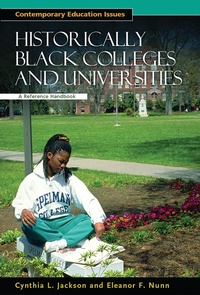
Historically Black Colleges and Universities
A Reference Handbook
Published on 16. September 2003
264 pages
978-1-85109-427-1 (ISBN)
Description

A highly readable overview of the rich past of historically black colleges and universities, and how their role in higher education is evolving for the future.
Historically black colleges and universities (HBCUs) have influenced African American lives and communities since 1837. Historically Black Colleges and Universities provides a past and present look at their role in higher education.
This volume addresses why these institutions exist, how effective they've been, and if today's 103 HBCUs are still necessary. Special attention is given to the years since 1954 and to desegregation cases such as Brown v. Board of Education, United States v. Fordice, and other judicial decisions. The volume highlights government relations, leadership, and philanthropy as they apply to HBCUs. Also, a chapter provides a case study of the Historically Minority Universities Bioscience and Biotechnology Program Initiative, and a final chapter suggests research agendas for the 21st century.
Historically black colleges and universities (HBCUs) have influenced African American lives and communities since 1837. Historically Black Colleges and Universities provides a past and present look at their role in higher education.
This volume addresses why these institutions exist, how effective they've been, and if today's 103 HBCUs are still necessary. Special attention is given to the years since 1954 and to desegregation cases such as Brown v. Board of Education, United States v. Fordice, and other judicial decisions. The volume highlights government relations, leadership, and philanthropy as they apply to HBCUs. Also, a chapter provides a case study of the Historically Minority Universities Bioscience and Biotechnology Program Initiative, and a final chapter suggests research agendas for the 21st century.
More details
Series
Language
English
Place of publication
Oxford
United Kingdom
Target group
Professional and scholarly
Interest Age: From 7 to 17 years
File size
1,65 MB
ISBN-13
978-1-85109-427-1 (9781851094271)
Copyright in bibliographic data and cover images is held by Nielsen Book Services Limited or by the publishers or by their respective licensors: all rights reserved.
Schweitzer Classification
Other editions
Additional editions
Cynthia L. Jackson | Eleanor F. Nunn
Historically Black Colleges and Universities
A Reference Handbook
Book
09/2003
ABC-CLIO
€59.10
Shipment within 3-4 weeks
Persons
Cynthia L. Jackson is a faculty member at the Union Institute in Cincinnati, OH. She is the author of ABC-CLIO's African American Education.
Eleanor F. Nunn is director of the Historically Minority Universities Biotechnology Center at the North Carolina Biotechnology Center in Research Triangle Park, NC.
Eleanor F. Nunn is director of the Historically Minority Universities Biotechnology Center at the North Carolina Biotechnology Center in Research Triangle Park, NC.
Content
- Cover
- Historically Black Colleges and Universities
- Contents
- Series Editor's Preface
- Preface
- Chapter One Introduction
- Who are the HBCUs?
- History of Private Four-Year, Graduate, and Professional Institutions
- Alabama
- Arkansas
- District of Columbia
- Florida
- Georgia
- Kentucky
- Louisiana
- Mississippi
- North Carolina
- Ohio
- South Carolina
- Tennessee
- Texas
- Virginia
- History of Public Four-Year, Graduate, and Professional Institutions
- Black Land-Grant Institutions
- Black Non-Land-Grant Institutions
- Alabama
- District of Columbia
- Georgia
- Louisiana
- Maryland
- Mississippi
- Missouri
- North Carolina
- Ohio
- Pennsylvania
- Texas
- Virgin Islands
- Virginia
- West Virginia
- History of Black Community Colleges and Junior Colleges
- Alabama
- Arkansas
- Louisiana
- Michigan
- Mississippi
- South Carolina
- The Mission of HBCUs
- The Debate over Curriculum
- Nationalism versus Assimilation
- Liberal Arts Education versus Vocational Education
- Talented Tenth versus the Masses
- Outside Forces on the Mission and Curricula
- Role of HBCUs in Higher Education
- Political Aspects of HBCUs
- Community Service
- Early Activism
- Unrest in the 1920s
- Unrest in the 1960s and 1970s
- Civil Right Movement of the 1960s
- Contemporary Activism
- Fulfillment of the Mission and Role
- Status of HBCUs
- Racial Identity
- Accreditation and Program Quality
- Leadership
- Faculty
- Admissions and Retention
- HBCUs and Technology
- Facilities
- Fiscal Concerns
- National Achievement Scholars and Rhodes Scholars
- The Continued Need for HBCUs in the Twenty-First Century
- References
- Chapter Two Chronology
- Chapter Three Legal Influences on HBCUs
- Governance of Higher Education
- Federal Government Intervention in Higher Education
- Presidential Executive Orders
- Affirmative Action
- White House Initiative on HBCUs
- U.S. Constitutional Amendments
- U.S. Legislative Acts
- Morrill Act of 1890
- Civil Rights Act of 1964
- Higher Education Act of 1965
- Court Cases
- Pre-Brown Era
- Post-Brown Era
- Conclusion
- References
- Chapter Four Philanthropy and Government Relations
- Philanthropy Defined
- Historical Overview
- Contemporary Philanthropy
- Individual Philanthropy
- Government Relations
- State Government
- Federal Government
- Federal Grants, Contracts, and Other Agreements
- Federal Student Assistance (FSA)
- Conclusion
- References
- Chapter Five Historically Minority Universities Bioscience and Biotechnology Program Initiative
- Impetus for the Model
- The Model
- The Model Outcomes
- Curriculum Development
- Faculty Development
- Student Recruitment
- Facilities, Equipment, and Supplies
- Conclusion
- References
- Chapter Six Research Agenda for the Twenty-First Century
- Chapter 1
- Chapters 1 and 3
- Chapters 1 and 4
- Chapter 4
- Chapter 5
- References
- Chapter Seven Directory of Organizations and Print Resources
- Organizations
- Print Resources
- Books about Specific HBCUs
- Dissertations
- Monographs
- Periodical Articles
- Reports
- Appendix 1 HBCUs by State
- Alabama
- Arkansas
- Delaware
- District of Columbia
- Florida
- Georgia
- Kentucky
- Louisiana
- Maryland
- Michigan
- Mississippi
- Missouri
- North Carolina
- Ohio
- Oklahoma
- Pennsylvania
- South Carolina
- Tennessee
- Texas
- Virgin Islands
- Virginia
- West Virginia
- Appendix 2 Selected Graduates of Historically Black Colleges and Universities
- Glossary
- Index
- About the Authors
