

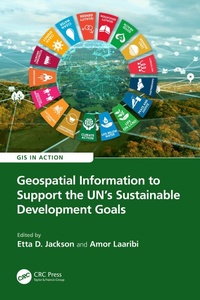
Geospatial Information to Support the UN's Sustainable Development Goals
Published on 9. December 2025
324 pages
978-1-040-69109-0 (ISBN)
Description

This unique book investigates the 2030 Agenda for Sustainable Development through geospatial information lenses, making the case that geospatial information is central to the SDGs and is imperative to understand the place, location, communities, and the people to identify where the root of the problem lies. Combined with other layers of information, it supports advanced analysis and visualizations and explains how SDG indicators can be interpreted and measured either through direct use of geospatial data itself or through integration with other statistical data. International case studies and coverage of all the SDGs help users evaluate impacts and monitor progress to achieve the SDGs.
Features
Demonstrates how geospatial information can be used to assess SDG targets and indicators.
Provides 16 applications and real-world case studies of SDGs and their related indicators where geospatial information contributes significantly to the implementation and monitoring.
Addresses practical and technological issues related to geospatial information, data acquisition, and integration approaches.
Illustrates the integration of geospatial information with statistical and other development information
Discusses the impact that applications have on policy and society to make informed decisions and implement better policies.
This book is for professionals, researchers, senior undergraduates and graduate students, working on or studying projects focused on specific GIS applications in support of sustainable development. It is also an excellent resource for policymakers and NGOs involved with UN SDGs.
Features
Demonstrates how geospatial information can be used to assess SDG targets and indicators.
Provides 16 applications and real-world case studies of SDGs and their related indicators where geospatial information contributes significantly to the implementation and monitoring.
Addresses practical and technological issues related to geospatial information, data acquisition, and integration approaches.
Illustrates the integration of geospatial information with statistical and other development information
Discusses the impact that applications have on policy and society to make informed decisions and implement better policies.
This book is for professionals, researchers, senior undergraduates and graduate students, working on or studying projects focused on specific GIS applications in support of sustainable development. It is also an excellent resource for policymakers and NGOs involved with UN SDGs.
More details
Series
Language
English
Place of publication
London
United Kingdom
Publishing group
Taylor & Francis Ltd
Target group
College/higher education
Professional and scholarly
Product notice
Reflowable
Illustrations
2 Tables, color; 30 Tables, black and white; 49 Line drawings, color; 1 Line drawings, black and white; 39 Halftones, color; 88 Illustrations, color; 1 Illustrations, black and white
File size
40,07 MB
ISBN-13
978-1-040-69109-0 (9781040691090)
Copyright in bibliographic data and cover images is held by Nielsen Book Services Limited or by the publishers or by their respective licensors: all rights reserved.
Schweitzer Classification
Other editions
Additional editions
Etta D. Jackson | Amor Laaribi
Geospatial Information to Support the UN's Sustainable Development Goals
Book
approx. 12/2025
1st Edition
CRC Press
€204.70
Not yet published
Persons
Etta D. Jackson has worked in the field of education for 25 years as a teacher, guidance counselor, and district desegregation coordinator in both New York and Wisconsin. Her passion for wanting to make a difference led her to the founding of The Institute for Conscious Global Change (ICGC), an international non-profit NGO organization in Special Consultative Status with the Economic and Social Council (ECOSOC) of the United Nations. She now serves as the CEO of the Institute. This New York based organization was founded in 2007 to provide visual but tangible development solutions to support the unfinished mandate of the United Nations Millennium Development Goals (MDGs) and now Sustainable Development Goals (SDGs) of the 2030 Agenda for Sustainable Development. With the aid of Geographic Information Systems (GIS), Earth Observation and GeoDesign technologies, ICGC engages governments and citizens to develop integrated holistic and comprehensive development models for implementation in each country. Dr. Jackson is also the author of four books and many articles.
Amor Laaribi has over 30 years of extensive technical, managerial, and policy experience in the development, implementation and evaluation of geospatial information strategies, programs and projects in support of decision making and sustainable development. He joined the United Nations Statistics Division in 2000 to define and plan the priorities of the Division in geospatial information and to promote its use and integration with census/statistical information in developing countries. Dr. Laaribi has written/co-written two other books.
Amor Laaribi has over 30 years of extensive technical, managerial, and policy experience in the development, implementation and evaluation of geospatial information strategies, programs and projects in support of decision making and sustainable development. He joined the United Nations Statistics Division in 2000 to define and plan the priorities of the Division in geospatial information and to promote its use and integration with census/statistical information in developing countries. Dr. Laaribi has written/co-written two other books.
Content
Introduction. Part 1: Eradication of Extreme Poverty, Food Security, Healthy Lives. 1. SDG #1- Leveraging Geographic Information Systems (GIS) to Address Multidimensional Poverty. 2. SDG #2 - Technology for Regenerative and Sustainable Agriculture for Food Security. 3. SDG #3 - Good Health: The Heart of UN SDGs Enabled by GIS. 4. SDG #4 - Mapping Learning beyond Indicators: GIS Impact for Achieving SDG 4 - Quality Education for All. Part 2: Innovations, Safe Communities and Life of Dignity. 5. SDG #5 - Leveraging Spatial Dimensions in Advancing Gender Equality. 6. SDG #6 - Earth Observation for SDG 15 & SDG 6 Reporting in North African Countries. 7. SDG #9 - Blueprint Strategies for Resilient Infrastructure, Inclusive Industrialization and Innovation. 8. SDG #11 - Geospatial Information for Sustainable Cities. Part 3: Climate, Food Consumption, and Environmental Sustainability. 9. SDG #12 - Responsible Consumption and Production: Spatially Enabled Assessment of Resource Consumption, Waste Generation, and Production Patterns. 10. SDG #13 - Global South Climate Change Protection Through GIS Study and Coordinated Sustainable Development Measures. 11. SDG #15- Disrupted Progress: The Impact of COVID-19 on Sustainable Development Goals in the Indian Subcontinent. Paret 4: Strong Institutions and Sustainable Development. 12. SDG #16 - The Role of Spatially Enabled Governance in the Implementation of the SDGs. 13. SDG#17: Implementation through Partnerships and Technology.
