

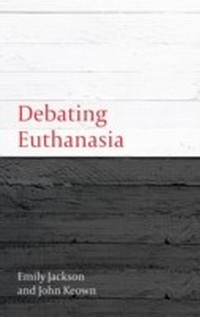
Debating Euthanasia
1st Edition
Published on 2. December 2011
200 pages
978-1-84731-771-1 (ISBN)
Description

In this new addition to the 'Debating Law' series, Emily Jackson and John Keown re-examine the legal and ethical aspects of the euthanasia debate.
Emily Jackson argues that we owe it to everyone in society to do all that we can to ensure that they experience a 'good death'. For a small minority of patients who experience intolerable and unrelievable suffering, this may mean helping them to have an assisted death. In a liberal society, where people's moral views differ, we should not force individuals to experience deaths they find intolerable. This is not an argument in favour of dying. On the contrary, Jackson argues that legalisation could extend and enhance the lives of people whose present fear of the dying process causes them overwhelming distress. John Keown argues that voluntary euthanasia and physician-assisted suicide are gravely unethical and he defends their continued prohibition by law. He analyses the main arguments for relaxation of the law - including those which invoke the experience of jurisdictions which permit these practices - and finds them wanting. Relaxing the law would, he concludes, be both wrong in principle and dangerous in practice, not least for the dying, the disabled and the disadvantaged.
Emily Jackson argues that we owe it to everyone in society to do all that we can to ensure that they experience a 'good death'. For a small minority of patients who experience intolerable and unrelievable suffering, this may mean helping them to have an assisted death. In a liberal society, where people's moral views differ, we should not force individuals to experience deaths they find intolerable. This is not an argument in favour of dying. On the contrary, Jackson argues that legalisation could extend and enhance the lives of people whose present fear of the dying process causes them overwhelming distress. John Keown argues that voluntary euthanasia and physician-assisted suicide are gravely unethical and he defends their continued prohibition by law. He analyses the main arguments for relaxation of the law - including those which invoke the experience of jurisdictions which permit these practices - and finds them wanting. Relaxing the law would, he concludes, be both wrong in principle and dangerous in practice, not least for the dying, the disabled and the disadvantaged.
More details
Series
Edition
1. Auflage
Language
English
Place of publication
London
United Kingdom
Publishing group
Bloomsbury Publishing PLC
Target group
College/higher education
ISBN-13
978-1-84731-771-1 (9781847317711)
Copyright in bibliographic data and cover images is held by Nielsen Book Services Limited or by the publishers or by their respective licensors: all rights reserved.
Schweitzer Classification
Other editions
Additional editions
Emily Jackson | John Keown
Debating Euthanasia
Book
12/2011
1st Edition
Hart Publishing
€40.50
Shipment within 15-20 days
Persons
Emily Jackson is a Professor of Law at the London School of Economics.
John Keown holds the Rose F Kennedy Chair in Christian Ethics in the Kennedy Institute of Ethics at Georgetown University. Formerly, he taught the law and ethics of medicine in the Faculty of Law at Cambridge, where he was a Fellow of Queens' College and of Churchill College
John Keown holds the Rose F Kennedy Chair in Christian Ethics in the Kennedy Institute of Ethics at Georgetown University. Formerly, he taught the law and ethics of medicine in the Faculty of Law at Cambridge, where he was a Fellow of Queens' College and of Churchill College
Content
Series Editor's Preface
Acknowledgements - John Keown and Emily Jackson
In Favour of the Legalisation of Assisted Dying by Emily Jackson
I. Introduction
II. Why We Should Try
III. The Status Quo is Indefensible
A. Double Effect
B. Terminal Sedation
C. 'Do Not Attempt Resuscitation' Orders
D. Treatment Withdrawal
E. Exporting the 'Problem' of Assisted Suicide
F. The Euthanasia/Assisted Suicide 'Underground' and the Benefits of Regulation
IV. Why Might Anyone Think We Shouldn't Try?
A. The Sanctity and Value of Life
B. Effect on Doctor-Patient Relationship
C. Regulatory Difficulties
V. What Might an Assisted Dying Law Look Like?
A. Other Countries' Experience
B. Process
C. Method: Assisted Suicide or Euthanasia, or Both?
D. Substance
VI. What are the Consequences of not Trying?
Against Decriminalising Euthanasia; For Improving Care by John Keown
I. Introduction
II. Definitions
III. Ten Arguments For Decriminalisation
A. Autonomy
B. Compassion
C. Legal Hypocrisy
D. A Right to Suicide
E. Public Opinion
F. Legal Failure
G. The Netherlands
H. Oregon
I. Religion
J. Economics
IV. Professor Jackson's Arguments
A. Jackson 1
B. Jackson 2
V. The Joffe Bill
A. The Bill
B. Key Committee Recommendations Not Adopted
C. Extension and Abuse
VI. Conclusions
Acknowledgements - John Keown and Emily Jackson
In Favour of the Legalisation of Assisted Dying by Emily Jackson
I. Introduction
II. Why We Should Try
III. The Status Quo is Indefensible
A. Double Effect
B. Terminal Sedation
C. 'Do Not Attempt Resuscitation' Orders
D. Treatment Withdrawal
E. Exporting the 'Problem' of Assisted Suicide
F. The Euthanasia/Assisted Suicide 'Underground' and the Benefits of Regulation
IV. Why Might Anyone Think We Shouldn't Try?
A. The Sanctity and Value of Life
B. Effect on Doctor-Patient Relationship
C. Regulatory Difficulties
V. What Might an Assisted Dying Law Look Like?
A. Other Countries' Experience
B. Process
C. Method: Assisted Suicide or Euthanasia, or Both?
D. Substance
VI. What are the Consequences of not Trying?
Against Decriminalising Euthanasia; For Improving Care by John Keown
I. Introduction
II. Definitions
III. Ten Arguments For Decriminalisation
A. Autonomy
B. Compassion
C. Legal Hypocrisy
D. A Right to Suicide
E. Public Opinion
F. Legal Failure
G. The Netherlands
H. Oregon
I. Religion
J. Economics
IV. Professor Jackson's Arguments
A. Jackson 1
B. Jackson 2
V. The Joffe Bill
A. The Bill
B. Key Committee Recommendations Not Adopted
C. Extension and Abuse
VI. Conclusions
