

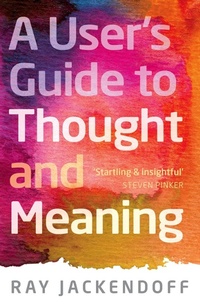
A User's Guide to Thought and Meaning
Published on 23. February 2012
978-0-19-162068-3 (ISBN)
Description

A User's Guide to Thought and Meaning presents a profound and arresting integration of the faculties of the mind - of how we think, speak, and see the world.
Ray Jackendoff starts out by looking at languages and what the meanings of words and sentences actually do. He shows that meanings are more adaptive and complicated than they're commonly given credit for, and he is led to some basic questions: How do we perceive and act in the world? How do we talk about it? And how can the collection of neurons in the brain give rise to conscious experience? As it turns out, the organization of language, thought, and perception does not look much like the way we experience things, and only a small part of what the brain does is conscious. Jackendoff concludes that thought and meaning must be almost completely unconscious. What we experience as rational conscious thought - which we prize as setting us apart from the animals - in fact rides on a foundation of unconscious intuition. Rationality amounts to intuition enhanced by language.
Written with an informality that belies both the originality of its insights and the radical nature of its conclusions, A User's Guide to Thought and Meaning is the author's most important book since the groundbreaking Foundations of Language in 2002.
More details
Other editions
Additional editions
Ray Jackendoff
A User's Guide to Thought and Meaning
Book
02/2012
Oxford University Press
€38.50
Shipment within 15-20 days
Person
Ray Jackendoff is Seth Merrin Professor of Philosophy and Co-Director of the Center for Cognitive Studies at Tufts University. His books include Semantics and Cognition (MIT 1983), Consciousness and the Computational Mind (MIT 1987), The Architecture of the Language Faculty (MIT 1997), Foundations of Language (OUP 2002), Simpler Syntax (with Peter Culicover, OUP 2005), Language, Consciousness, Culture: Essays on Mental Structure (MIT 2007), and Meaning and the Lexicon: The Parallel Architecture, 1975-2010 (OUP, 2010). He is the 2014 recipient of the David E. Rumelhart Prize, the premier award in the field of cognitive science.
Content
- 1: Why do we need a User's Guide to thought and meaning?
- Part One: Language, Words, and Meaning
- 2: What's a language?
- 3: Perspectives on English
- 4: Perspectives on sunsets, tigers, and puddles
- 5: What's a word?
- 6: What counts as the same word?
- 7: Some uses of mean and meaning
- 8: "Objective" and "subjective" meaning
- 9: What do meanings have to be able to do?
- 10: Meanings can't be visual images
- 11: Word meanings aren't cut and dried
- 12: Not all the meaning is in the words
- 13: Meanings, concepts, and thoughts
- 14: Does your language determine your thought?
- Part Two: Consciousness and Perception
- 15: What's it like to be thinking?
- 16: Some phenomena that test the Unconscious Meaning Hypothesis
- 17: Conscious and unconscious
- 18: What does "What is consciousness?" mean?
- 19: Three cognitive correlates of conscious thought
- 20: Some prestigious theories of consciousness
- 21: What's it like to see things?
- 22: Two components of thought and meaning
- 23: See something as a fork
- 24: Other modalities of spatial perception
- 25: How do we see the world as "out there"?
- 26: Other "feels" in experience
- Part Three: Reference, Truth, and Thought
- 27: How do we use language to talk about the world?
- 28: Mismatching reference in conversation
- 29: What kinds of things can we refer to? (Cognitive metaphysics, Lesson 1)
- 30: Referential files for pictures and thoughts
- 31: What's truth?
- 32: Problems for an ordinary perspective on truth
- 33: What's it like to judge a sentence true?
- 34: Noticing something's wrong
- 35: What's it like to be thinking rationally?
- 36: How much rational thinking do we actually do?
- 37: How rational thinking helps
- 38: Chamber music
- 39: Rational thinking as a craft
- 40: Some pitfalls of apparently rational thinking
- Part IV: A Larger View
- 41: Some speculation on science and the arts
- 42: Ordinary and cognitive perspectives on morality
- 43: Ordinary and cognitive perspectives on religion
- 44: Learning to live with multiple perspectives
- Index
