

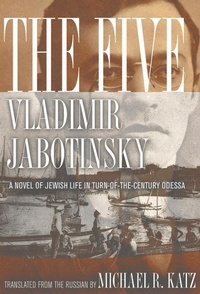
The Five
A Novel of Jewish Life in Turn-of-the-Century Odessa
Published on 19. September 2014
224 pages
978-0-8014-7162-9 (ISBN)
Description

"The beginning of this tale of bygone days in Odessa dates to the dawn of the twentieth century. At that time we used to refer to the first years of this period as the 'springtime,' meaning a social and political awakening. For my generation, these years also coincided with our own personal springtime, in the sense that we were all in our youthful twenties. And both of these springtimes, as well as the image of our carefree Black Sea capital with acacias growing along its steep banks, are interwoven in my memory with the story of one family in which there were five children: Marusya, Marko, Lika, Serezha, and Torik."-from The Five
The Five is an captivating novel of the decadent fin-de-siEcle written by Vladimir Jabotinsky (1880-1940), a controversial leader in the Zionist movement whose literary talents, until now, have largely gone unrecognized by Western readers. The author deftly paints a picture of Russia's decay and decline-a world permeated with sexuality, mystery, and intrigue. Michael R. Katz has crafted the first English-language translation of this important novel, which was written in Russian in 1935 and published a year later in Paris under the title Pyatero.
The book is Jabotinsky's elegaic paean to the Odessa of his youth, a place that no longer exists. It tells the story of an upper-middle-class Jewish family, the Milgroms, at the turn of the century. It follows five siblings as they change, mature, and come to accept their places in a rapidly evolving world. With flashes of humor, Jabotinsky captures the ferment of the time as reflected in political, social, artistic, and spiritual developments. He depicts with nostalgia the excitement of life in old Odessa and comments poignantly on the failure of the dream of Jewish assimilation within the Russian empire.
The Five is an captivating novel of the decadent fin-de-siEcle written by Vladimir Jabotinsky (1880-1940), a controversial leader in the Zionist movement whose literary talents, until now, have largely gone unrecognized by Western readers. The author deftly paints a picture of Russia's decay and decline-a world permeated with sexuality, mystery, and intrigue. Michael R. Katz has crafted the first English-language translation of this important novel, which was written in Russian in 1935 and published a year later in Paris under the title Pyatero.
The book is Jabotinsky's elegaic paean to the Odessa of his youth, a place that no longer exists. It tells the story of an upper-middle-class Jewish family, the Milgroms, at the turn of the century. It follows five siblings as they change, mature, and come to accept their places in a rapidly evolving world. With flashes of humor, Jabotinsky captures the ferment of the time as reflected in political, social, artistic, and spiritual developments. He depicts with nostalgia the excitement of life in old Odessa and comments poignantly on the failure of the dream of Jewish assimilation within the Russian empire.
Reviews / Votes
For Jabotinsky, Arab national aspirations, like those of the Zionists, were legitimate. Hence his acknowledgment of the inevitable violence of the struggle.... In Jabotinsky's future, Arab and Jew would not be neighbors so much as carefully differentiated groupings within the body politic of the new state.... In Jabotinsky's writing, Zionism both affirms and doubts itself. What would Israel look like today if the modern leaders who have claimed to take their inspiration from him-Begin, Netanyahu, Sharon, and now Olmert, who referred to Jabotinsky in his speech to the first session of the new Knesset at the beginning of May-had shown themselves capable of such radical self-questioning.- Jacqueline Rose (The Nation) In his sympathetic depiction of the flawed Milgroms, Jabotinsky at once created a paean to the beloved city of his youth while providing Russian literature with the very type of sympathetic Jewish novel whose absence he bemoaned, and which he predicted was not likely to appear even when Soviet Russian literature matured.
- Louis Gordon (Jerusalem Report) The most remarkable thing about The Five is not that it was written by a man who, the year before its publication, was occupied day and night in leading his Revisionist Party out of the World Zionist Organization and founding a rump Zionist body after a negotiated truce between him and Ben-Gurion was voted down.... The Five would be just as tender yet unsentimental a novel, and as technically accomplished, even were it to turn out that its author had been publicly played by a double while spending his time holed up in his Paris apartment, composing leisurely draft after draft. The most remarkable thing about this novel is how good it is.
- Hillel Halkin (The New Republic) This autobiographical novel was first published in Russian in Paris in 1936. Set in the Odessa of the author's youth and narrated by a character much like himself, it recounts the fortunes of a Jewish family, the Milgroms, through whom we witness the rise and fall of Jewish Odessa from the beginning of the twentieth century to the Russian Revolution. It also offers a fervent account of the temporary success and ultimate failure of Jewish assimilation in the Russian empire. The Five portrays the lost world of Odessa's Jews in all its color and vitality, its historical vulnerability and perennial optimism; now appearing in English, it is bound to become indispensable for American literary fiction readers and students of Jewish-Russian literature.
(Booklist)
More details
Language
English
Place of publication
Ithaca
United States
Product notice
Reflowable
ISBN-13
978-0-8014-7162-9 (9780801471629)
Copyright in bibliographic data and cover images is held by Nielsen Book Services Limited or by the publishers or by their respective licensors: all rights reserved.
Schweitzer Classification
Other editions
Additional editions
Book
04/2005
Cornell University Press
€28.46
Shipment within 10-20 days
Book
04/2005
Cornell University Press
€143.61
Shipment within 10-20 days
Persons
Michael R. Katz is C. V. Starr Professor of Russian Studies at Middlebury College. He is the author of The Literary Ballad in Early Nineteenth-Century Russian Literature and Dreams and the Unconscious in Nineteenth-Century Russian Fiction. Katz is also the translator of many novels, including Nikolai Chernyshevsky's What Is to Be Done? and Mikhail Artsybashev's Sanin, both from Cornell. Vladimir Jabotinsky was a Russian Jewish Revisionist Zionist leader, author, poet, orator, soldier and founder of the Jewish Self-Defense Organization in Odessa. With Joseph Trumpeldor, he co-founded the Jewish Legion[2] of the British army in World War I. Later he established several Jewish organizations in what was then called Palestine, including Beitar, HaTzohar and the Irgun. Michael Stanislawski is Nathan J. Miller Professor of Jewish History at Columbia University and the author of several books, including Zionism and the Fin de Siecle: Cosmopolitanism and Nationalism from Nordau to Jabotinsky.
Content
<pre>
Contents
Translator's Preface
Introduction by Michael Stanislawski
Principal Characters
Instead of a Preface 000
I. Youth 000
II. Serezha 000
III. In the Literary Circle 000
IV. Around Marusya 000
V. The World of Business 000
VI. Lika 000
VII. Marko 000
VIII. My Porter 000
IX. The Alien 000
X. Along Deribasov Street 000
XI. A Many-Sided Soul 000
XII. The Arsenal on Moldavanka 000
XIII. Something like the Decameron 000
XIV. Inserted Chapter, Not Intended for the Reader 000
XV. Confession on Langeron 000
XVI. Signor and Mademoiselle 000
XVII. The Godseeker 000
XVIII. Potemkin Day 000
XIX. Potemkin Night 000
XX. The Wrong Way 000
XXI. Broad Jewish Natures 000
XXII. One More Confession 000
XXIII. Visiting Marusya 000
XXIV. Mademoiselle and Signor 000
XXV. Gomorrah 000
XXVI. Something Bad 000
XXVII. The End of Marusya 000
XXVIII. The Beginning of Torik 000
XXIX. L'envoi 000
Selected Bibliography
</pre>
