

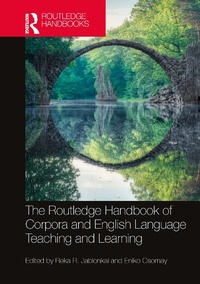
The Routledge Handbook of Corpora and English Language Teaching and Learning
1st Edition
Published on 29. July 2022
558 pages
978-1-000-56890-5 (ISBN)
Description

The Routledge Handbook of Corpora and English Language Teaching and Learning provides a wide-ranging and authoritative overview of the latest developments and innovations in how corpus approaches, corpus technologies, and corpus data can inform and transform English language teaching and learning.
Featuring a broad range of international experts, the Handbook presents state-of-the-art scholarship and inspires new avenues for research focusing on six key areas:
English language teaching and learning informed by language corpora;
corpora in syllabus and materials design;
corpora and English for specific and academic purposes;
learner corpora for English language teaching;
data-driven learning; and
corpora and corpus tools for language teaching.
Unique to this pioneering volume, the authors cover key areas at the cross-roads of corpus research and English language teaching by drawing on cutting-edge corpus applications, methods, and pedagogical approaches, hence, bridging the research-practice gap in the field.
This Handbook is a collection of novel contributions offering essential reading for those researching and studying English language teaching and learning through the application of corpus approaches.
Featuring a broad range of international experts, the Handbook presents state-of-the-art scholarship and inspires new avenues for research focusing on six key areas:
English language teaching and learning informed by language corpora;
corpora in syllabus and materials design;
corpora and English for specific and academic purposes;
learner corpora for English language teaching;
data-driven learning; and
corpora and corpus tools for language teaching.
Unique to this pioneering volume, the authors cover key areas at the cross-roads of corpus research and English language teaching by drawing on cutting-edge corpus applications, methods, and pedagogical approaches, hence, bridging the research-practice gap in the field.
This Handbook is a collection of novel contributions offering essential reading for those researching and studying English language teaching and learning through the application of corpus approaches.
More details
Series
Edition
1. Auflage
Language
English
Place of publication
London
United Kingdom
Publishing group
Taylor & Francis Ltd
Target group
College/higher education
Professional and scholarly
Illustrations
35 Tables, black and white; 17 Line drawings, black and white; 28 Halftones, black and white; 45 Illustrations, black and white
ISBN-13
978-1-000-56890-5 (9781000568905)
Copyright in bibliographic data and cover images is held by Nielsen Book Services Limited or by the publishers or by their respective licensors: all rights reserved.
Schweitzer Classification
Other editions
Additional editions
Reka R. Jablonkai | Eniko Csomay
The Routledge Handbook of Corpora and English Language Teaching and Learning
Book
03/2025
1st Edition
Routledge
€71.60
Shipment within 10-20 days
Reka R. Jablonkai | Eniko Csomay
The Routledge Handbook of Corpora and English Language Teaching and Learning
Book
07/2022
1st Edition
Routledge
€335.20
Shipment within 15-20 days
Persons
Reka R. Jablonkai is an award-winning Assistant Professor in Education and Applied Linguistics at the University of Bath. Her research interests include corpus-based discourse analysis, corpora in language teaching, and multilingual educational contexts. Her research projects were funded by the British Association for International & Comparative Education and the British Council. She has published in edited volumes and journals (e.g. English for Specific Purposes, ESP Today) and regularly presents at international conferences (e.g. EuroCALL, TALC, Corpora and Discourse International Conference). She is Chair of the CorpusCALL SIG of EuroCALL. She worked as a teacher trainer and visiting scholar in various contexts, for example, Italy, Lithuania, Germany, Slovenia, and Turkey.
Eniko Csomay is Professor of Applied Linguistics at San Diego State University. She applies corpus-based methods to text analysis, with a primary interest in discourse and language use at the university including English Medium Instruction (EMI) settings.Her main focus has been various aspects of university classroom discourse as well as student writing. Her articles appeared in highly ranked international journals, for example, Applied Linguistics, Journal of English for Academic Purposes, the International Journal of Corpus Linguistics, and Register Studies. She is an editor for the Journal of Corpora and Discourse Studies, and an editorial board member for English for Specific Purposes and the Journal of English for Academic Purposes. In addition to her edited volumes, she also co-authored a textbook (Doing Corpus Linguistics with Routledge). She was awarded multiple international fellowships (e.g. Soros-Oxford, British Council, Fulbright, English Language Specialist) and worked with pre- and in-service teachers and teacher trainers in several countries including Hungary, Georgia, Mexico, Morocco, and Singapore.
Eniko Csomay is Professor of Applied Linguistics at San Diego State University. She applies corpus-based methods to text analysis, with a primary interest in discourse and language use at the university including English Medium Instruction (EMI) settings.Her main focus has been various aspects of university classroom discourse as well as student writing. Her articles appeared in highly ranked international journals, for example, Applied Linguistics, Journal of English for Academic Purposes, the International Journal of Corpus Linguistics, and Register Studies. She is an editor for the Journal of Corpora and Discourse Studies, and an editorial board member for English for Specific Purposes and the Journal of English for Academic Purposes. In addition to her edited volumes, she also co-authored a textbook (Doing Corpus Linguistics with Routledge). She was awarded multiple international fellowships (e.g. Soros-Oxford, British Council, Fulbright, English Language Specialist) and worked with pre- and in-service teachers and teacher trainers in several countries including Hungary, Georgia, Mexico, Morocco, and Singapore.
Content
Contents
List of figures
List of tables
List of corpora and corpus tools
Contributors
Acknowledgements
Introduction
Reka R. Jablonkai and Eniko Csomay
Section 1 English language teaching and learning informed by language corpora
1 A historical overview of using corpora in English language teaching
Jiajin Xu
2 Corpora and Second Language Acquisition
Magali Paquot
3 Corpora in the teaching of vocabulary and phraseology
Pawel Szudarski
4 Corpus analysis of grammar-in-discourse for English language teaching
Stefan Frazier
5 Corpora in instructed second language pragmatics
Kathleen Bardovi-Harlig and Sabrina Mossman
6 Corpora and speaking skills
William Crawford
7 Corpora for teaching social conversation
Michael McCarthy and Jeanne McCarten
8 Corpora for teaching culture and intercultural communication
Tania Fahey Palma
9 Corpora for materials design
Eric Friginal and Jennifer Roberts
10 Corpora for English language learning textbook evaluation
Mike Nelson
11 English as a Lingua Franca corpora and English language teaching
Xue Wu and Lei Lei
Section 2 Corpora and English for Specific Purposes and English for Academic Purposes
12 Corpus analysis of disciplinary variation and the teaching of ESP/EAP
Paul Thompson
13 Corpora for teaching and learning vocabulary in ESP
Averil Coxhead
14 Corpora for teaching collocations in ESP
Clarence Green
15 Lexical bundles in EAP
Viviana Cortes
16 Corpora for EAP writing
Lynne Flowerdew
17 Corpora and EAP listening comprehension
Belinda Crawford Camiciottoli
18 Corpora and feedback in EAP
Hilary Nesi and Benet Vincent
Section 3 Learner corpora for English language teaching
19 Written learner corpora to inform teaching
Gaetanelle Gilquin
20 Spoken learner corpora for language teaching
Dana Gablasova and Raffaella Bottini
21 Learner corpora to inform testing and assessment
Sandra Goetz
Section 4 Data-driven Learning
22 DDL pedagogy, participants, and perspectives
Fiona Farr and Petter Hagen Karlsen
23 Revamping DDL: Affordances of digital technology
Fanny Meunier
24 Multimodal corpora and concordancing in DDL
Francesca Coccetta
25 DDL for younger learners
Peter Crosthwaite
26 How learners use corpora
Pascual Perez Paredes
27 Corpora and autonomous language learning
Maggie Charles
28 DDL for English language teaching in perspective
Ivor Timmis and Jane Templeton
Section 5 Corpora and corpus tools for English Language Teaching
29 Evaluating corpus analysis tools for the classroom
Clinton Hendry and Emily Sheepy
30 Building corpora for ELT
Reka R. Jablonkai
31 Parallel corpora in ELT
Laura M. Hartwell and Olivier Kraif
32 Automated syntactic analysis for ELT
Xiaofei Lu, J. Elliott Casal and Yingying Liu
33 Training teachers and learners to use corpora
Agnieszka Lenko-Szymanska
Index
List of figures
List of tables
List of corpora and corpus tools
Contributors
Acknowledgements
Introduction
Reka R. Jablonkai and Eniko Csomay
Section 1 English language teaching and learning informed by language corpora
1 A historical overview of using corpora in English language teaching
Jiajin Xu
2 Corpora and Second Language Acquisition
Magali Paquot
3 Corpora in the teaching of vocabulary and phraseology
Pawel Szudarski
4 Corpus analysis of grammar-in-discourse for English language teaching
Stefan Frazier
5 Corpora in instructed second language pragmatics
Kathleen Bardovi-Harlig and Sabrina Mossman
6 Corpora and speaking skills
William Crawford
7 Corpora for teaching social conversation
Michael McCarthy and Jeanne McCarten
8 Corpora for teaching culture and intercultural communication
Tania Fahey Palma
9 Corpora for materials design
Eric Friginal and Jennifer Roberts
10 Corpora for English language learning textbook evaluation
Mike Nelson
11 English as a Lingua Franca corpora and English language teaching
Xue Wu and Lei Lei
Section 2 Corpora and English for Specific Purposes and English for Academic Purposes
12 Corpus analysis of disciplinary variation and the teaching of ESP/EAP
Paul Thompson
13 Corpora for teaching and learning vocabulary in ESP
Averil Coxhead
14 Corpora for teaching collocations in ESP
Clarence Green
15 Lexical bundles in EAP
Viviana Cortes
16 Corpora for EAP writing
Lynne Flowerdew
17 Corpora and EAP listening comprehension
Belinda Crawford Camiciottoli
18 Corpora and feedback in EAP
Hilary Nesi and Benet Vincent
Section 3 Learner corpora for English language teaching
19 Written learner corpora to inform teaching
Gaetanelle Gilquin
20 Spoken learner corpora for language teaching
Dana Gablasova and Raffaella Bottini
21 Learner corpora to inform testing and assessment
Sandra Goetz
Section 4 Data-driven Learning
22 DDL pedagogy, participants, and perspectives
Fiona Farr and Petter Hagen Karlsen
23 Revamping DDL: Affordances of digital technology
Fanny Meunier
24 Multimodal corpora and concordancing in DDL
Francesca Coccetta
25 DDL for younger learners
Peter Crosthwaite
26 How learners use corpora
Pascual Perez Paredes
27 Corpora and autonomous language learning
Maggie Charles
28 DDL for English language teaching in perspective
Ivor Timmis and Jane Templeton
Section 5 Corpora and corpus tools for English Language Teaching
29 Evaluating corpus analysis tools for the classroom
Clinton Hendry and Emily Sheepy
30 Building corpora for ELT
Reka R. Jablonkai
31 Parallel corpora in ELT
Laura M. Hartwell and Olivier Kraif
32 Automated syntactic analysis for ELT
Xiaofei Lu, J. Elliott Casal and Yingying Liu
33 Training teachers and learners to use corpora
Agnieszka Lenko-Szymanska
Index
