

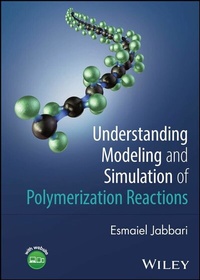
Understanding Modeling and Simulation of Polymerization Reactions
Description

Model and simulate chemical reactions that create plastics and polymers
Understanding Modeling and Simulation of Polymerization Reactions fills a critical gap in existing literature by teaching the science behind polymer design using advanced mathematical and computational methods and providing tools to predict and control how polymers are formed. The book covers both traditional and cutting-edge polymerization methods and uses four powerful modeling techniques: z-transform, method of moments, Markov chains, and Monte Carlo simulations.
The book emphasizes hands-on, equation-driven approaches that help readers understand the underlying chemistry and physics and relate reaction conditions to specific polymer properties. Real-world examples and practice problems are included to reinforce learning, with an online solutions manual available for adopting professors.
Written by an experienced teaching professor, Understanding Modeling and Simulation of Polymerization Reactions discusses:
- Mechanisms of chain formation from monomers including addition, step-growth, and their combinations
- Theoretical models for predicting composition of propagating species for several types of polymerization reactions including conventional radical, reversible deactivation radical, anionic, and cationic polymerization
- Stochastic models of chain distribution, based on the Markovian process, for addition and step-growth polymerization
- Theoretical models to relate viscosity of the reaction medium to monomer conversion, chain diffusivity, and polymer molecular weight
- Copolymer sequences, monomer sequence distributions, and copolymer randomness
Understanding Modeling and Simulation of Polymerization Reactions is an ideal high-level academic textbook for advanced undergraduate and graduate courses on polymer engineering, polymer science, and polymer materials. With its broad scope, the book is also valuable for practicing professionals in the polymer and materials industries.
More details
Other editions
Additional editions
Person
Esmaiel Jabbari, PhD is Professor of Chemical and Biomedical Engineering at the University of South Carolina. His research focuses on the application of resorbable polymeric biomaterials in medicine for drug delivery and regenerative medicine. He was elected a Fellow of the American Institute of Medical and Biological Engineering in 2013.
Content
Preface xvii
Acknowledgment xxi
About the Companion Website xxii
1 Mechanisms and Methods of Polymerization 1
1.1 Introduction 1
1.2 Mechanisms of Polymerization 2
1.2.1 Addition Polymerization 2
1.2.1.1 Conventional Radical Polymerization 2
1.2.1.2 Anionic Polymerization 3
1.2.1.3 Cationic Polymerization 4
1.2.1.4 Reversible-deactivation Radical Polymerization 7
1.2.1.5 Ring-opening Polymerization 11
1.2.1.6 Group Transfer Polymerization 13
1.2.2 Step-growth Polymerization 14
1.2.3 Step Transfer-addition and Radical Termination Polymerization 15
1.3 Living Polymerization 17
1.4 Copolymerization 21
1.5 Architecture of Polymer Chains 22
1.6 Summary 23
1.7 List of Symbols and Abbreviations 24
1.8 Practice Problems 27
References 28
2 Elementary Reactions in Polymerization 43
2.1 Introduction 43
2.2 Initiation Reaction 44
2.2.1 Radical Initiation 44
2.2.1.1 Irreversible Radical Initiation 44
2.2.1.2 Reversible Radical Initiation 49
2.2.2 Anionic Initiation 51
2.2.3 Cationic Initiation 52
2.3 Propagation Reaction 52
2.4 Termination Reactions 52
2.5 Chain Transfer Reactions to Small Molecules 54
2.6 Chain Backbiting Reaction 57
2.7 Chain Combination Reactions 58
2.7.1 Termination by Combination 59
2.7.2 Radical Transfer to Polymer Reaction 59
2.7.3 Radical Transfer to Terminal Double Bond of Polymer Reaction 61
2.7.4 Radical Transfer to Pendant Double Bond of Polymer Reaction 61
2.7.5 Condensation Reaction in Step-growth Polymerization 62
2.8 Chain Dissociation Reactions 63
2.9 Summary 64
2.10 List of Symbols and Abbreviations 65
2.11 Practice Problems 69
References 70
3 Functions with Distributed Variables 85
3.1 Introduction 85
3.2 Moments of a Distribution 86
3.3 Relating Molar-based Distribution of Polymer Chains to Weight-based Distribution 88
3.4 Relating Molar-based Moments of Polymer Chains to Weight-based Moments 89
3.4.1 Example Problem 1 90
3.5 Relating Number-average, Weight-average, and z-average Degree of Polymerization of Polymer Chains to Molar-based Moments of Chain Distribution 92
3.5.1 Example Problem 2 94
3.6 Relating Viscosity-average Degree of Polymerization of Polymer Chains to Molar-based Moments of Chain Distribution 94
3.6.1 Example Problem 3 95
3.7 Variance and Polydispersity of a Polymer Chain Distribution 97
3.7.1 Example Problem 4 98
3.8 Skewness and Kurtosis of a Polymer Chain Distribution 98
3.8.1 Example Problem 5 100
3.9 Standard Distribution Functions Used in Polymerization Reactions 101
3.9.1 Poisson Distribution Function 101
3.9.2 Flory-Schulz Distribution Function 102
3.9.3 Exponential Distribution Function 104
3.9.4 Schulz-Zimm Distribution Function 105
3.9.5 Lognormal Distribution Function 106
3.9.6 Weibull Distribution Function 107
3.9.7 Example Problem 6 108
3.10 Summary 111
3.11 List of Symbols and Abbreviations 111
3.12 Practice Problems 113
References 116
4 Z-transform in Polymerization Reactions 121
4.1 Introduction 121
4.2 Definition of Z-transform 122
4.3 Moments of a Distributed Function in Z Domain 122
4.4 Properties of a Function in the Z Domain 124
4.5 Inverse Z-transform 126
4.5.1 Example Problem 1 127
4.6 Application of Z-transform in Addition Polymerization 128
4.6.1 Z-transform in Termination by Combination 128
4.7 Application of Z-transform in Step-growth Polymerization 130
4.7.1 Z-transform in Condensation of Bifunctional Monomers A-R-B 130
4.7.1.1 Conservation Equation for n-mer Chains 131
4.7.1.2 Overall Conservation Equation 132
4.7.1.3 Conservation Equation for n-mer Chains in Terms of Conversion 133
4.7.1.4 Z-transform of Conservation Equation for n-mers 134
4.7.1.5 Z-transform of Initial Reaction Condition 134
4.7.1.6 Inverse Z-transform of Chain Distribution Function 135
4.7.2 Z-transform in Condensation Polymerization of Bifunctional Monomer A-R-B and Monofunctional Monomer A-x 136
4.7.2.1 Conservation Equation for Bifunctional n-mer Chains 138
4.7.2.2 Conservation Equation for Monofunctional n-mer Chains 140
4.8 Summary 141
4.9 List of Symbols and Abbreviations 142
4.10 Practice Problems 145
References 148
5 Conservation of Moments of Distribution of Chains in Polymerization 153
5.1 Introduction 153
5.2 Elementary Reactions in Polymerization in a Differential Time Interval 153
5.3 Mixing Theory of Polymer Chains 154
5.3.1 Example Problem 1 157
5.4 Conservation of kth Order Moment of Polymer Chains in a Reaction 158
5.4.1 Conservation of kth Order Moment of Terminated Polymer Chains in the Absence of Convective or Diffusive Mass Transfer 160
5.4.2 Conservation of kth Order Moment of Dormant Polymer Chains in the Absence of Convective or Diffusive Mass Transfer 161
5.4.3 Conservation of kth Order Moment of Propagating Polymer Chains in the Absence of Convective or Diffusive Mass Transfer 161
5.5 Derivation of the General Conservation Equation for kth Order Moment of Polymer Chains in a Reaction 162
5.5.1 Moment Conservation Equations Applied to Batch Stirred Vessel Reactor 167
5.5.2 Moment Conservation Equations Applied to Continuous Stirred Tank Reactor 168
5.5.3 Moment Conservation Equations Applied to Plug-flow Tubular Reactor 169
5.5.4 Moment Conservation Equations Applied to Batch Bulk, Solution, and Suspension Polymerizations 171
5.5.5 Moment Conservation Equations Applied to Batch Emulsion Polymerization 172
5.6 Formation of Reactive Species in Conventional Radical Polymerization and the Quasi-steady State Assumption 174
5.6.1 Quasi-steady State in Dilute Polymerization Regime 175
5.6.2 Quasi-steady State in Concentrated Polymerization Regime with Reaction Temperature Above Glass Transition Temperature 175
5.6.3 Quasi-steady State in Concentrated Polymerization Regime with Reaction Temperature Below Glass Transition Temperature 176
5.7 Initiation and Formation of Reactive Species in Polymerization 176
5.7.1 Conventional Radical Polymerization with Equal Reactivity of Radical Species 176
5.7.2 Reversible-deactivation Radical Polymerization with Unequal Reactivity of Reactive Species 178
5.7.3 Anionic Polymerization with Free, Stable, and Reactive Anionic Species 181
5.7.4 Cationic Polymerization with Free and Ion-pair, Reactive Cationic Species 182
5.8 Summary 184
5.9 List of Symbols and Abbreviations 185
5.10 Practice Problems 187
References 189
6 Moments of Elementary Reactions in Addition Polymerization 205
6.1 Introduction 205
6.2 Instantaneous kth Order Moments of Propagating Chains After Propagation in Terms of Propagating Chains Prior to Propagation 205
6.3 Instantaneous kth Order Moments of Chains Produced by Termination in Terms of kth Order Moments of Propagating Chains 207
6.3.1 Termination by Disproportionation 207
6.3.2 Termination by Combination 207
6.4 Instantaneous kth Order Moments of Chains Produced by Transfer Reactions in Terms of kth Order Moments of Propagating Chains 208
6.4.1 Instantaneous kth Order Moments of Terminated Chains Produced by Transfer to Small Molecules and Transfer Agent 208
6.4.2 Instantaneous kth Order Moments of Dormant Chains Produced by Reaction with Transfer Agent with Reversible Deactivation 209
6.4.3 Instantaneous kth Order Moments of Terminated Chains Produced by Transfer to Polymer Chains 209
6.4.3.1 Instantaneous kth Order Moments of Terminated Chains Produced by Transfer to Polymer Chains via Hydrogen Abstraction 209
6.4.3.2 Instantaneous kth Order Moments of Terminated Chains Produced by Chain Transfer to Polymer by Reaction with Terminal Double Bond 210
6.4.3.3 Instantaneous kth Order Moments of Terminated Chains Produced by Chain Transfer to Polymer by Reaction with Double Bond Along Polymer Chain 212
6.4.4 Instantaneous kth Order Moments of Terminated Chains Produced by Intramolecular Hydrogen Abstraction or Backbiting 213
6.5 Instantaneous kth Order Moments of Chains Produced by Chain Scission 213
6.5.1 Instantaneous kth Order Moments of Chains Produced by ß 2 Scission 213
6.5.2 Instantaneous kth Order Moments of Chains Produced by ß 3 Scission 215
6.6 Summary 218
6.7 List of Symbols and Abbreviations 218
6.8 Practice Problems 221
References 223
7 Conservation of Moments Applied to Polymerization Reactions 229
7.1 Introduction 229
7.2 General Conservation Equations for kth Order Moment of Propagating, Dormant, and Terminated Chains 229
7.3 Modeling Radical Polymerization with Termination by Disproportionation in the Absence of Chain Transfer 230
7.3.1 Modeling Radical Polymerization with Termination by Disproportionation in a Batch Stirred Vessel Reactor (BSVR) 231
7.3.1.1 Time Dependence of Concentration of Propagating Chains in Radical Polymerization with Termination by Disproportionation 232
7.3.1.2 Time Dependence of Monomer Concentration in Radical Polymerization with Termination by Disproportionation 233
7.3.1.3 First-order Moment of Propagating Chains in Radical Polymerization with Termination by Disproportionation 234
7.3.1.4 Second-order Moment of Propagating Chains in Radical Polymerization with Termination by Disproportionation 235
7.3.1.5 Concentration of Terminated Polymer Chains in Radical Polymerization with Termination by Disproportionation 237
7.3.1.6 First-order Moment of Terminated Polymer Chains in Radical Polymerization with Termination by Disproportionation 238
7.3.1.7 Second-order Moment of Terminated Polymer Chains in Radical Polymerization with Termination by Disproportionation 239
7.3.1.8 (1+a)-order Moment of the Terminated Chains in Radical Polymerization with Termination by Disproportionation 240
7.3.1.9 Example Problem 1 241
7.3.2 Modeling Radical Polymerization with Termination by Disproportionation in a Continuous Stirred Tank Reactor (CSTR) 246
7.3.3 Modeling Radical Polymerization with Termination by Disproportionation in a Plug Flow Tubular Reactor (PFTR) 250
7.4 Modeling Radical Polymerization with Chain Transfer Agent 251
7.4.1 Concentration of Propagating Chains in Radical Polymerization with Chain Transfer Agent 252
7.4.2 Concentration of Chain Transfer Agent in Radical Polymerization with Chain Transfer Agent 253
7.4.3 Monomer Concentration in Radical Polymerization with Chain Transfer Agent 253
7.4.4 kth Order Moments of Propagating Chains in Radical Polymerization with Chain Transfer Agent 254
7.4.5 Concentration of Terminated Polymer Chains in Radical Polymerization with Chain Transfer Agent 254
7.4.6 Higher Moments of Terminated Chains in Radical Polymerization with Chain Transfer Agent 255
7.5 Modeling Radical Polymerization with Chain Transfer to the Terminated Polymer Chains 256
7.5.1 Higher Moments of Propagating Chains in Radical Polymerization with Chain Transfer to Terminated Chains 257
7.5.2 Higher Moments of Terminated Polymer Chains in Radical Polymerization with Chain Transfer to Terminated Chains 258
7.5.3 Long Branching Density in Radical Polymerization with Chain Transfer to Terminated Chains 258
7.6 Modeling Radical Polymerization with ß 2 Chain Scission 259
7.6.1 Higher Moments of Propagating Chains in Radical Polymerization with ß 2 Chain Scission 260
7.6.2 Concentration of Terminated Polymer Chains in Radical Polymerization with ß 2 Chain Scission 261
7.6.3 Higher Moments of Terminated Polymer Chains in Radical Polymerization with ß 2
Chain Scission 261
7.6.4 Density of Terminal Double Bonds in Terminated Polymer Chains in Radical Polymerization with ß 2 Chain Scission 262
7.7 Modeling Radical Polymerization with Photoinitiation 263
7.7.1 Absorbed Radiation in Radical Polymerization with Photoinitiation 264
7.7.2 Concentration of Primary Radicals and Propagating Chains in Radical Polymerization with Photoinitiation 267
7.7.3 Monomer Concentration in Radical Polymerization with Photoinitiation 268
7.7.4 Higher Moments of Propagating Chains in Radical Polymerization with Photoinitiation 269
7.7.5 Concentration of Terminated Polymer Chains in Radical Polymerization with Photoinitiation 270
7.7.6 Higher Moments and Average Degree of Polymerization of Terminated Polymer Chains in Radical Polymerization with Photoinitiation 271
7.8 Modeling Reversible-deactivation Radical Polymerization by Atom transfer Radical Polymerization 271
7.8.1 Atom Transfer Radical Polymerization in the Absence of Chain Termination 271
7.8.1.1 Conversion of Primary Radicals to Propagating Chains in ATRP in the Absence of Chain Termination 272
7.8.1.2 Monomer Concentration in ATRP in the Absence of Chain Termination 273
7.8.1.3 Higher Moments of the Propagating Chains in ATRP in Absence of Chain Termination 273
7.8.1.4 Higher Moments of Dormant Chains in ATRP in the Absence of Chain Termination 275
7.8.2 Atom Transfer Radical Polymerization in the Presence of Chain Termination 276
7.8.2.1 Concentration of Propagating Chains in ATRP in the Presence of Termination Reaction 277
7.8.2.2 Higher Moments of Propagating Chains in ATRP in the Presence of Termination Reaction 278
7.8.2.3 Concentration and Higher Moments of Dormant Chains in ATRP in the Presence of Termination Reaction 279
7.8.2.4 Concentration and Higher Moments of Terminated Chains in ATRP in the Presence of Termination Reaction 279
7.9 Modeling Ionic Polymerization 281
7.9.1 Modeling Anionic Polymerization with Butyl Lithium Initiation 281
7.9.2 Modeling Cationic Polymerization with HI/ZnI 2 Initiation 282
7.9.2.1 Modeling Cationic Polymerization with HI/ZnI 2 Initiation in the Absence of nBu 4 NCl 284
7.9.2.2 Modeling Cationic Polymerization with HI/ZnI 2 Initiation in the Presence of nBu 4 NCl 286
7.10 Summary 287
7.11 List of Symbols and Abbreviations 288
7.12 Practice Problems 294
References 297
8 Diffusion Controlled Polymerization Reactions 307
8.1 Introduction 307
8.2 Relating Diffusion Coefficient and Viscosity to Molecular Weight 308
8.2.1 Dilute Polymerization Regime Below the Onset of Chain Entanglement 308
8.2.2 Semi-dilute or Concentrated Regime Below Threshold Molecular Weight for Reptation 312
8.2.3 Concentrated Regime Above Threshold Molecular Weight for Reptation 312
8.3 Role of Diffusion in Bulk Polymerization of Methyl Methacrylate 313
8.3.1 Diffusion Time of Monomer and Other Small Molecules 313
8.3.2 Diffusion Time of Propagating and Terminated Polymer Chains 314
8.3.2.1 Diffusion Time of PMMA Propagating Chains in Dilute Regime 318
8.3.2.2 Diffusion Time of PMMA Propagating Chains in Semi-dilute Regime 318
8.3.2.3 Diffusion Time of PMMA Propagating Chains in Reptation Regime 319
8.3.2.4 Diffusion Time of PMMA Propagating Chains in Glassy Regime 319
8.4 Termination Rate Constant in Diffusion-limited Polymerization Reactions 321
8.4.1 Mass Conservation Equation for Propagating Chains in Diffusion-limited Polymerization Reactions 321
8.4.2 Diffusive Flux of Propagating Chains in Diffusion-limited Polymerization Reactions 324
8.4.3 Transfer Rate of Reactive Species on Propagating Chains in Diffusion-limited Polymerization Reactions 324
8.4.4 Local Termination Rate of the Reactive Species in Diffusion-limited Polymerization Reactions 325
8.4.5 Local Concentration of Propagating Chains in Diffusion-limited Polymerization Reactions 326
8.4.6 Apparent Termination Rate Constant in Diffusion-limited Polymerization Reactions 326
8.4.7 Time Constant for Termination Reaction in Diffusion-limited Polymerization Reactions 327
8.5 Quasi Steady State in Diffusion-limited Polymerization Reactions 328
8.5.1 Mass Conservation Equation for Primary Reactive Species in Diffusion-limited Polymerization 329
8.6 Modeling Diffusion-limited Radical Polymerization with Termination by Disproportionation and Combination and Chain Transfer to Monomer 330
8.6.1 Time dependence of Reaction Volume in Diffusion-limited Polymerization 331
8.6.2 Time Dependence of Initiator Concentration in Diffusion-limited Polymerization 332
8.6.3 Time Dependence of Monomer Concentration in Diffusion-limited Polymerization 332
8.6.4 Conservation Equation for kth Order Molar Concentration Moments of Propagating Chains in Diffusion-limited Polymerization 333
8.6.4.1 Concentration of Propagating Chains in Diffusion-limited Polymerization 335
8.6.4.2 Kinetic Chain Length of Propagating Chains in Diffusion-limited Polymerization 335
8.6.5 Conservation Equation for kth Order Molar Concentration Moments of Terminated Chains in Diffusion-limited Polymerization 336
8.6.5.1 Concentration of Terminated Chains in Diffusion-limited Polymerization 337
8.6.5.2 Number-average Degree of Polymerization of Terminated Chains in Diffusion-limited Polymerization 337
8.6.5.3 Weight-average Degree of Polymerization of Terminated Chains in Diffusion-limited Polymerization 338
8.7 Modeling Diffusion-limited Bulk Radical Polymerization of Methyl Methacrylate 338
8.7.1 Dependence of Polymer Diffusion Coefficient on Conversion in Bulk MMA Polymerization 341
8.7.2 Dependence of Apparent Initiation Efficiency and Rate Constants on Conversion in Bulk MMA Polymerization 342
8.7.3 Time Dependence of Conversion in Bulk MMA Polymerization 343
8.7.4 Time Dependence of kth Order Concentration Moments of Propagating Chains in Bulk MMA Polymerization 343
8.7.5 Dependence of kth Order Concentration Moments of Terminated Chains on Conversion in Bulk MMA Polymerization 345
8.8 Summary 347
8.9 List of Symbols and Abbreviations 348
8.10 Practice Problems 356
References 358
9 Markov Chain Modeling of Polymerization Reactions 367
9.1 Introduction 367
9.2 Definition of a Markov Chain 367
9.3 State Space of a Markov Chain 368
9.4 Initial Probability Vector 368
9.5 One-step Uniform Transition Probability Matrix 368
9.6 n-step Uniform Transition Probability Matrix 369
9.7 n-step Absolute Probability Vector 370
9.8 Types of States in State Space of a Markov Chain 370
9.9 n-step Probability of Reaching an Absorbing State 371
9.10 Matrix Operations 372
9.10.1 Multiplication of a Matrix by a Scalar 372
9.10.2 Addition and Subtraction of Matrices 373
9.10.3 Multiplication of Matrices 373
9.10.4 Determinant of a Matrix 373
9.10.5 Matrix of Cofactors 374
9.10.6 Transpose of a Matrix 374
9.10.7 Adjugate Matrix 375
9.10.8 Inverse of a Matrix 375
9.11 Application of Markov Chains to Radical Polymerization 375
9.11.1 Radical Polymerization with Termination by Disproportionation 375
9.11.2 Radical Polymerization with Exclusion of Monomers from Chain Distribution 378
9.11.3 Radical Polymerization with Termination by Disproportionation and Combination and Exclusion of Monomers from Chain Distribution 380
9.12 Application of Markov Chain to Condensation Polymerization 383
9.12.1 Condensation Polymerization of ARB Monomers 383
9.12.2 Condensation Polymerization of AR 1 A, AR 2 , BR 3 B, and BR 4 Monomers 385
9.12.3 Condensation Polymerization of AR 1 A and BR 3 B Monomers with Unequal Number of A and B Groups 387
9.13 Summary 389
9.14 List of Symbols and Abbreviations 390
9.15 Practice Problems 393
References 395
10 Markov Chain Modeling of Copolymerization Reactions 399
10.1 Introduction 399
10.2 Number Representation of Copolymer Sequences 399
10.3 Order of Copolymerization 400
10.4 State Space of Copolymerization Reaction 402
10.5 Conditional Probability Matrix for Copolymerization Reaction 403
10.6 Composition of Copolymer 403
10.7 Copolymer Sequence Distribution 404
10.7.1 Probability of Finding n-mer or Longer Sequences of a Monomer in Copolymer 405
10.7.2 Probability of Finding n-mer Sequences of a Monomer in Copolymer 405
10.7.3 Fraction of n-mer Sequences of a Monomer in Copolymer 406
10.7.4 Number-average of n-mer Sequences of a Monomer in Copolymer 407
10.7.5 Deviation Parameter from Random Copolymer 407
10.8 Modeling Terminal Copolymerization of Two Monomers 409
10.8.1 Copolymer Composition in Terminal Copolymerization 410
10.8.1.1 Random Terminal Copolymer 411
10.8.1.2 Ideal Terminal Copolymer 411
10.8.1.3 Alternating Terminal Copolymer 411
10.8.1.4 Block Terminal Copolymer 411
10.8.2 Sequence Distributions in Terminal Copolymerization and Sequence Averages 413
10.8.2.1 Probability of Finding n-mer Sequences of a Monomer 413
10.8.2.2 Mole Fraction of n-mer Sequences and Number-average of Sequences of M 0 n-mers 413
10.8.2.3 Weight Fraction of n-mer Sequences and Weight-average of Sequences of M 0 n-mers 413
10.8.2.4 Deviation Parameter from Random Copolymer 414
10.8.2.5 Determination of Ratio of Reaction Rate Constants 414
10.8.2.6 Testing Terminal Copolymerization Model 417
10.8.2.7 Limitations of Terminal Copolymerization Model 418
10.9 Modeling Terminal Terpolymerization of Three Monomers 418
10.9.1 Conditional Probabilities in Terminal Terpolymerization 419
10.9.2 Copolymer Composition in Terminal Terpolymerization 420
10.9.2.1 Random Terminal Terpolymer 421
10.9.2.2 Ideal Terminal Terpolymer 421
10.9.2.3 Alternating Terminal Terpolymer 422
10.9.2.4 Block Terminal Terpolymer 422
10.9.3 Terpolymer Sequence Distributions and Sequence Averages 422
10.9.3.1 Probability of Finding an n-mer Sequence of a Monomer 423
10.9.3.2 Mole Fraction of n-mer Sequences and Number-average of Sequences of M 0 n-mers 423
10.9.3.3 Weight Fraction of n-mer Sequences and Weight-average of Sequences of M 0 n-mers 424
10.9.3.4 Polydispersity Index for Sequences of M 0 n-mers 425
10.9.4 Deviation Parameter from Random Terpolymer 425
10.9.5 Determination of Ratio of Reaction Rate Constants 426
10.9.6 Testing Terminal Terpolymerization Model 426
10.10 Summary 427
10.11 List of Symbols and Abbreviations 428
10.12 Practice Problems 430
References 434
11 Monte Carlo Simulation of Polymerization Reactions 439
11.1 Introduction 439
11.2 Theory of Monte Carlo Simulation 439
11.3 Estimation of an Integral Function with Monte Carlo Method 440
11.4 Probability Distributions of Random Numbers in Monte Carlo Simulation 441
11.4.1 Rectangular Probability Distribution 442
11.4.2 Normal Probability Distribution 442
11.4.3 Poisson Probability Distribution 442
11.4.4 ¿ 2 Probability Distribution 442
11.5 Error Estimation in Monte Carlo Simulation 443
11.6 Testing Uniformity of Random Numbers 445
11.6.1 Test of Uniformity 445
11.6.2 Example Problem 1 446
11.6.3 Test of Interval Correlation 447
11.6.4 Example Problem 2 448
11.6.5 Test of Serial Correlation 448
11.6.6 Example Problem 3 449
11.6.7 Example Problem 4 449
11.7 Monte Carlo Simulation of Initiator Dissociation 451
11.8 Monte Carlo Simulation of Methyl Methacrylate Polymerization 452
11.9 Monte Carlo Simulation of Branching in Butadiene Emulsion Polymerization 457
11.9.1 Elementary Reactions 458
11.9.2 Reaction Conditions and Rate Constants 459
11.9.3 Simulation Assumptions 460
11.9.4 Simulation Method 461
11.9.4.1 Aqueous Phase Reactions 461
11.9.4.2 Micelle Phase Reactions 462
11.9.4.3 Determination of Reaction Times of Elementary Reactions 465
11.9.4.4 Simulation Results 465
11.10 Summary 467
11.11 List of Symbols and Abbreviations 468
11.12 Practice Problems 472
References 474
Index 481
