

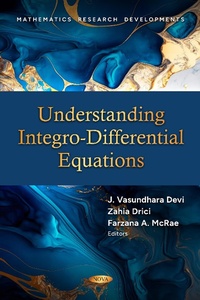
Understanding Integro-Differential Equations
Published on 18. October 2023
267 pages
979-8-89113-136-1 (ISBN)
Description

This book presents an overview of the theory of Integro-Differential Equations (InDEs). Beginning with the history of the inception of InDEs, the existence and uniqueness results for the initial value problem of InDEs is given. Next, stability concepts are discussed, including Lyapunov stability and Ulam-Rassias stability. Numerical techniques and operational matrix methods are also introduced. A specific study of second order InDEs of Fredholm InDes in complex plane is presented and an application to Finance is given.
More details
Other editions
Additional editions
J. Vasundhara Devi
Understanding Integro-Differential Equations
Book
10/2023
Nova Science Publishers Inc
€256.99
Shipment within 3-4 weeks
Content
- Intro
- UNDERSTANDING INTEGRODIFFERENTIALEQUATIONS
- UNDERSTANDING INTEGRODIFFERENTIALEQUATIONS
- Contents
- PREFACE
- Chapter 1AN OVERVIEW OF EXISTENCE RESULTS FORSOME INTEGRO-DIFFERENTIAL EQUATIONS
- Abstract
- 1. Introduction
- 2. Integral Equations
- 3. Classification of Integral Equations
- 3.1. Fredholm Integral Equation
- 3.1.1. Fredholm Integral Equation of First Kind
- 3.1.2. Fredholm Integral Equation of Second Kind
- 3.2. Volterra Integral Equation
- 3.2.1. Volterra Integral Equation of First Kind
- 3.2.2. Volterra Integral Equation of Second Kind
- 4. Integro-Differential Equations
- 4.1. Classification of Integro-Differential Equations
- 4.1.1. Fredholm Integro-Differential Equation
- 4.1.2. Fredholm Integro-Differential Equation of Second Kind
- 4.1.3. Volterra Integro-Differential Equation
- 4.1.4. Volterra-Fredhlom Integro-Differential Equation
- 5. Existence Using Fixed Point Theorems
- 5.1. Existence Result Using Tychonoff Fixed Point Theorem
- 5.2. Existence Using Schauder Fixed Point Theorem
- 6. Monotone Iterative Technique
- 6.1. InDE with Retardation and Anticipation
- 6.2. PBVP of InDE
- 6.3. MIT for Higher Order Integro-Differential Equations
- 7. Quasilinearization
- Conclusion
- References
- Chapter 2 A BRIEF OVERVIEW OF THE STABILITY THEORY OF INTEGRO-DIFFERENTIAL EQUATIONS
- Abstract
- 1. Introduction
- 2. Part I - Linear Integro-Differential Equations
- 2.1. InDE of Convolution Type
- 2.2. InDE of Convolution Type with Infinite Memory
- 2.3. Integral as Perturbation
- 2.4. Linear InDE with Nonlinear Perturbation
- 2.5. Quasilinear InDS
- 2.6. Linear Barbashin Type InDE
- 2.7. Impulsive InDS
- 3. Part II - Nonlinear Integro-Differential Equations
- 3.1. Introduction
- 3.2. Lyapunov Functionals
- 3.2.1. Existence of Lyapunov Functionals
- 3.2.2. Lyapunov Functional for a Specific Scalar InDE
- 3.2.3. Lyapunov Functional for a General Scalar InDE
- 3.3. Method of Lyapunov Functions
- 3.3.1. Stability Using Minimal Classes
- 3.4. Lyapunov Functions on Product Spaces
- 3.4.1. Stability in Two Measures
- 3.4.2. Practical Stability for InDE
- Conclusion
- References
- Chapter 3Advances in the Qualitative Theoryof Integro-Differential Equations
- Abstract
- 1. Introduction
- 2. Basic Results
- 3. Lyapunov and Lyapunov -Krasovskii QualitativeResults of IDEs
- 4. Ulam Stability, Ulam- Hyers Stability, Ulam -Hyers-RassiasStability of IDEs
- Conclusion
- References
- Chapter 4MATHEMATICAL METHODS FORINTEGRO-DIFFERENTIAL EQUATIONS ANDTHEIR APPLICATIONS
- Abstract
- 1. Introduction
- 2. Differential TransformMethod
- 2.1. Fredholm Integro-Differential Equations
- One-dimensional differential transform
- Two-dimensional differential transform
- 2.2. Higher-Order Integro-Differential Equations
- 2.3. Numerical Approach of Differential Transform Method
- 3. Numerical Results
- 4. The Adomain DecompositionMethod
- 5. The Laplace DecompositionMethod
- 5.1. Laplace Transform Method
- 6. The Variational IterationMethod
- Conclusion
- References
- Chapter 5OPERATIONAL MATRICES FOR SOLVINGFRACTIONAL ORDER INTEGRAL ANDINTEGRO-DIFFERENTIAL EQUATIONS
- Abstract
- 1. Introduction
- 2. Fractional Calculus
- 2.1. Riemann-Liouville Fractional Integral and Derivative
- 2.2. Caputo Fractional Derivative
- 3. Legendre Polynomials and Related Results
- 4. Approximation of Functions in Terms of LegendrePolynomials
- 5. Operational Matrices Based on Legendre Polynomi-als
- 5.1. The Operational Matrix of Riemann-Liouville Fractional In-tegral
- 5.2. The OperationalMatrix of the Product
- 6. Applications
- 6.1. Solving Fractional Differential Equation
- 6.2. Solving Fractional Integro-Differential Equation
- 7. Existence, Uniqueness, Stability and ConvergenceResults
- 7.1. Existence and Uniqueness
- 7.2. Ulam-Hyers Stability
- 7.3. Convergence Analysis
- Conclusion
- References
- Chapter 6 ON A SECOND ORDER NONLINEAR INTEGRO-DIFFERENTIAL EQUATION OF FREDHOLM TYPE IN A COMPLEX PLANE
- Abstract
- 1. Introduction
- 2. Preliminaries
- 3. Existence and Uniqueness
- 4. Numerical Study
- 5. Extended Study Overview
- 6. Simulation Results
- Conclusion
- References
- Chapter 7LINEAR AND NONLINEAR PARTIALINTEGRO-DIFFERENTIAL EQUATIONSARISING FROM FINANCE
- Abstract
- 1. Introduction
- 2. Background and Motivation
- 3. Preliminaries and Definitions
- 3.1. Exponential L´evy Models
- 3.2. Examples of L´evy Processes in Finance
- 3.2.1. Jump-Diffusion Models
- Merton's Model
- 3.2.2. Infinite Activity Pure Jump Models
- Variance Gamma Process
- Normal Inverse Gaussian Model
- Generalized Hyperbolic Model
- 3.3. Admissible Activity L´evy Measures
- 4. Multidimensional Linear and Nonlinear PIDE
- 4.1. Existence and Uniqueness Results of PIDE
- 4.2. Maximal Monotone Operator Technique for SolvingNonlinear Parabolic Equations
- 4.2.1. Existence and Uniqueness of a Solution to the CauchyProblem
- 5. Applications to Option Pricing
- 5.1. Linearization of PIDE
- 6. Feedback Effects under Jump-Diffusion AssetPrice Dynamics
- 6.1. Numerical Simulation for the Underlying PIDE
- 7. Hamilton-Jacobi-Bellman Equation
- 7.1. Static Markowitz Model for Portfolio Optimization
- 7.2. Riccati Transformation of the HJB Equationand Application to Optimal Portfolio Selection Problem
- 7.2.1. Riccati Transformation
- 7.2.2. Properties of the Value Function as a Diffusion Function
- 7.2.3. Point-Wise a-Priori Estimates of Solution with Their Existenceand Uniqueness
- 7.2.4. Application to Stochastic Dynamic Optimal PortfolioSelection Problem
- 7.2.5. Numerical Examples
- Conclusion
- Acknowledgments
- References
- Index
- Blank Page
