

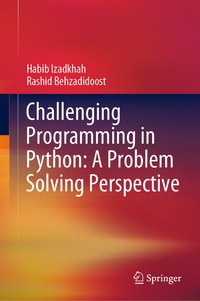
Challenging Programming in Python: A Problem Solving Perspective
Description

This book aims to strengthen programming skills and foster creative thinking by presenting and solving 90 challenging problems. The book is intended for individuals with elementary, intermediate, and advanced Python programming skills who aspire to take their abilities to the next level. Additionally, the book is valuable for individuals interested in enhancing their creative thinking and logical reasoning skills. It is a self-instructional book meant to provide readers with the ability to solve challenging problems independently. The presented challenges are lucidly and succinctly expressed, facilitating readers to follow along and comprehend the problem-solving process. The challenges cover various fields, making it suitable for a wide range of individuals.
The book is divided into eight chapters, beginning with an introduction in chapter one. The second chapter presents essential Python basics for programming challenging problems, while the subsequent chapters focuson specific types of challenges. These include math-based challenges in chapter three, number-based challenges in chapter four, string-based challenges in chapter five, game-based challenges in chapter six, count-based challenges in chapter seven, and miscellaneous challenges in chapter eight. Each chapter comprises a set of challenges with examples, hints, algorithms, and Python code solutions. The target audience of the book includes computer science and engineering students, teachers, software developers, and participants in programming competitions.
More details
Other editions
Additional editions
Persons
Dr. Habib Izadkhah is an associate professor at the Department of Computer Science, University of Tabriz, Iran. He worked in the industry for a decade as a software engineer before becoming an academic. His research interests include algorithms and graphs, software engineering, and bioinformatics. More recently, he has been working on developing and applying deep learning to a variety of problems, dealing with biomedical images, speech recognition, text understanding, and generative models. He has contributed to various research projects, authored a number of research papers in international conferences, workshops, and journals, and also has written five books, including Source Code Modularization: Theory and Techniques from Springer and Deep Learning in Bioinformatics from Elsevier.
Rashid Behzadidoost is a Ph.D. candidate in Computer Science at the University of Tabriz, Iran. He is currently pursuing his doctoral degree in Computer Science, specializing in artificial intelligence and natural language processing. Rashid has a deep passion for coding and enjoys solving challenging problems. He has obtained his skills through years of study, practice, and teaching. He has taught several courses on computer sciences including challenging programming, microprocessor, and data structure at the University of Tabriz.
Content
Introduction.- Python Basics.- Math.- Number.- String.- Game.- Count.- Miscellaneous Problems.
