

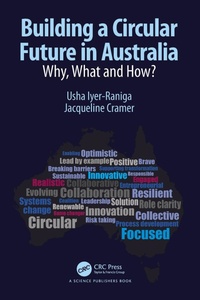
Building a Circular Future in Australia
Why, What and How?
Published on 27. January 2026
248 pages
978-1-040-74116-0 (ISBN)
Description

This book explores the transition to the circular economy through a multi-dimensional lens, highlighting its necessity for a sustainable future. It analyses both public and network governance models essential for systemic transitions and contextualises these for Australia's unique socio-political landscape. Through analyses in two key sectors-textiles and construction-the book identifies emerging trends, barriers, and opportunities. The findings reveal a fragmented but promising public and network governance approach fostering increasing collaboration across actors. The book concludes with ten actionable takeaways for implementing circular practices, underscoring the importance of enabling transformative, inclusive, and place-based circular economy transitions.
More details
Language
English
Place of publication
London
United Kingdom
Publishing group
Taylor & Francis Ltd
Target group
Professional and scholarly
Product notice
Reflowable
Illustrations
30 Tables, black and white; 8 Line drawings, color; 15 Line drawings, black and white; 8 Illustrations, color; 15 Illustrations, black and white
File size
8,00 MB
ISBN-13
978-1-040-74116-0 (9781040741160)
Copyright in bibliographic data and cover images is held by Nielsen Book Services Limited or by the publishers or by their respective licensors: all rights reserved.
Schweitzer Classification
Other editions
Additional editions
Book
01/2026
1st Edition
CRC Press
€174.10
Shipment within 10-20 days
Persons
Dr. Usha Iyer-Raniga has always worked in sustainability in the built environment and is Co-lead of Circular Built Environment (CBE), GlobalABC/One Planet Network's Materials Hub hosted by UNEP. The circularity research and engagement associated with CBE responds to Sustainable Development Goals 4, 6, 7, 8, 9, 12, 13, 15 and 17. As a practitioner-academic, Prof. Iyer-Raniga's teaching and research have been focused on accelerating the transition to sustainable and circular futures across the Global North and Global South.
Dr. Jacqueline Cramer has always combined her academic career with being a practitioner in sustainability working in both industry and government. As a university professor since 1990, she specialised in strategic environmental management, corporate social responsibility and transition management (particularly circular economy). Prof. Cramer has served on over 120 influential boards of government, industry, and non-profit organizations. From 2007-2010 she was Minister of Housing, Spatial Planning and the Environment for the Netherlands.
Dr. Jacqueline Cramer has always combined her academic career with being a practitioner in sustainability working in both industry and government. As a university professor since 1990, she specialised in strategic environmental management, corporate social responsibility and transition management (particularly circular economy). Prof. Cramer has served on over 120 influential boards of government, industry, and non-profit organizations. From 2007-2010 she was Minister of Housing, Spatial Planning and the Environment for the Netherlands.
Content
Preface. Acknowledgements. Introduction. WHY: CIRCULAR ECONOMY (CE) AND ITS IMPORTANCE. The Meaning of CE. Governance of the CE. Transitioning from Linear to a CE. WHERE: THE AUSTRALIAN CONTEXT. Background. Governance in Australia. The Emergence of CE. WHAT: CREATING THE SYSTEMIC CHANGE FOR CE IN AUSTRALIA. State of Play. Circular Clothing and Textiles. Circular Buildings and Construction. HOW: TRANSITIONING TO THE CE IN AUSTRALIA. Ten Key Takeaways for Developing and Implementing the CE in Australia. Index.
