

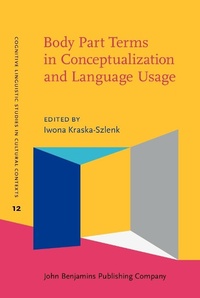
Body Part Terms in Conceptualization and Language Usage
Early Cinema's Incarnations
1st Edition
Published on 23. March 2020
319 pages
978-90-272-6166-3 (ISBN)
Description

The volume focuses on body part terms as the vehicle of embodied cognition and conceptualization. It explores the relationship between universal embodiment, language-specific cultural models and linguistic usage practices. The chapters of the volume add to the previous research in a novel way. The presentation of original data from previously undescribed languages spoken by small communities in Africa and South America allows to discover unknown aspects of embodiment and to propose new interpretations. Well-known languages are analyzed from a new perspective relying on the benefits of linguistic corpora. Contrastive and theoretically oriented studies help to pinpoint similarities and differences among languages, as well as tendencies in conceptualization patterns and semantic development of the lexis of body part terms. The volume contributes to the field of linguistics, but also to cognitive science, anthropology and cultural studies.
More details
Other editions
Additional editions
Iwona Kraska-Szlenk
Body Part Terms in Conceptualization and Language Usage
Book
03/2020
John Benjamins Publishing Co
€123.30
Shipment within 10-15 days
Content
- Intro
- Body Part Terms in Conceptualization and Language Usage
- Editorial page
- Title page
- Copyright page
- Table of contents
- Acknowledgements
- Introduction
- 1. Previous studies on embodiment and body part terms
- 2. An overview of the volume
- References
- Part 1. General and Contrastive Studies
- Linguistic embodiment in linguistic experience: A corpus-based study
- 1. Introduction
- 2. Language and thought in metaphor studies
- 3. A corpus-based study of Chinese body-part terms for "face" and "heart"
- 3.1 The Chinese "face"
- 3.2 The Chinese "heart"
- 4. Conclusion
- References
- Polysemic chains, body parts and embodiment
- 1. Perceptual and action-based grounding of cognition
- 2. Intralingual and interlingual polysemic displacement and meaning reconceptualization
- 3. Metonymy
- 4. Metonymic grammaticalization displacement chains
- 5. Metaphoricity - polysemous extensions into other domains
- 5.1. Bi-directionality of body part names polysemies
- 5.1. Metaphtonymy
- 5.2. Complex blended portmanteau forms
- 6. Interlinguistic conceptual displacement
- 7. Cultural conceptualizations and re-conceptualizations
- 8. Typology of polysemic embodied extension basis
- 9. Body schema and the Embodiment Hypothesis
- References
- Internet sources
- Body-part terms as a linguistic topic and the relevance of body-parts as tools
- 1. Introduction
- 2. Origins and structures of simplex body-part terms
- 2.1. 'Borrowed, derived and metaphorical terms for body-parts'
- 2.2. 'Compound body-part terms'
- 2.3. 'Derivations denoting body-parts'
- 3. Body-parts of objects
- 4. Body-parts with tool-functions
- 5. Conclusion
- References
- Towards a semantic lexicon of body part terms
- 1. Introduction
- 2. Embodied cognition and linguistic embodiment
- 3. Cross-linguistic tendencies in extension of body part terms
- 4. Body part terms and cross-linguistic equivalence
- 5. Equivalence of extended senses
- Concluding remarks and further research questions
- Acknowledgement
- References
- Body part terms in musical discourse
- 1. Introduction
- 2. Body part terms in organology
- 3. Body part terms in theories of musical form
- 4. Body part terms in Western notation practice
- 5. Conclusion
- References
- Part 2. Grammaticalization Studies
- 'Body' and the relationship between verb and participants
- 1. The aim of the study
- 2. The problem
- 3. Co-referentiality of arguments within the clause in Pero
- 4. Other grammatical function of the noun 'cíg' 'body'
- 4.1 Hypothesis 1: Classes of verbs
- 4.2 Contrast between the form cíg, its absence, and other morphemes in the same position
- 4.3 Classes of nouns as a factor in the use of cíg?
- 4.4 An overarching hypothesis
- 5. Marking the pronominal object as evidence for the non-affectedness function of the form 'cíg'
- 5.1 Conclusions about Pero
- 6. Body in Mina and Lele
- 6.1 Mina
- 6.2 Lele
- 7. Conclusions
- References
- On the grammatical uses of the 'head' in Wolof: From reflexivity to intensifying uses
- 1. Introduction
- 2. The noun 'bopp' 'head' and why it did not grammaticalize into a locative marker
- 3. The reflexive pronoun
- 3.1 Direct Reflexive vs. Middle construction
- 3.2 Oblique reflexives
- 3.3 Genitive (possessive) reflexives
- 4. The prepositional reflexive as an adnominal intensifier
- 4.1 Emphasizing agentivity ('by him or herself')
- 4.2 Emphasizing identity ('in person', 'per se', 'the actual one')
- 4.3 Emphasizing the inclusion in an ordered list ('even him or her')
- 4.4 Semantic continuity, limits and motivation: Comparison with 'ci wàllu boppam'
- 5. Conclusion
- Aknowledments
- References
- Multifaceted body parts in Murui: A case study from Northwest Amazonia
- 1. Typological profile of Murui
- 2. Murui body part terms and grammaticalization
- 2.1 The domain of spatial orientation and time
- 2.2 The domain of comparison
- 2.3 The domain of counting
- 2.4 The domain of 'self'
- 3. Summary
- References
- Appendix
- Part 3. Lexical Case Studies
- The metonymic folk model of language in Turkish
- 1. Introduction
- 2. Data collection and analysis
- 3. Conceptualizations of 'dil' 'tongue'
- 3.1 Tongue for speaking
- 3.2 Tongue for speech
- 3.3 Tongue for language
- 4. Conceptualizations of 'agız' 'mouth'
- 4.1 Mouth for speaking
- 4.2 Mouth for speech
- 4.3 Mouth for language (subdialect)
- 5. Conceptualizations of 'dudak' 'lip'
- 6. Conceptualizations of 'çene' 'chin'
- 7. Conceptualizations of 'ses' 'voice'
- 8. Discussion
- 9. Conclusion
- Acknowledgements
- References
- Dictionaries
- Keeping an eye on body parts: Cultural conceptualizations of the 'eye' in Hungarian
- 1. Introduction
- 2. Conceptualization of body parts
- 2.1 Embodiment in language
- 2.2 Previous research on 'eye'
- 3. Meanings of 'szem' 'eye'
- 4. Conceptualizations of 'szem'
- 4.1 Szem as the SEAT OF CULTURAL VALUES
- 4.1.1 Conceptualizations of morality and conscience
- 4.1.2 Conceptualizations of respect
- 4.2 PERCEPTION/ALERTNESS
- 4.3 SZEM as the SEAT OF INTELLECT
- 4.4 SZEM as the SEAT OF EMOTION
- 4.5 BEHAVIOR
- 4.6 INTERPERSONAL POWER, CONTROL and the cultural schema EVIL EYE
- 4.7 Summary
- 5. Spatial metaphors related to 'szem': The case study of 'szeme közé'
- 6. Conclusion
- References
- The conceptualization of 'ido' 'eye' in Hausa
- 1. Introduction
- 2. 'Ido' 'eye' as body part
- 3. The figurative uses of 'ido' 'eye'
- 3.1. The lexicalization of ido in compounds
- 3.2. Ido as an instrument for looking
- 3.3. Ido and the conceptualization of sight
- 3.4. Ido in the domain of knowledge
- 3.5. Ido in the domain of attention
- 3.6. Ido in the domains of decision and measurement
- 3.7. Ido as indicator of emotions
- 3.8. Ido as character traits
- 4. Reflexivity
- 5. Conclusion
- Acknowledgement
- References
- Conceptualisations of entrails in English and Polish
- 1. Introduction
- 2. Conceptualisations of guts in the English language
- 2.1. The bowels as the seat of emotions
- 2.2. Entrails as the location of true feelings and emotions
- 2.3. The GUTS ARE KNOWLEDGE/ EMOTIONS metaphor
- 2.4. Metonymical and metaphorical extensions
- 2.5. The figurative association between entrails and courage
- 2.6. Guts in the process of grammaticalisation and word formation
- 2.7. Other conceptualisations
- 3. Conceptualisations of guts in Polish
- 4. Summary
- Acknowledgement
- References
- Cultural conceptualisations of 'nawsk' 'belly/stomach' in Kurdish
- 1. Introduction
- 2. The language and its speakers
- 3. Synopsis of the research design, method, and sources of data
- 4. Cultural linguistics
- 5. 'Sk' and 'Nawsk' conceptual categories
- 5.1 'Sk' category
- 5.2 Nawsk category
- 6. 'Nawsk' and conceptualisations of emotions in Kurdish
- 6.1 Nawsk as love, passion, and intimacy
- 6.2 Nawsk as sympathy, empathy, and pity
- 6.3 Nawsk as hate, curse, and revenge
- 6.4 Nawsk as complain, fear, and anger
- 7. 'Nawsk' conceptualisations and personality traits, character and mood
- 7.1 Wicked and devilish
- 7.2 Gluttonous and insatiable
- 7.3 Opportunistic and greedy
- 7.4 An abusive person
- 7.5 A nag
- 8. 'Nawsk' and conceptual metaphor
- 8.1 Nawsk can be filled or emptied
- 8.2 Nawsk can be tightened or torn
- 9. Conceptualisations of 'Nawsk' in Kurdish literature
- 10. Concluding remarks
- References
- Index
