

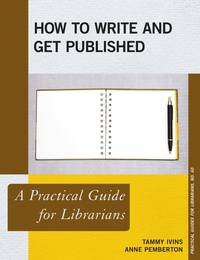
How to Write and Get Published
A Practical Guide for Librarians
1st Edition
Published on 22. April 2019
160 pages
979-8-7651-7342-8 (ISBN)
Description

Selected as a 2025 Doody's Core Title
Written by two librarians with extensive publication experience, this book provides practical techniques and tools to prepare librarians to publish successfully. This book is neither a research methodology nor a 'craft of writing' book. Instead, its sole goal is to help librarians (and other information science professionals) start writing, identify an outlet for publication, and publish successfully. It dispels the mythos surrounding "scholarly writing" by providing practical tools and advice to help soon-to-be authors get started on the publication journey now.
This book will guide aspiring authors step-by-step through the writing and publication process, from nurturing an idea to fruition all the way to enjoying a successful publication. Along the way, readers will learn how to identify the best publication type and venue, gather the needed information to make a convincing argument, and skillfully manage even the most complex project. Topics range from cerebral (such as how to maintain motivation through a project) to technical (such as common grammar and vocabulary errors), but all are designed to be practical and of immediate use to a writer.
Whether a graduate student at the beginning of your career in the field of information sciences, a newly minted librarian fresh out of graduate school, a library administrator at the peak of your career, or somewhere in between, publishing can keep you engaged in the issues facing the profession and enhance your career and professional success. Readers will be inspired and ready to contribute to library scholarship and start building their own successful scholarly habit.
Written by two librarians with extensive publication experience, this book provides practical techniques and tools to prepare librarians to publish successfully. This book is neither a research methodology nor a 'craft of writing' book. Instead, its sole goal is to help librarians (and other information science professionals) start writing, identify an outlet for publication, and publish successfully. It dispels the mythos surrounding "scholarly writing" by providing practical tools and advice to help soon-to-be authors get started on the publication journey now.
This book will guide aspiring authors step-by-step through the writing and publication process, from nurturing an idea to fruition all the way to enjoying a successful publication. Along the way, readers will learn how to identify the best publication type and venue, gather the needed information to make a convincing argument, and skillfully manage even the most complex project. Topics range from cerebral (such as how to maintain motivation through a project) to technical (such as common grammar and vocabulary errors), but all are designed to be practical and of immediate use to a writer.
Whether a graduate student at the beginning of your career in the field of information sciences, a newly minted librarian fresh out of graduate school, a library administrator at the peak of your career, or somewhere in between, publishing can keep you engaged in the issues facing the profession and enhance your career and professional success. Readers will be inspired and ready to contribute to library scholarship and start building their own successful scholarly habit.
More details
Other editions
Additional editions
Book
04/2019
Rowman & Littlefield Publishers
€101.00
Shipment within 3-4 weeks
Persons
Tammy Ivins is currently the Online & Distance Education Librarian at the University of North Carolina Wilmington (UNCW). She received a BA in Theatre and Classical Studies from Davidson College, NC before falling love with libraries. She went on to get her MA in Library Science from the University of North Carolina at Chapel Hill in 2011, and she is currently pursuing an MA in Conflict Management and Resolution from UNCW. She previously served as a Reference Library and later Head of Reference at Francis Marion University and prior to that as the Archives Fellow at Davidson College.
Anne Pemberton is currently the Associate Director of Research and Instructional Services and Library Assessment at the University of North Carolina Wilmington (UNCW). She received her Bachelor of Arts degree in Psychology in 1997 from the University of Tennessee, her Master of Science degree in Information Sciences in 2000 from the University of Tennessee, and her Master of Science degree in Instructional Technology in 2012 from the UNCW. She previously served as the Social Sciences Librarian at the University of Tennessee and prior to that as Library Fellow at North Carolina State University.
Anne Pemberton is currently the Associate Director of Research and Instructional Services and Library Assessment at the University of North Carolina Wilmington (UNCW). She received her Bachelor of Arts degree in Psychology in 1997 from the University of Tennessee, her Master of Science degree in Information Sciences in 2000 from the University of Tennessee, and her Master of Science degree in Instructional Technology in 2012 from the UNCW. She previously served as the Social Sciences Librarian at the University of Tennessee and prior to that as Library Fellow at North Carolina State University.
Content
Preface
Part 1: Should I really do this?
Chapter 1 Deciding to Write
Chapter 2 Picking a Topic
Chapter 3 Choosing a Publication Type
Chapter 4 Getting Started Through Conferences
Part 2: Okay, I'm ready to try writing
Chapter 5 Getting Organized
Chapter 6 Collecting Sources
Chapter 7 Writing It
Chapter 8 Maintaining Motivation
Part 3: Ohmaigosh, I've really written something!
Chapter 9 Choosing a Scholarly Journal
Chapter 10 Surviving the Publication Process
Chapter 11 Thriving After Publication
Appendices
Appendix 1: Brainstorming Topics for Writing
Appendix 2: Identifying Conferences
Appendix 3: BEAM Planner
Appendix 4: Chapter 7 Activities - Answer Key
Appendix 5: Jump Over Those Hurdles
Appendix 6: Identifying Journals
Bibliography
Index
About the Authors
Part 1: Should I really do this?
Chapter 1 Deciding to Write
Chapter 2 Picking a Topic
Chapter 3 Choosing a Publication Type
Chapter 4 Getting Started Through Conferences
Part 2: Okay, I'm ready to try writing
Chapter 5 Getting Organized
Chapter 6 Collecting Sources
Chapter 7 Writing It
Chapter 8 Maintaining Motivation
Part 3: Ohmaigosh, I've really written something!
Chapter 9 Choosing a Scholarly Journal
Chapter 10 Surviving the Publication Process
Chapter 11 Thriving After Publication
Appendices
Appendix 1: Brainstorming Topics for Writing
Appendix 2: Identifying Conferences
Appendix 3: BEAM Planner
Appendix 4: Chapter 7 Activities - Answer Key
Appendix 5: Jump Over Those Hurdles
Appendix 6: Identifying Journals
Bibliography
Index
About the Authors
