

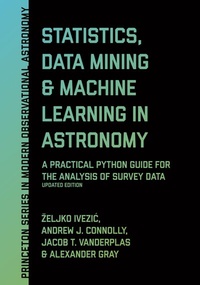
Statistics, Data Mining, and Machine Learning in Astronomy
A Practical Python Guide for the Analysis of Survey Data, Updated Edition
1st Edition
Published on 10. February 2020
552 pages
978-0-691-19705-0 (ISBN)
Description

Statistics, Data Mining, and Machine Learning in Astronomy is the essential introduction to the statistical methods needed to analyze complex data sets from astronomical surveys such as the Panoramic Survey Telescope and Rapid Response System, the Dark Energy Survey, and the Large Synoptic Survey Telescope. Now fully updated, it presents a wealth of practical analysis problems, evaluates the techniques for solving them, and explains how to use various approaches for different types and sizes of data sets. Python code and sample data sets are provided for all applications described in the book. The supporting data sets have been carefully selected from contemporary astronomical surveys and are easy to download and use. The accompanying Python code is publicly available, well documented, and follows uniform coding standards. Together, the data sets and code enable readers to reproduce all the figures and examples, engage with the different methods, and adapt them to their own fields of interest.
An accessible textbook for students and an indispensable reference for researchers, this updated edition features new sections on deep learning methods, hierarchical Bayes modeling, and approximate Bayesian computation. The chapters have been revised throughout and the astroML code has been brought completely up to date. - Fully revised and expanded
- Describes the most useful statistical and data-mining methods for extracting knowledge from huge and complex astronomical data sets
- Features real-world data sets from astronomical surveys
- Uses a freely available Python codebase throughout
- Ideal for graduate students, advanced undergraduates, and working astronomers
An accessible textbook for students and an indispensable reference for researchers, this updated edition features new sections on deep learning methods, hierarchical Bayes modeling, and approximate Bayesian computation. The chapters have been revised throughout and the astroML code has been brought completely up to date. - Fully revised and expanded
- Describes the most useful statistical and data-mining methods for extracting knowledge from huge and complex astronomical data sets
- Features real-world data sets from astronomical surveys
- Uses a freely available Python codebase throughout
- Ideal for graduate students, advanced undergraduates, and working astronomers
More details
Other editions
Additional editions
Zeljko Ivezic | Andrew J. Connolly | Jacob T. VanderPlas
Statistics, Data Mining, and Machine Learning in Astronomy
A Practical Python Guide for the Analysis of Survey Data, Updated Edition
Book
12/2019
Princeton University Press
€101.50
Shipment within 10-20 days
Persons
Zeljko Ivezic is professor of astronomy at the University of Washington. Andrew J. Connolly is professor of astronomy at the University of Washington. Jacob T. VanderPlas is a software engineer at Google. Alexander Gray is vice president of AI science at IBM.
Content
- Cover
- Contents
- Preface
- I: Introduction
- 1. About the Book and Supporting Material
- 1.1 What Do Data Mining, Machine Learning, and Knowledge Discovery Mean?
- 1.2 What Is This Book About?
- 1.3 An Incomplete Survey of the Relevant Literature
- 1.4 Introduction to the Python Language and the Git Code Management Tool
- 1.5 Description of Surveys and Data Sets Used in Examples
- 1.6 Plotting and Visualizing the Data in This Book
- 1.7 How to Efficiently Use This Book
- References
- 2. Fast Computation on Massive Data Sets
- 2.1 Data Types and Data Management Systems
- 2.2 Analysis of Algorithmic Efficiency
- 2.3 Seven Types of Computational Problem
- 2.4 Eight Strategies for Speeding Things Up
- 2.5 Case Studies: Speedup Strategies in Practice
- References
- II: Statistical Frameworks and Exploratory Data Analysis
- 3. Probability and Statistical Distributions
- 3.1 Brief Overview of Probability and Random Variables
- 3.2 Descriptive Statistics
- 3.3 Common Univariate Distribution Functions
- 3.4 The Central Limit Theorem
- 3.5 Bivariate and Multivariate Distribution Functions
- 3.6 Correlation Coefficients
- 3.7 Random Number Generation for Arbitrary Distributions
- References
- 4. Classical Statistical Inference
- 4.1 Classical vs. Bayesian Statistical Inference
- 4.2 Maximum Likelihood Estimation (MLE)
- 4.3 The Goodness of Fit and Model Selection
- 4.4 ML Applied to Gaussian Mixtures: The Expectation Maximization Algorithm
- 4.5 Confidence Estimates: The Bootstrap and the Jackknife
- 4.6 Hypothesis Testing
- 4.7 Comparison of Distributions
- 4.8 Nonparametric Modeling and Histograms
- 4.9 Selection Effects and Luminosity Function Estimation
- 4.10 Summary
- References
- 5. Bayesian Statistical Inference
- 5.1 Introduction to the Bayesian Method
- 5.2 Bayesian Priors
- 5.3 Bayesian Parameter Uncertainty Quantification
- 5.4 Bayesian Model Selection
- 5.5 Nonuniform Priors: Eddington, Malmquist, and Lutz-Kelker Biases
- 5.6 Simple Examples of Bayesian Analysis: Parameter Estimation
- 5.7 Simple Examples of Bayesian Analysis: Model Selection
- 5.8 Numerical Methods for Complex Problems (MCMC)
- 5.9 Hierarchical Bayesian Modeling
- 5.10 Approximate Bayesian Computation
- 5.11 Summary of Pros and Cons for Classical and Bayesian Methods
- References
- III: Data Mining and Machine Learning
- 6. Searching for Structure in Point Data
- 6.1 Nonparametric Density Estimation
- 6.2 Nearest-Neighbor Density Estimation
- 6.3 Parametric Density Estimation
- 6.4 Finding Clusters in Data
- 6.5 Correlation Functions
- 6.6 Which Density Estimation and Clustering Algorithms Should I Use?
- References
- 7. Dimensionality and Its Reduction
- 7.1 The Curse of Dimensionality
- 7.2 The Data Sets Used in This Chapter
- 7.3 Principal Component Analysis
- 7.4 Nonnegative Matrix Factorization
- 7.5 Manifold Learning
- 7.6 Independent Component Analysis and Projection Pursuit
- 7.7 Which Dimensionality Reduction Technique Should I Use?
- References
- 8. Regression and Model Fitting
- 8.1 Formulation of the Regression Problem
- 8.2 Regression for Linear Models
- 8.3 Regularization and Penalizing the Likelihood
- 8.4 Principal Component Regression
- 8.5 Kernel Regression
- 8.6 Locally Linear Regression
- 8.7 Nonlinear Regression
- 8.8 Uncertainties in the Data
- 8.9 Regression That Is Robust to Outliers
- 8.10 Gaussian Process Regression
- 8.11 Overfitting, Underfitting, and Cross-Validation
- 8.12 Which Regression Method Should I Use?
- References
- 9. Classification
- 9.1 Data Sets Used in This Chapter
- 9.2 Assigning Categories: Classification
- 9.3 Generative Classification
- 9.4 K-Nearest-Neighbor Classifier
- 9.5 Discriminative Classification
- 9.6 Support Vector Machines
- 9.7 Decision Trees
- 9.8 Deep Learning and Neural Networks
- 9.9 Evaluating Classifiers: ROC Curves
- 9.10 Which Classifier Should I Use?
- References
- 10. Time Series Analysis
- 10.1 Main Concepts for Time Series Analysis
- 10.2 Modeling Toolkit for Time Series Analysis
- 10.3 Analysis of Periodic Time Series
- 10.4 Temporally Localized Signals
- 10.5 Analysis of Stochastic Processes
- 10.6 Which Method Should I Use for Time Series Analysis?
- References
- IV: Appendices
- A. An Introduction to Scientific Computing with Python
- A.1 A Brief History of Python
- A.2 The SciPy Universe
- A.3 Getting Started with Python
- A.4 IPython: The Basics of Interactive Computing
- A.5 Introduction to NumPy
- A.6 Visualization with Matplotlib
- A.7 Overview of Useful NumPy/SciPy Modules
- A.8 Efficient Coding with Python and NumPy
- A.9 Wrapping Existing code in Python
- A.10 Other Resources
- B. AstroML: Machine Learning for Astronomy
- B.1 Introduction
- B.2 Dependencies
- B.3 Tools Included in AstroML v1.0
- B.4 Open Source Deep Learning Libraries
- C. Astronomical Flux Measurements and Magnitudes
- C.1 The Definition of the Specific Flux
- C.2 Wavelength Window Function for Astronomical Measurements
- C.3 The Astronomical Magnitude Systems
- D. SQL Query for Downloading SDSS Data
- E. Approximating the Fourier Transform with the FFT
- References
- Visual Figure Index
- Index
- Color Plates
