

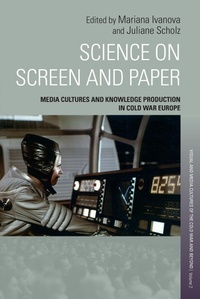
Science on Screen and Paper
Description

During the Cold War, scientific discoveries were adapted and critiqued in many different forms of media across a divided Europe. Now, more than 30 years since the end of the Cold War, Science on Screen and Paper explores the intersections between scientific research and media by drawing from media history, film studies, and the history of science. From public relations material to educational and science films, from children's magazines to television broadcasts, the contributions in this collected volume seek to embrace medial differences and focus on intersectional themes and strategies for the representation of science.
More details
Other editions
Additional editions
Persons
Mariana Ivanova is Associate Professor for German Film and Media and the Academic Director of the DEFA Film Library at the University of Massachusetts Amherst. Her monograph, Cinema of Collaboration (Berghahn Books, 2019) was finalist for the international Willy Haas award. Her research has been published in The German Studies Review, The Historical Journal of Film, Radio and Television, and in numerous edited volumes on East German and Central European cinema.
Content
List of Illustrations
List of Acronyms
Introduction: Science and Media in Cold War Europe
Mariana Ivanova and Juliane Scholz
Part I: Institutional and Industrial Contexts
Chapter 1. Whitewashing the Nazi Past: Continuity and Transformation in Scientific Cinematography in Germany, 1934-1956
Juliane Scholz
Chapter 2. Flow Vis for the Space Race: German Science Films in US Education During the Cold War
Mario Schulze
Chapter 3. Raw Film Manufacturing: Between Economic Efficiency and Environmental Awareness in East Germany
Josephine Diecke
Part II: Imaginaries of Self and Other
Chapter 4. Between Cooperation and Competition: Cold War Imaginaries and Representations of US-Soviet Encounters in Space
Darina Volf
Chapter 5. Post-Colonial Science Heroes in East German Science Fiction Films
Evan Torner
Chapter 6. The Culture of Anticipation and Scientific Fiction in Socialist Romania
Doru Aurel Pop
Chapter 7. (Un)Healthy Tunes: Body, Mind, and Music in Socialist Television
Sandra Schnädelbach
Part III: Science in Public and Educational Media
Chapter 8. Science for Children and Adults: The Space Race in Italian Communist Party Publications, 1957-1964
Ettore Costa
Chapter 9. "Effective Films:" Science Film and Education in East Germany
Sophia Gräfe and Kerrin von Engelhardt
Chapter 10. German Technology and Education for 'Young Nations:' Cold War Politics and Aesthetics of Development Aid in two West German Governmental PR Films of 1961
Jan Uelzmann
Chapter 11. French Educational Films for Africa: The Question of Decolonization in the 1960s and 1970s
Sarah Stein
