

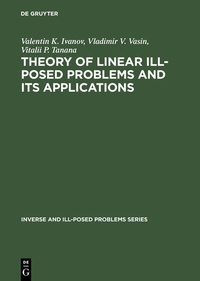
Theory of Linear Ill-Posed Problems and its Applications
1st Edition
Published on 18. February 2013
XIII, 281 pages
978-3-11-094482-2 (ISBN)
Description

This monograph is a revised and extended version of the Russian edition from 1978. It includes the general theory of linear ill-posed problems concerning e. g. the structure of sets of uniform regularization, the theory of error estimation, and the optimality method. As a distinguishing feature the book considers ill-posed problems not only in Hilbert but also in Banach spaces.
It is natural that since the appearance of the first edition considerable progress has been made in the theory of inverse and ill-posed problems as wall as in ist applications. To reflect these accomplishments the authors included additional material e. g. comments to each chapter and a list of monographs with annotations.
More details
Other editions
Additional editions
Valentin K. Ivanov | Vladimir V. Vasin | Vitalii P. Tanana
Theory of Linear Ill-Posed Problems and its Applications
Book
07/2002
VSP International Science Publishers
€269.00
Article exhausted; check different version
Valentin K. Ivanov | Vladimir V. Vasin | Vitalii P. Tanana
Theory of Linear Ill-Posed Problems and its Applications
Book
01/2002
1st Edition
De Gruyter
€399.00
Article exhausted; check different version

Valentin K. Ivanov | Vladimir V. Vasin | Vitalii P. Tanana
Theory of Linear Ill-Posed Problems and its Applications
Book
De Gruyter
€109.95
Shipment within 5-7 days
Persons
Valentin K. Ivanov ┼; Vladimir V. Vasin, Institute of Mathematics and Mechanics, Russian Academy of Sciences, Ekaterinburg, Russia; Vitalii P. Tanana, South Ural State University, Chelyabinsk, Russia.
Content
- Intro
- Introduction
- Chapter 1. Well-posedness of problems
- 1.1. Problem formulation. Hadamard's concept of well-posedness
- 1.2. Examples of ill-posed problems
- 1.3. Tikhonov's concept of well-posedness. Sets of well-posedness
- 1.4. Stability theorems and their applications
- 1.5. Normal solvability of operator equations
- 1.6. Quasisolutions on compact and boundedly compact sets
- Chapter 2. Regularizing family of operators
- 2.1. Pointwise and uniform regularization of operator equations
- 2.2. Geometric theorems on structure of boundedly compact sets
- 2.3. Uniform regularization of equations with completely continuous operators
- 2.4. Structure of sets of uniform regularization in Hilbert spaces
- 2.5. Sets of uniform regularization for continuous operators
- Chapter 3. Basic techniques for constructing regularizing algorithms
- 3.1. Reduction to operator equations of the second kind
- 3.2. Method of quasisolutions
- 3.3. Tikhonov's method of regularization
- 3.4. Method of residual
- 3.5. On relations between variational methods
- 3.6. Generalized method of residual
- 3.7. Method based on the Picard theorem
- 3.8. Iterative methods
- 3.9. Regularization of the Fredholm integral equations of the first kind
- 3.10. Regularization methods for differential equations
- Chapter 4. Optimality and stability of methods for solving ill-posed problems. Error estimation
- 4.1. Classification of ill-posed problems and the concept of an optimal method
- 4.2. Lower estimate for error of the optimal method
- 4.3. Error of the regularization method
- 4.4. Algorithmic peculiarities of the generalized method of residual
- 4.5. Error of the quasisolution method
- 4.6. The regularization method with the parameter a satisfying the residual principle
- 4.7. Investigation of the simplest scheme of the Lavrent'ev method
- 4.8. The method of projective regularization
- 4.9. Calculation of the module of continuity
- Chapter 5. Determination of values of unbounded operators
- 5.1. A unified approach to the solution of ill-posed problems
- 5.2. Multivalued linear operators and their properties
- 5.3. Determination of normal values of linear operators by variational methods
- 5.4. The best approximation of unbounded operators
- 5.5. Optimal regularization of the problem of evaluating a derivative in the space C(-8, 8)
- Chapter 6. Finite-dimensional approximation of regulirizing algorithms
- 6.1. The concept of r-uniform convergence of linear operators
- 6.2. A general scheme of the finite-dimensional approximation
- 6.3. Application of the general scheme
- 6.4. Projection method
- 6.5. Necessary and sufficient conditions for convergence of the projection method
- 6.6. Error estimation
- 6.7. Numerical applications
- Bibliography
- Additional Bibliography to the Second Edition
- Comments to Additional Bibliography
- Index
