

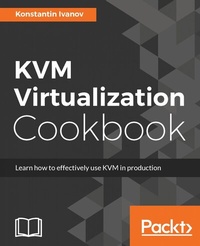
KVM Virtualization Cookbook
Learn how to use KVM effectively in production
Published on 8. July 2025
340 pages
978-1-78829-150-7 (ISBN)
Description

Deploy, manage, and scale virtual instances using Kernel-based Virtual Machines
Key Features
- Build, manage and scale virtual machines with practical step-by-step examples
- Leverage the libvirt user-space tools and libraries to manage the life-cycle of KVM instances
- Deploy and scale applications inside KVM virtual machines with OpenStack
Book DescriptionVirtualization technologies such as KVM allow for better control over the available server resources, by deploying multiple virtual instances on the same physical host, or clusters of compute resources. With KVM it is possible to run various workloads in isolation with the hypervisor layer providing better tenant isolation and higher degree of security. This book will provide a deep dive into deploying KVM virtual machines using qemu and libvirt and will demonstrate practical examples on how to run, scale, monitor, migrate and backup such instances. You will also discover real production ready recipes on deploying KVM instances with OpenStack and how to programatically manage the life cycle of KVM virtual machines using Python. You will learn numerous tips and techniques which will help you deploy & plan the KVM infrastructure. Next, you will be introduced to the working of libvirt libraries and the iPython development environment. Finally, you will be able to tune your Linux kernel for high throughput and better performance. By the end of this book, you will gain all the knowledge needed to be an expert in working with the KVM virtualization infrastructure. What you will learn
- Deploy different workloads in isolation with KVM virtualization and better utilize the available compute resources
- Explore the benefits of running applications with KVM and learn to prevent the "bad-neighbor" effect
- Leveraging various networking technologies in the context of virtualization with Open vSwitch and the Linux bridge.
- Create KVM instances using Python and inspect running KVM instances
- Understand Kernel Tuning for enhanced KVM performance and better memory utilization
Who this book is forIf you are a system administrator working KVM virtualization, this book will help you grow on your expertise of working with the infrastructure to manage things in a better way. You should have a knowledge of working with Linux based systems.
Key Features
- Build, manage and scale virtual machines with practical step-by-step examples
- Leverage the libvirt user-space tools and libraries to manage the life-cycle of KVM instances
- Deploy and scale applications inside KVM virtual machines with OpenStack
Book DescriptionVirtualization technologies such as KVM allow for better control over the available server resources, by deploying multiple virtual instances on the same physical host, or clusters of compute resources. With KVM it is possible to run various workloads in isolation with the hypervisor layer providing better tenant isolation and higher degree of security. This book will provide a deep dive into deploying KVM virtual machines using qemu and libvirt and will demonstrate practical examples on how to run, scale, monitor, migrate and backup such instances. You will also discover real production ready recipes on deploying KVM instances with OpenStack and how to programatically manage the life cycle of KVM virtual machines using Python. You will learn numerous tips and techniques which will help you deploy & plan the KVM infrastructure. Next, you will be introduced to the working of libvirt libraries and the iPython development environment. Finally, you will be able to tune your Linux kernel for high throughput and better performance. By the end of this book, you will gain all the knowledge needed to be an expert in working with the KVM virtualization infrastructure. What you will learn
- Deploy different workloads in isolation with KVM virtualization and better utilize the available compute resources
- Explore the benefits of running applications with KVM and learn to prevent the "bad-neighbor" effect
- Leveraging various networking technologies in the context of virtualization with Open vSwitch and the Linux bridge.
- Create KVM instances using Python and inspect running KVM instances
- Understand Kernel Tuning for enhanced KVM performance and better memory utilization
Who this book is forIf you are a system administrator working KVM virtualization, this book will help you grow on your expertise of working with the infrastructure to manage things in a better way. You should have a knowledge of working with Linux based systems.
All prices
More details
Edition
Digital original
Language
English
Place of publication
Birmingham
United Kingdom
Target group
Professional and scholarly
US School Grade: College Graduate Student
Edition type
Digital original
File size
1,25 MB
ISBN-13
978-1-78829-150-7 (9781788291507)
Copyright in bibliographic data and cover images is held by Nielsen Book Services Limited or by the publishers or by their respective licensors: all rights reserved.
Schweitzer Classification
Other editions
Additional editions
Konstantin Ivanov
KVM Virtualization Cookbook
Book
06/2017
Packt Publishing
€69.20
Shipment within 3-4 weeks
Person
Ivanov Konstantin :
Konstantin Ivanov is a Linux Systems Engineer, an open source developer, and a technology blogger who has been designing, configuring, deploying, and administering large-scale, highly available Linux environments for more than 15 years. His interests include large distributed systems and task automation, along with solving technical challenges involving multiple technology stacks. Konstantin received two Master of Science in Computer Science degrees from universities in Bulgaria and the United States, specializing in System and Network security and Software engineering. In his spare time, he loves writing technology blogs and spending time with his two boys.
Konstantin Ivanov is a Linux Systems Engineer, an open source developer, and a technology blogger who has been designing, configuring, deploying, and administering large-scale, highly available Linux environments for more than 15 years. His interests include large distributed systems and task automation, along with solving technical challenges involving multiple technology stacks. Konstantin received two Master of Science in Computer Science degrees from universities in Bulgaria and the United States, specializing in System and Network security and Software engineering. In his spare time, he loves writing technology blogs and spending time with his two boys.
Content
Table of Contents
Getting Started with QEMU and KVM
Using libvirt to Manage KVM
KVM Networking with libvirt
Migrating KVM Instances
Monitoring and Backup of KVM Virtual Machines
Deploying KVM Instances with OpenStack
Using Python to Build and Manage KVM Instances
Kernel Tuning for KVM Performance
Getting Started with QEMU and KVM
Using libvirt to Manage KVM
KVM Networking with libvirt
Migrating KVM Instances
Monitoring and Backup of KVM Virtual Machines
Deploying KVM Instances with OpenStack
Using Python to Build and Manage KVM Instances
Kernel Tuning for KVM Performance

