

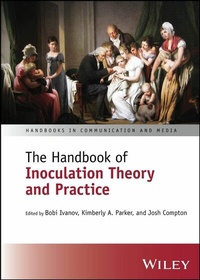
The Handbook of Inoculation Theory and Practice
Description

Provides a comprehensive account of inoculation theory across multiple disciplines and applied contexts worldwide
Inoculation theory has become one of the most influential frameworks for understanding how people resist persuasion, misinformation, and undue influence. Despite its wide-ranging application in fields as diverse as political communication, health promotion, advertising, organizational management, law, and public relations, much of the available literature on inoculation remains scattered across journal articles and limited book chapters. The Handbook of Inoculation Theory and Practice addresses this critical gap by offering a single, authoritative resource that brings together the full scope of theory, research, and application.
Spanning 35 chapters organized into three major sections, the Handbook provides unparalleled depth and breadth. The opening section traces the foundations of inoculation theory, its historical development, and evolving conceptual frameworks. The second section addresses issues of study design, measurement, and analytic strategies essential to advancing inoculation research. The volume concludes by highlighting applications across a wide spectrum of contexts, including politics, health, sports, crisis communication, gaming, education, journalism, public policy, and beyond. Featuring contributions from leading scholars, each chapter delivers both rigorous theoretical grounding and forward-looking perspectives that reveal how inoculation continues to shape communication practice and research.
Mapping what inoculation theory has achieved while exploring its enduring potential in confronting today's complex communication challenges, The Handbook of Inoculation:
- Integrates classical perspectives with cutting-edge research and applications
- Explores a wide range of real-world contexts, from misinformation and conspiracy theories to health and political messaging
- Offers practical strategies for designing effective inoculation-based communication interventions
- Identifies emerging questions and future directions for inoculation research and practice
The Handbook of Inoculation: Theory and Practice is an essential reference for graduate students, scholars, and practitioners working in communication, psychology, sociology, political science, marketing, public health, and related disciplines. It is especially relevant for advanced courses in persuasion, social influence, communication theory, social psychology, and resistance to persuasion, and serves as a foundational resource for researchers and professionals seeking to apply inoculation strategies in diverse contexts.
More details
Other editions
Additional editions
Persons
Bobi Ivanov is a Professor of Advertising in the College of Journalism and Communications at the University of Florida. His research focuses on social influence, persuasion, and resistance, with an emphasis on inoculation theory, strategic message design, advertising, and risk communication. He has published extensively in leading journals and contributed to advancing inoculation scholarship across multiple domains.
Kimberly A. Parker is a Professor in the University of Kentucky College of Communication and Information. A former Fulbright Scholar, she studies social influence, persuasive communication, and resistance, with a focus on promoting positive social change. With 25 years of nonprofit collaboration experience, Dr. Parker has published widely and applies her expertise to both academic and applied contexts.
Josh Compton is Professor of Speech at Dartmouth College. Internationally recognized for his expertise on inoculation theory, he has studied the field for more than two decades, publishing influential work that has sparked conversations among groups as varied as NATO, the U.S. Department of Defense, healthcare professionals, and medievalists.
Content
Notes on Contributors xi
Acknowledgements xviii
Introduction to Inoculation Theory and Strategy 1
Bobi Ivanov, Kimberly A. Parker, and Josh Compton
Part 1 Theory
1 Origins of Inoculation Theory 15
John A. Banas and Elena Bessarabova
2 Threat 29
Josh Compton
3 Inoculation Theory and Counterarguing 43
John A. Banas and Elena Bessarabova
4 Inoculation Theory Then and Now: Extending the Boundaries of Theory and Practice 57
Alicia M. Mason Copyrighted Material
5 Beyond Threat and Counterarguing: A Consideration of Additional Inoculation Theory Mechanisms 69
Shelley L. Wigley and Michel M. Haigh
6 The Nature of Resistance: Mechanisms in Inoculation Theory vis- à- vis Alternative Theories/Models 83
Lijiang Shen
7 Exploring the Interplay of Temporal Factors and Resistance Within Inoculation Theory 97
Jacob J. Matig
8 Persuasive Inoculation Message Design Features: Style, Language, Content, and Structure 109
Bobi Ivanov and Lindsay L. Dillingham
9 Inoculation: Length and Modality 123
Sarah A. Geegan and Kimberly A. Parker
10 (Mis)Matching in Inoculation: The Impact of Composition, Strength, Structure, and Modality Between and Within Established Positions and Messages 137
Bobi Ivanov and Amanda R. Slone
11 The Use of Humor and Narratives in the Inoculation Process 151
Juliana L. Barbati
12 Affect, Motivation, and Resistance in Inoculation 165
Claude H. Miller
13 After Inoculation: Persuasive Attack as the Understudied Second Pillar 179
Lindsay L. Dillingham
Part 2 Inoculation Theory Study, Design, Measurement, Analysis, and Application
14 Inoculation Study Designs, Methods, and Procedures 193
Stephen A. Rains
15 Best Practices for Modeling the Inoculation Process 207
Adam S. Richards
16 Inoculation Message Design and Strategic Application 223
Bobi Ivanov
Part 3 Strategic Contextual (Practical) Application
17 Consumer Inoculation: The Inoculation Paradigm at the Consumer- Organization Interface 239
Yufei Qiu and Sven Mikolon
18 Public Relations and Corporate Image: Leveraging Inoculation to Build Trust, Foster Relationships, and Navigate Reputational Crisis 251
Sarah A. Geegan, Danielle E. Jaffe, and Ansley M. George
19 Inoculation Theory and Politics 265
Wayne Wei- Kuo Lin, Josh Compton, and Bobi Ivanov
20 Preventing Violence Through Inoculation: Strategic Counter- Messaging to Undermine Beliefs and Attitudes that Justify Harm 279
Kurt Braddock
21 Inoculation Strategy for the Promotion of Healthy and the Prevention of Risky Behaviors 293
Kimberly A. Parker and Sarah A. Geegan
22 Inoculation Against Misinformation: Theoretical and Practical Implications 307
Rakoen Maertens, Jon Roozenbeek, and Sander van der Linden
23 Inoculation Theory at the Intersection of Disasters and Catastrophes 321
Christine Gilbert, Kenneth Lachlan, and Patric R. Spence
24 Inoculation Theory, Family, and Interpersonal Relationships 333
Josh Compton
25 Inoculation Theory and the Media 345
Anne Amegbeha Amissah, Fidelis Y. Sesenu, and Kimberly A. Parker
26 Inoculation and Culture 359
Elena Bessarabova, Neil Talbert, Emmanuel Odunfa, Marisa Penkauskas, and Maleeha Shahid
27 Inoculation Theory and Legal Communication 371
Josh Compton and Peter Reilly
28 Inoculation in Education, Instruction, and Training Contexts 385
Amanda R. Slone
29 Inoculation Theory and Sport, Exercise, and Physical Activity 399
Kaila Putter, Timothy Budden, James Dimmock, and Luke Tomlin
30 Inoculation in Organizations, the Workplace, and Small Groups: Current and Future Directions 411
Samantha N. Pfeiffer and Kimberly A. Parker
31 Inoculation Theory and the Communication of Scientific Findings 423
William J. Burns and Timothy L. Sellnow
32 Inoculation Theory and Public Policy 435
Jiawei Liu, Yiwei Xu, and Jeff Niederdeppe
33 Additional Issues and Topics in Inoculation Theory Research 447
Josh Compton
Conclusion: Lessons Learned and the Future of Inoculation Theory, Research, and Strategy 461
Bobi Ivanov, Kimberly A. Parker, and Josh Compton
Index 483
Notes on Contributors
Bobi Ivanov is a professor of Advertising at the University of Florida. He studies strategic message design, consumer behavior, and strategic communications. He has primarily taught advertising, marketing, communication, research, and strategic communication-related courses in number of different departments/units. His main research interests concern social influence (persuasion and resistance) and message design, processing, and retention. His theoretical work focuses on the study of inoculation theory, images, and attitudes and their composition, hierarchical structure, and function as applied in various contexts including commercial, health, intercultural, instructional/educational, interpersonal, political, and risk/crisis management.
Kimberly A. Parker holds a Ph.D. from the University of Oklahoma and is a former Fulbright Scholar. She studies persuasive campaigns and message design, social marketing, inoculation theory, and promoting social change across a variety of contexts. She also has 25 years of experience working with nonprofits in the area of social change campaigns. Her work is unique in its ability to provide meaningful insights into the work of nonprofits and provide important academic contributions.
Josh Compton is a professor of Speech at Dartmouth College, where he studies inoculation theory and how it travels to surprising places. He has published more than 90 peer-reviewed works, including articles and book chapters in leading disciplinary and interdisciplinary outlets. His research has explored topics from nicotine vaping and conspiracy messaging to Stephen King adaptations, hockey loyalty, and stochastic terrorism, alongside traditional work in health, politics, and education. Recognized with multiple Top Paper Awards at national and international conferences, his work has sparked dialogue with NATO officials, medievalists, and many in between. For him, inoculation thrives in dialogue, and he invites collaborators from across disciplines to join that work.
Shelley L. Wigley is an associate professor in the Department of Communication at the University of Texas at Arlington where she teaches public relations courses. She earned her Ph.D. at the University of Oklahoma in 2007 where Dr. Michael Pfau served as her dissertation chair. Her research focuses on inoculation theory, crisis communication, and social media. Her work has been published in Public Relations Review, Public Relations Journal, Corporate Communications: An International Journal, Corporate Reputation Review, Electronic News, and Communication Research Reports.
Michel M. Haigh has been a professor at Texas State since July 2017. She served as the graduate program advisor/director until 2023 and currently teaches in the public relations program. She earned her Ph.D. at the University of Oklahoma in 2006 where Dr. Michael Pfau served as her dissertation chair. She has co-authored more than 40 conference papers and more than 40 articles and book chapters. Her work has appeared in journals such as Journalism & Mass Communication Quarterly, Journal of Broadcasting & Electronic Media, Corporate Communications: An International Journal, Communication Monographs, Communication Research, Newspaper Research Journal, and Communication Quarterly.
Alicia M. Mason is Professor of Communication at Pittsburg State University. A communication scholar-practitioner, she advances inoculation theory by testing message designs that preempt deceptive persuasion and improve health outcomes in prophylactic and therapeutic contexts. Her publications examine mechanisms of resistance, including regulatory fit and linguistic signatures in commercial advertising and public health settings. Bridging theory and practice through experimental and applied work, Mason authored Chapter 4 of Wiley's Handbook of Inoculation Theory and Practice.
Lijiang Shen (Ph.D., University of Wisconsin-Madison) is a professor in the Department of Communication Arts & Sciences, Pennsylvania State University. His primary area of research considers the impact of message features and audience characteristics in persuasive health communication, message processing, and the processes of persuasion/resistance to persuasion, as well as quantitative research methods in communication. His research has been published in major communication and related journals.
Jacob J. Matig is an associate teaching professor in the Department of Marketing at Miami University's Farmer School of Business. His research interests focus on the intersection of interpersonal and health communication, specifically how issues of identity influence everyday health decisions. He has contributed to research published in Health Communication, The Journal of American College Health, and The Journal of Communication and Media Studies, as well as several scholarly book chapters. He holds a doctorate in communication from the University of Kentucky.
Lindsay L. Dillingham (Ph.D., University of Kentucky, 2014), is an Associate Professor of Marketing in the College of Business at Lipscomb University. The theoretical focus of her research is resistance to persuasion, and specifically inoculation theory. Her work in this area has been published in outlets such as Western Journal of Communication and Handbook of Applied Communication Research. Her applied focus includes tourism, healthcare, financial investing, and risk management, in journals such as Annals of Tourism Research and Journal of Applied Communication Research. She also studies crisis communication and featured publications include pieces in Management Communication Quarterly and Corporate Reputation Review.
Amanda R. Slone (Ph.D., University of Kentucky) is a faculty lecturer for the School of Information Science in the College of Communication and Information at the University of Kentucky. She specializes in organizational and instructional communication, with a focus on training and development in business and education settings, as well as social network analysis and strategic message design using inoculation during socialization. Her work and collaborations have appeared in various publications, including Communication Teacher, Management Communication Quarterly, and Communication Studies. She also has over 10 years of experience teaching undergraduate students effective writing, public speaking, and professional communication skills.
Juliana L. Barbati (Ph.D., University of Arizona) is an analyst for the Center for Science and Democracy at the Union of Concerned Scientists. She is an expert in persuasive and media messaging more broadly and is particularly interested in how message reception differs based on its source, medium, or content.
Sarah A. Geegan is an assistant professor in the Department of Integrated Strategic Communication at the University of Kentucky. Her scholarship focuses on persuasion and social influence with an applied focus on public relations and health. Her work has been featured in book chapters, such as Handbook of Applied Communication Research and in journals such as Journal of Social Marketing, the International Journal of Strategic Communication, Hispanic Journal of Behavioral Sciences, Journal of Communication and Media Studies, Western Journal of Communication, and Communication Quarterly. Dr. Geegan has more than 10 years of experience working in the PR industry.
Claude H. Miller is Professor Emeritus of Communication, Department of Communication, University of Oklahoma; Ph.D. in Communication, University of Arizona; M.A. in Film and Video, American University; and B.A. in Fine Art, University of Florida. He has published in the areas of persuasion, social influence, emotion, motivation, disaster preparedness, and health communication and serves on the editorial boards of Social Influence, Human Communication Research, and Health Communication. His work investigates human affective and motivation-based responses to influential messages in various contexts, applying psychological reactance, vested interest, and terror management theories to health promotion and risk prevention message design and crisis and disaster-related communication.
Stephen A. Rains is a professor of Communication at the University of Arizona. His research is situated in the areas of health communication, social influence, and communication and technology. He is interested in better understanding how and why messages influence people, particularly in health contexts and when using communication technologies. His work in recent years has primarily focused on social support, though he routinely studies digital coping, incivility, persuasion resistance, and related topics. He is especially interested in leveraging computational social science techniques to explore the dynamic communication processes involved in these phenomena.
Danielle E. Jaffe works in executive and crisis communications for the University of Kentucky, is a part-time instructor of public relations, and is pursuing a Ph.D. in Communication. Her research examines strategic communication, persuasion, and crisis communication, often exploring how scholarly inquiry and professional practice inform one another in higher education and public safety contexts.
Adam S. Richards (Ph.D., University of Maryland, 2014) is a professor of Communication Studies at Furman University. His research interests are in the areas of social influence and resistance to persuasion.
Ansley M. George is a Ph.D. candidate in the College of Communication and Information at the University of Kentucky,...
