

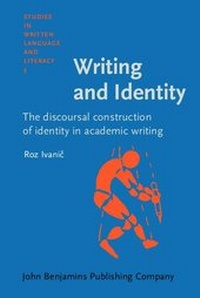
Writing and Identity
The discoursal construction of identity in academic writing
1st Edition
Published on 15. March 1998
XIII, 373 pages
978-90-272-8551-5 (ISBN)
Description

Writing is not just about conveying 'content' but also about the representation of self. (One of the reasons people find writing difficult is that they do not feel comfortable with the 'me' they are portraying in their writing. Academic writing in particular often poses a conflict of identity for students in higher education, because the 'self' which is inscribed in academic discourse feels alien to them.)
The main claim of this book is that writing is an act of identity in which people align themselves with socio-culturally shaped subject positions, and thereby play their part in reproducing or challenging dominant practices and discourses, and the values, beliefs and interests which they embody. The first part of the book reviews recent understandings of social identity, of the discoursal construction of identity, of literacy and identity, and of issues of identity in research on academic writing. The main part of the book is based on a collaborative research project about writing and identity with mature-age students, providing:
? a case study of one writer's dilemmas over the presentation of self;
? a discussion of the way in which writers' life histories shape their presentation of self in writing;
? an interview-based study of issues of ownership, and of accommodation and resistance to conventions for the presentation of self;
? linguistic analysis of the ways in which multiple, often contradictory, interests, values, beliefs and practices are inscribed in discourse conventions, which set up a range of possibilities for self-hood for writers.
The book ends with implications of the study for research on writing and identity, and for the learning and teaching of academic writing.
The book will be of interest to students and researchers in the fields of social identity, literacy, discourse analysis, rhetoric and composition studies, and to all those concerned to understand what is involved in academic writing in order to provide wider access to higher education.
The main claim of this book is that writing is an act of identity in which people align themselves with socio-culturally shaped subject positions, and thereby play their part in reproducing or challenging dominant practices and discourses, and the values, beliefs and interests which they embody. The first part of the book reviews recent understandings of social identity, of the discoursal construction of identity, of literacy and identity, and of issues of identity in research on academic writing. The main part of the book is based on a collaborative research project about writing and identity with mature-age students, providing:
? a case study of one writer's dilemmas over the presentation of self;
? a discussion of the way in which writers' life histories shape their presentation of self in writing;
? an interview-based study of issues of ownership, and of accommodation and resistance to conventions for the presentation of self;
? linguistic analysis of the ways in which multiple, often contradictory, interests, values, beliefs and practices are inscribed in discourse conventions, which set up a range of possibilities for self-hood for writers.
The book ends with implications of the study for research on writing and identity, and for the learning and teaching of academic writing.
The book will be of interest to students and researchers in the fields of social identity, literacy, discourse analysis, rhetoric and composition studies, and to all those concerned to understand what is involved in academic writing in order to provide wider access to higher education.
More details
Other editions
Additional editions
Book
03/1998
John Benjamins Publishing Co
€127.20
Shipment within 10-15 days
Person
Content
- WRITING AND IDENTITY
- Editorial page
- Title page
- Copyright page
- Table of contents
- List of Figures
- Acknowledgments
- CHAPTER 1. Introduction
- Me and you
- Introducing the topic: the fine art analogy
- The academic writing of mature students as a research focus
- Ways of talking about 'identity'
- Ways of thinking about 'identity'
- Four aspects of 'writer identity'
- An overview of the book
- PART ONE. Theoretical approaches to writing andidentity
- CHAPTER 2. Discourse and identity
- Introduction
- The focus on speaker identity in sociolinguistics
- Halliday
- Fairclough: a social view of language
- The heterogeneity of discourse
- Intertextuality and identity
- The social origins of the mind: Wertsch 1991
- Conclusion
- CHAPTER 3. Literacy and identity
- Introduction
- Literacy is embedded in social context
- The ecology of literacy
- Literacy practices
- Multiplicity
- Developing and extending literacies
- Literacy practices, written language and the construction of identity
- Conclusion to this chapter
- CHAPTER 4. Issues of identity in academic writing
- Introduction
- A social approach to the study of academic writing
- The idea of 'academic discourse communities'
- Intertextuality, plagiarism, imitation and identity in academic writing
- Authority and authorial presence in academic writing
- The distinction between ethos and persona in self-presentation: Cherry 1988
- Critical approaches to academic discourse
- Reasons why writer identity has not been a focus of recent research
- Applying Goffman's theory of self-presentation to academic writing
- Conclusion to this chapter and to Part One
- PART TWO. The discoursal construction of identity in academic writing: An investigation with eight mature students
- CHAPTER 5. Introduction to Part Two
- The scope of Part Two
- The co-researcher relationship
- My co-researchers
- The data collected for each co-researcher
- Critical Language Awareness as a research methodology
- Integrating analysis of texts with analysis of interviews about texts
- Data presentation conventions
- The organization of Part Two
- CHAPTER 6 Rachel Dean: A case study of writing and identity
- Rachel's story
- Rachel's assignment
- Rachel's literacy practices associated with this assignment
- Rachel's essay Family Case Study: an overview
- Rachel's multiple positioning in this essay
- Jostling voices in Rachel's writing
- Rachel's dilemmas over identity
- Rachel in relation to her readers
- Conclusion
- CHAPTER 7. The origins of discoursal identity in writers' experience
- Introduction
- Writing as the product of the writer's life-history
- The intermental/intertextual origins of 'voices'
- Origins which are signalled
- From plagiarism to ownership
- Where do people's words and phrases come from?
- Intertextual sources of discourse characteristics larger than words and phrases
- The origins of written argument in a specific conversation
- Conclusion to this chapter
- Notes
- CHAPTER 8. The sense of self and the role of the reader in the discoursal construction of writeridentity
- Introduction
- The sense of 'the real self'
- Owned identities, sincerity and commitment
- Disowned identities, cynicism and alienation
- Multiple identities, contradictions and ambivalence
- Identities in a state of flux
- Readers, power relations and the assessment process
- Accommodation and resistance
- Protective practices towards the reader
- Conclusion
- Notes
- CHAPTER 9. The discoursal construction of academic community membership
- Introduction
- Institutional identity in lexical and grammatical choices
- Discourse organization as an aspect of the institutional voice
- Conclusion to this chapter
- CHAPTER 10. Multiple possibilities for self-hood in the academic discourse community
- Introduction
- Aspects of identity related to fields of study
- Aspects of identity related to role in the academic community
- Aspects of identity related to ideologies of knowledge-making
- Aspects of identity which are not dependent on the academic community
- Conclusion to this chapter and Part Two
- Notes
- CONCLUSION
- CHAPTER 11. Writer identity on the agenda in theory and in practice
- Introduction
- Putting identity on the agenda in theorizing writing
- Putting writer identity on the agenda in the teaching and learning of academic writing
- Writing and identity beyond pedagogy
- Notes
- References
- Index
- The series Studies in Written Language and Literacy
