

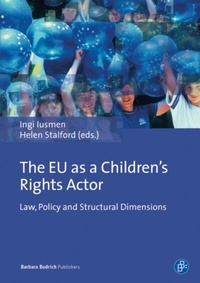
The EU as a Children's Rights Actor
Law, Policy and Structural Dimensions
1st Edition
Published on 16. November 2015
331 pages
978-3-8474-0412-5 (ISBN)
Description

This edited collection critiques, from an interdisciplinary perspective, the growing body of EU children's rights activities in the light of broader political, economic and legal processes. Specifically, it interrogates whether EU intervention effectively responds to what are perceived as violations of children's rights and the extent to which EU efforts to uphold children's rights complement and reinforce parallel national and international pursuits. Moreover, it scrutinises the compatibility of EU children's rights measures with the principles and provisions enshrined in the UN Convention on the Rights of the Child (CRC).
Reviews / Votes
[...] insgesamt vermittelt das Buch profunde Einblicke in die verschiedenen Bereiche und Handlungsansätze der EU-Kinderrechtspolitik und regt dazu an, sich genauer mit ihr auseinanderzusetzen. socialnet.de, 24.03.2016More details
Other editions
Additional editions
Ingi Iusmen | Helen Stalford
The EU as a Children's Rights Actor
Law, Policy and Structural Dimensions
Book
11/2015
1st Edition
Verlag Barbara Budrich
€42.00
No shipping information available
Persons
Dr. Ingi Iusmen, Lecturer in Governance and Policy, University of Southampton, UK. Prof. Helen Stalford, Founding director of the European Children's Rights Unit (ECRU), Professor at the School of Law & Social Justice, University of Liverpool, UK
Content
- Cover
- The EU as a Children's Rights Actor
- Acknowledgements
- Table of Contents
- Introduction: The EU as a Children's Rights Actor: Law, Policy and Structural Dimensions
- 'Actorness'
- Embracing the CRC
- The development of EU-level systems to protect child rights
- The effects of EU actions (law, policy) on child rights
- Journeys to European Justice: (How) Can the EU Enable Children to Enforce their Rights?
- Introduction
- 1. Defining Access to Justice
- 2. Applying Access to Justice Principles to Children
- 3. Children's Access to Justice at European Union Level -Why Is It Important and What Does It Involve?
- 4. How Do Children Change or Propose EU Laws with a View to Enhancing Their Rights?
- 4.1 The Citizens' Initiative
- 4.2 Children's Rights 'Champions'
- 5. How do children complain about EU actions or, indeed, omissions that impede the exercise of their rights?
- 5.1 Holding the EU Institutions to Account for Violations of Children's Rights: The EU Ombudsman
- 5.2 Alleged breaches of EU children's rights by EU ordomestic level authorities: European Parliament Petitions
- 6. How can children harness the EU's authority to hold Member States to account for breaching or failing toimplement their EU rights?
- 6.1 Challenging Member States' failure to implement EUlaw relating to children: Infringement Proceedings
- Conclusion: The future of children's access to justice at EU level?
- Developing a Model for Mainstreaming Children's Rights into EU Law and Policy-making
- 1. Introduction
- 2. Child Rights Mainstreaming: A review of currentpractice
- 2.1 How does the EU mainstream children's rights?
- 2.2 Shortcomings in EU children's rights mainstreaming
- 2.3 Better outcomes for children when mainstreaming children's rights
- 3. Child Rights Mainstreaming: Lessons from Practice
- 3.1 Step 1: The need for political will and leadership
- 3.2 The impact of political will and leadership on the EU's role as children's rights actor
- 3.3 Step 2: Awareness, capacity and resources in the services responsible
- 3.4 Step 3: Commitment to use the CRC as the startingpoint
- 3.5 Step 4: Mainstreaming applies equally to legislation, policy and funding and throughout the policy cycle
- 3.6 Step 5: Impact assessments are applied systematically
- 3.7 Step 6: Stakeholders are consulted and involved indecision-making
- 3.8 Step 7: The views and experiences of children and young people are sought and taken seriously
- Conclusions
- Central Authorities and the European Judicial Network: Mainstreaming Children's Rights into Cross-border Cooperation in EU Family Law
- Introduction
- 1. Mainstreaming children's rights in EU family lawthrough Art 24 of the Charter
- 2. Making child rights mainstreaming effective in European family law
- 2.1 The conception of rights underpinning mainstreaming
- 2.2 Resourcing and training for child rights mainstreaming
- 2.3 Implementation at all levels of the polity
- 3. Central Authorities and the European Judicial Network: Cross-border cooperation over family law disputes
- 3.1 Central Authorities
- 3.2 European Judicial Network
- 4. Enhancing Children's Rights Mainstreaming in Central Authorities and the Network
- 4.1 Raising awareness of children's rights
- 4.2 Debating children's rights protection through EU family law
- 4.3 Capacity for children's rights in the implementation of EU law
- Conclusions
- The EU and Child Protection Systems: The Role and the Impact of the EU in Advancing Children's Protection Rights
- Introduction
- 1. Child protection - The international legal framework
- 1.1 Definition of child protection
- 1.2 UN Study on Violence Against Children
- 1.3 General Comment No. 13 (2011): The right of the child to freedom from all forms of violence
- 1.4 Child Protection Systems
- 2. The general role of the EU in protecting children from violence
- 2.1 The general character and role of EU measures
- 2.2 Illustrations of EU Action - Achievements to date
- 2.2.1 Directive of 13 December 2011 on combating the sexual abuse and sexual exploitation of children and child pornography
- 2.2.2 The Action Plan on Unaccompanied Minors
- 2.3 Conclusion
- 3. Future directions - How can the EU effectively contribute to national child protection systems
- 3.1 EU support to national and regional coordination mechanisms
- 3.2 Legal and policy frameworks
- 3.3 Services and justice for children
- 3.4 Child participation
- 3.5 Training for professionals
- 3.6 Adequate resources
- 3.7 Future Challenges
- 4. General conclusions - The EU as a global actor
- The Implementation of the Right to be Heard in Juvenile Justice Proceedings in Europe
- 1. Introduction
- 2. Child-friendly justice in Europe
- 2.1 The right to be heard - Art 12 CRC
- 2.2 Impact of the CRC at EU level
- 2.3 The right to a fair trial - Art 6 ECHR
- 2.4 The Council of Europe Guidelines on Child-Friendly Justice
- 2.5 EU law and child-friendly justice
- 3. Methodological considerations: Juvenile law in action
- 3.1 An overview of the study
- 4. Hearing the views of juvenile defendants
- 4.1 The physical setting
- 4.2 Juvenile defendants' views
- 5. Juvenile defendants' understanding
- 5.1 Explanation and legal terminology
- 5.2 Clarifying the judgment and sentence
- 6. Conclusion
- The EU and the De-Institutionalisation of Children
- Introduction
- 1. Children's rights and de-institutionalisation
- 2. The EU and the de-institutionalisation of children: The EU enlargement process
- 2.1 Romania
- 2.2 Bulgaria
- 3. The EU's de-institutionalisation policy
- 4. The EU and de-institutionalisation: key challenges
- 4.1 Structural Funds spending
- 4.2 Fundamental rights
- 4.3 Involvement of civil society actors
- 4.4 Integrated approach
- Conclusion
- "When we buy a young boy .": Migrant Footballers, Children's Rights and the Case for EU Intervention
- 1. Introduction
- 2. Children's Rights and Young Migrant Footballers
- 2.1 The experiences of migrant child footballers
- 2.2 The children's rights issues at play
- 3. Football's Transfer and Recruitment System: Creating a Market For Young Migrant Footballers
- 4. Attempts by Football's Governing Bodies to Regulate the Trade in Young Migrant Footballers
- 4.1 The Article 19 RSTP exceptions
- 4.2 A children's rights rhetoric from FIFA and CAS?
- 5. Making the Case for EU Intervention
- 5.1 The rationale for EU intervention from a children's rights perspective
- 5.2 The rationale for EU intervention from a sports perspective
- 5.3 Softly, softly: The use of alternative modes of EU governance in the context of children's rights and sport
- 6. Conclusion
- Networked Children, Commercial Profiling and the EU Data Protection Reform Agenda: In the Child's Best Interests?
- Introduction
- 1. The EU Strategy and Information Self-Determination
- 1.1 Framing the Problem: The Model of Empowerment
- 1.2 The Problem with Empowerment
- 2. Networked Publics: Communication, Visibility and the Autonomy Trap
- 2.1 Information Collection in Networked Environments
- 2.2 Networked Publics
- 3. The EU Data Protection Directives, the Protection of Children's Personal Data and Networked Environments
- 3.1 Personal Data
- 3.2 Conditions Imposed on Processing Personal Data
- 3.3 Profiling and Behavioural Advertising: A Closer Look
- 3.4 Proposals for Reform: The General Data Protection Regulations
- 4. A Counterfactual Analysis: What if.?
- 4.1 Applying the Convention on the Rights of the Child to the protection of children's personal data
- 4.2 'What if'?
- 4.2.1 Codes of Practice
- 4.2.2 Privacy by Design
- Conclusion: Where is Empowerment Taking our Children?
- Child Labour and EU Law and Policy: A Regional Solution for a Global Issue
- Introduction
- 1. Child labour: A global solution for a global issue?
- 2. EU labour policy: Competences and evolution
- 3. Children in the EU's (internal) labour policy
- 3.1 Children as incidental beneficiaries
- 3.2 Children as direct beneficiaries
- 3.3 Post-2000: A bi-cephalous era?
- 3.4 Where are we now and where do we go next?
- 4. Compatibility with supra-national and internationalinstruments
- 4.1 The United Nations framework
- 4.2 The Council of Europe framework
- 4.3 The EU's human rights framework
- 5. Scope for improvement and policy recommendations
- 6. Conclusion
- Children's Rights-Based Approaches to EUDevelopment Cooperation: A SWOT-Analysis
- 1. Introduction
- 2. Children's Rights-Based Approaches to Development
- 3. EU Children's Rights Instruments and Actors
- 3.1 Council of the European Union
- 3.2 European Commission
- 3.3 The High Representative and the European ExternalAction Service (EEAS)
- 4. A SWOT-Analysis
- 4.1 Internal Strengths
- 4.2 Internal Weaknesses
- 4.3 External Opportunities
- 4.4 External Threats
- 5. Conclusions
- Conclusion: How Can the EU Be a Better Children's Rights Actor?
- Beyond decorative provision towards embedding children's rights within the fabric of the EU
- What (more) needs to be done to consolidate the EU'srole(s) as a child rights actor?
- Learning from children
- Top down and bottom up - the crucial mediating role of civil society
- The importance of independent scholarship
- A final word on achieving legitimacy
- About the Authors
- Index
