

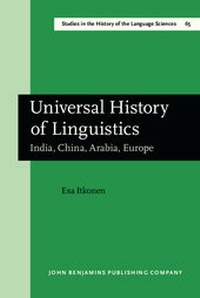
Universal History of Linguistics
India, China, Arabia, Europe
1st Edition
Published on 5. December 1991
X, 368 pages
978-90-272-7767-1 (ISBN)
Description

This wide-ranging book presents the linguistic achievements of four major cultures to readers presumably conversant with modern theoretical linguistics. The chapter on India discusses in detail Pan?ini's (c. 400 B.C.) grammar Ast-adhy-ay-i as well as the work of his commentators Katyayana, Patanjali, and Bhartr?hari. In the Chinese tradition, the Confucian doctrine of the Rectification of Names' is singled out for treatment. Arabic linguistics is represented by Sibawaihi's (d. 793) grammar al-Kitab, in particular its syntax, as well as the subsequent commentary tradition. The chapter on Europe, which is the most comprehensive of the four, covers the time span from antiquity to the 20th century; special attention is devoted to the contributions of Plato, Aristotle, the Stoics, Varro, Apollonius Dyscolus, and the Modistae. The achievements of the cultures in linguistics are treated throughout from a deliberately value-laden point of view. The achievements of Western antiquity and the Middle Ages are shown to be much more than the average linguist is inclined to believe. Even more importantly, it is shown that the Indian and the Arab traditions have been superior to the European tradition at least until the 20th century. The fact that a linguistic theory created some 2,400 years ago is fully as adequate as our best theories today must have far-reaching implications for the notion of 'scientific progress'. More precisely, it proves necessary to distinguish between 'progress in the human sciences' and 'progress in the natural sciences'. These issues, which pertain to the general philosophy of science, are treated in the final chapter of the book.
More details
Other editions
Additional editions
Book
12/1991
John Benjamins Publishing Co
€132.50
Shipment within 10-15 days
Person
Content
- UNIVERSAL HISTORY OF LINGUISTICS: INDIA, CHINA, ARABIA, EUROPE
- Editorial page
- Title page
- Copyright page
- Preface
- Table of contents
- 1. Introduction
- 2. India
- 2.1 The Relation of Linguistic Theory to Hinduism
- 2.2 Linguistics before Panini
- 2.3 Panini
- 2.3.1 General Remarks
- 2.3.2 The Main Peculiarities of Panini's Grammar
- A) Use of Conventional Labels and Determinatives
- B) Brevity of Pânini's Style
- C) Order of Rules
- 2.3.3 The Types of Rules Employed by Panini
- A) Metagrammatical Rules
- i) Definitions
- ii) Interpretation Rules
- B) Grammatical Rules
- i) Expression Rules
- ii) Combination Rules
- iii) Substitution Rules
- 2.3.4 On the 'Axiomatic' Character of Panini's Grammar
- 2.3.5 Panini's Descriptive Technique: How It Works
- A) The Notion of'Käraka'
- B) How to Describe a Simple Sentence Containing Simple Words: an Outline
- C) How to Describe a (Semantically) Complex Sentence: an Outline
- D) How to Describe a Complex Word: an Outline
- E) How to Describe a Simple Word: a Detailed Example
- 2.4 Linguistics after Panini
- 2.4.1 Katyayana and Patañjali
- 2.4.2Bhartrhari
- 2.5 Conclusion: Panini and the Riddle of 'Progress'
- Notes
- 3. China
- 3.1 Confucius
- 3.2 Mencius
- 3,3 The School of Names
- 3,4 The Taoist School
- 3.5 Mo Tzu and His School
- 3.6 Hsün Tzu
- 3.7 The Legalist School
- 3.8 The Aftermath
- 3.9 Conclusion: Panini and Confucius
- Notes
- 4. Arabia
- 4.1 The Cultural Context of Arab Linguistics
- 4.2 General Characteristics of the Arab Linguistic Tradition
- 4.3 Central Aspects of the Arab Syntactic Theory
- 4.4 Metatheoretical Implications
- 4.5 Sibawaihi's Conception of 'Discourse-Based' Linguistics
- 4.6 Residual Issues
- 4.7 Conclusion: Panini, Confucius, and Sibawaihi
- Notes
- 5. Europe
- 5.1 Linguistic Thinking in Greek Philosophy
- 5.1.1 Plato
- 5.1.2 Aristotle
- 5.1.3 The Stoics
- 5.1.4 The Relation between Mind and Reality in Greek Philosophy
- 5.2 The Alexandrian School
- 5.2.1 Dionysius Thrax
- 5.2.2 An Interlude: Varro
- 5.2.3 Apollonius Dyscolus
- A) The Attitude towards the Data
- B) Grammatical Explanation
- C) Abstract Analysis
- D) Deciding the Category-Membership
- E) The Problem of Isomorphism
- 5.2.4 The Aftermath: Priscian
- 5.3 Linguistics in the Middle Ages
- 5.3.1 Precursors: Ammonius, Boethius, Abaelard
- 5.3.2 Philosophy of Linguistics
- 5.3.3 Isomorphism as the Basis for Universal Grammar
- 5.3.4 Grammatical Description
- 5.3.5 Logical Linguistics
- 5.3.6 The Demise of the Modistic Doctrine
- 5.4 Grammatical Theory 1500-1900
- 5.4.1 The 16th Century
- 5.4.2 The 17th Century
- 5.4.3 The 18th Century
- 5.4.4 The 19th Century
- 5.5 The 20th Century
- 5.5.1 Some Philosophical Background
- 5.5.2 Autonomous Linguistics
- 5.5.3 Causal or Functional Linguistics
- A) A Taxonomy of Explanations
- B) The Notion of Analogy
- a) Extralinguistic Reality
- b) Extralinguistic Reality and Language
- c) Language
- 5.6 Conclusion: Unity in Variety
- Notes
- 6. Implications for the Philosophy of Science
- 6.1 The Notion of Progress
- 6.1.1 Progress in the Natural Sciences
- 6.1.2 Progress in Linguistics
- 6.1.3 Scientific vs. Social Progress
- 6.2 Relativism vs. Universalism
- 6.3 Externalism vs. Internalism
- Notes
- 7. Conclusion
- References
- Name Index
