

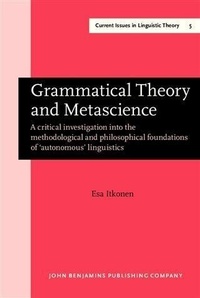
Grammatical Theory and Metascience
A critical investigation into the methodological and philosophical foundations of 'autonomous' linguistics
1st Edition
Published on 1. January 1978
X, 355 pages
978-90-272-8139-5 (ISBN)
Description

In this book, the author analyses the nature of the science of grammar. After presenting some methodological and historical background, he sets forth a theory of language and of grammar, showing that the science of grammar is not an empirical, but a normative science, comparable to logic and philosophy, characterized by the use of the method of explication.
More details
Other editions
Additional editions
Esa Itkonen
Grammatical Theory and Metascience
A critical investigation into the methodological and philosophical foundations of 'autonomous' linguistics
Book
01/1978
John Benjamins Publishing Co
€132.50
Shipment within 10-15 days
Content
- Intro
- GRAMMATICAL THEORY AND METASCIENCE
- Editorial page
- Title page
- Copyright page
- Preface
- Table of contents
- 1.0. THE IDEA OF 'POSITIVISM'
- 1.1. The Data of Positivist Science
- the Definition of 'Empirical'
- 1.2. Explanation, Prediction, and Testing
- 1.3. Comparison with Peirce's Logic of Science
- 1.4. Theory and Observation
- 1.5. Ontology
- 1.6. Concluding Remarks
- 2.0. THE IDEA OF 'HERMENEUTICS'
- 2.1. Psychology
- 2.2. Sociology
- 2.3. Psychoanalysis and Psychotherapy
- 2.4. Sociology of Knowledge
- 2.5. Philosophy
- 2.6. Logic
- 2.7. Concluding Remarks
- 3.0. 20TH-CENTURY LINGUISTIC THEORIES: A BRIEF SURVEY
- 3.1. Saussure
- 3.2. Hjelmslev
- 3.3. Sapir
- 3.4. Bloomfield
- 3.5. Harris
- 3.6. Transformational Grammar
- 3.7. Some Recent Developments in Linguistic Theory
- 3.8. Conclusion
- 4.0. PHILOSOPHICAL FOUNDATIONS OF THE CONCEPT OF LANGUAGE
- 4.1. Characterisation of the Traditionist Epistemology
- 4.2. Refutation of the Traditionist Epistemology
- 4.2.1. The Axiomaticity of the Concepts of Person and Thing
- 4.2.2. Mind, Behaviour, and Environment
- 4.2.3. Characterisation of Mental Phenomena: the Notion of 'Pattern'
- 4.2.4. General Characteristics of the Conceptual Distinctions Employed in the Present Study
- 4.2.5. The Impossibility of Private Languages
- 4.3. Implications for Linguistic Theory
- 4.3.1 . Psycholinguistics
- 4.3.2. Theory of Grammar
- 5.0. THE CONCEPT OF LANGUAGE
- 5.1. Ontology: Rules of Language as Constituted by 'CommonKnowledge '
- 5.2. Epistemology: the Distinction between Language and Linguistic Intuition
- 5.3. Rules of Language and Certainty
- 5.4. Rules of Language and Social Control
- 6.0. THE BASIS OF THE NONEMPIRICAL NATURE OF GRAMMAR
- 6.1. The Difference Between Rule-Sentences and EmpiricalHypotheses
- 6.2. Examples of Rules and Rule-Sentences
- 6.3. Two Different Types of Rule-Sentence
- 7.0. THE ??EL IMI???I L??? OF LINGUISTIC NORMATIVITY
- 7.1. A Synchronic Grammar Does not Investigate Spatiotemporal Utterances, but Correct Sentences
- 7.2. Grammatical Concepts Are not Comparable to Theoretical Concepts of Natural Science
- 7.3 Rules Ave not Regularities of Non-Normative Actions
- 7.4. Grammatical Descriptions Cannot Be Replaced by Psycholinguists'c and/or Socio linguistic Descriptions
- 7.5. The Position of Transformational Grammar vis-à-vis Linguistic Normativity
- 8.0. LANGUAGE AND GRAMMAR
- 8.1. The Basis of the Difference between Natural Science andHuman Science: Observer's Knowledge vs. Agent's Knowledge
- 8.2. The Two-Level Nature of the Human Sciences : Atheoretical vs. Theoretical
- 8.3. The Two-Level Nature of Grammar
- 8.4. The Ontological Reality of Grammatical Descriptions
- 9.0. THE METHODOLOGY OF GRAMMAR
- 9.1. General Remarks
- 9.2. Explanation and Prediction
- 9.3. Testing
- 9.4. Universal Linguistic Theory
- 9.5. Appendix: Examples Taken from the Transformationalist Literature
- 10.0. GRAMMAR AND LOGIC
- 10.1. The Basts of the Similarity 'between Generative Grammars and Systems of Logic
- 10.2. Testing
- 10.3. Explanation
- 11.0. GRAMMAR AND PHILOSOPHY
- 11.1. The Methodology of Classical Philosophy
- 11.2. The Concept of 'Explication'
- 11.3. Grammars as Instances of Explication
- CONCLUSION
- NOTES
- Chap. 1. THE IDEA OF 'POSITIVSM'
- Chap. 2. THE IDEA OF 'HERMENEUTICS'
- Chap. 3. 20-TH CENTURY LINGUISTIC THEORIES
- Chap. 4. PHILOSOPHICAL FOUNDATIONS OF THE CONCEPT OF LANGUAGE
- Chap. 5. THE CONCEPT OF LANGUAGE
- Chap. 6. THE BASIS OF THE NONEMPIRICAL NATURE OF GRAMMAR
- Chap. 7. THE INELIMINABILITY OF LINGUISTIC NORMATIVITY
- Chap. 8. LANGUAGE AND GRAMMAR
- Chap. 9. THE METHODOLOGY OF GRAMMAR
- Chap. 10. GRAMMAR AND LOGIC
- Chap. 11. GRAMMAR AND PHILOSOPHY
- REFERENCES
- INDEX OF AUTHORS
- INDEX OF TERMS
